
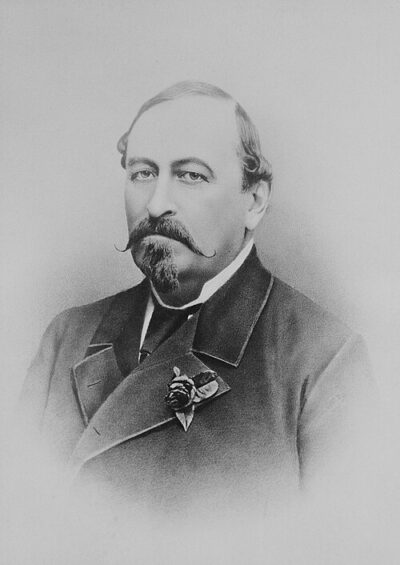
Ernest II, Duke of Saxe-Coburg and Gotha
Ernest II, Duke of Saxe-Coburg and Gotha was a German prince. Born June 21, 1818, in Coburg. Died August 22, 1893, in Reinhardsbrunn. Educated at University of Bonn. Awards include Pour le Mérite, Order of St. Andrew and Knight Grand Cross of the Order of the Saxe-Ernestine.
Facts
38 facts · 2 confirmed by two sources · 7 cited · 29 from one source
Where this comes from
Papalocal keeps its own record. It started from these sources; what each one said is kept here as it was copied, so a change on their side never changes this page by itself. Tap one to read its version.
What Wikidata says · copied November 16, 2026 · revision 2563988706
- Described as
- German prince (1818–1893)
- Other names
- Ernst herzog von Sachsen-Coburg-Gotha II, Duke of Saxe-Coburg, Ernst II, Duke of Saxe-Coburg-Gotha, Ernst II., Ernst II, Duke of Saxe-Coburg and Gotha, Ernest II of Saxe-Coburg and Gotha, Ernst II of Saxe-Coburg and Gotha
- Born
- June 21, 1818 · 7 references
- Died
- August 22, 1893 · 5 references
- Born in
- Coburg · 1 reference
- Died in
- Reinhardsbrunn · 1 reference
- Buried in
- Morizkirche
- Name at birth
- Ernst August Karl Johann Leopold Alexander Eduard von Sachsen-Coburg-Saalfeld
- Citizen of
- Duchy of Saxe-Coburg and Gotha
- Occupation
- military officer · 1 reference; composer · 1 reference; painter; aristocrat; military commander · 1 reference
- Education
- University of Bonn
- Member of
- German Academy of Sciences Leopoldina
- Genre
- opera
- Awards
- Pour le Mérite; Order of St. Andrew; Knight Grand Cross of the Order of the Saxe-Ernestine; Knight of the Order of Saint Joachim; Order of Fidelity; Knight Grand Cross of the Order of the Zähringer Lion; Order of Saint Hubert; Grand Cross of the Order of Henry the Lion; Order of St. George; Knight Grand Cross of the Royal Order of the Welfs; Grand Cross of the House Order of the White Falcon; Order of the Rue Crown; Knight Commander of the Order of Saint Henry; Order of the Black Eagle; Grand Cross of the Order of the Red Eagle
- Field
- military affairs · 1 reference; music · 1 reference
- Spouse
- Princess Alexandrine of Baden (1842–) · 1 reference
- Father
- Ernest I, Duke of Saxe-Coburg and Gotha
- Mother
- Princess Louise of Saxe-Gotha-Altenburg
- Siblings
- Prince Albert of Saxe-Coburg and Gotha
- Religion
- Lutheranism
- Military rank
- general
- Wikipedias with a page
- 33
Wikidata item Q213630 (wikidata.org/wiki/Q213630), public domain (CC0). Copied November 16, 2026.
What Wikipedia says · copied November 16, 2026 · revision 1370936341
Ernest II (German: Ernst August Karl Johann Leopold Alexander Eduard; 21 June 1818 – 22 August 1893) was Duke of Saxe-Coburg and Gotha from 29 January 1844 to his death in 1893. He was born in Coburg to Ernest I, Duke of Saxe-Coburg-Saalfeld, and Princess Louise of Saxe-Gotha-Altenburg. His father became Duke of Saxe-Coburg and Gotha (as Ernest I) in 1826 through an exchange of territories.
In 1842, Ernest married Princess Alexandrine of Baden in what was to be a childless marriage. Two years later, he became Duke of Saxe-Coburg and Gotha when his father died. Ernest supported the German Confederation in the Schleswig-Holstein Wars against Denmark, sending thousands of troops and becoming the commander of a German corps; he was instrumental in the 1849 victory at the battle of Eckernförde against Danish forces. After King Otto of Greece was deposed in 1862, the British government put Ernest's name forward as a possible successor. Negotiations concerning this failed for various reasons—not least of which was that he would not give up his beloved duchies in favor of the Greek throne.
A supporter of a unified Germany, Ernest watched the various political movements with great interest. While he initially was a great and outspoken proponent of German liberalism, he surprised many by switching sides and supporting the more conservative (and eventually victorious) Prussians during the Austro-Prussian and Franco-Prussian Wars and subsequent unification of Germany. His support of the conservatives came at a price however, and he was no longer viewed as the possible leader of a political movement. According to historian Charlotte Zeepvat, Ernest became "increasingly lost in a whirl of private amusements which earned only contempt from outside".
Ernest and his only full sibling, his younger brother Prince Albert (consort to Queen Victoria of the United Kingdom), were born 14 months apart and raised as though twins. They became closer upon the separation and divorce of their parents as well as the eventual death of their mother. Their relationship experienced phases of closeness as well as minor arguments as they grew older. After Albert's death in 1861, Ernest published anonymous pamphlets against various members of the British royal family. However, he accepted Albert's second son, Prince Alfred, Duke of Edinburgh, as his heir-presumptive. Upon Ernest's death at Reinhardsbrunn, Alfred succeeded to the ducal throne.
- Born, in its opening lines
- June 21, 1818
- Died, in its opening lines
- August 22, 1893
From the Wikipedia article “Ernest II of Saxe-Coburg and Gotha” (en.wikipedia.org/wiki/Ernest_II_of_Saxe-Coburg_and_Gotha), by its contributors, under CC BY-SA 4.0 (creativecommons.org/licenses/by-sa/4.0/). Copied November 16, 2026; not changed.
Confirmed Two sources agree. Cited One source, and it names where it got it. One source One source, without a reference of its own. Sources disagree The sources disagree. We show the best-supported value and keep theirs below.
