
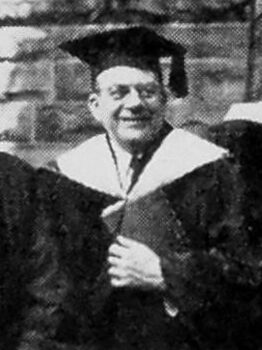
Erwin Panofsky
Erwin Panofsky was a German art historian. Born March 30, 1892, in Hanover. Died March 14, 1968, in Princeton. Known for Saturn and Melancholy and Early Netherlandish Painting. Educated at University of Freiburg and LMU Munich. Awards include Pour le Mérite for Sciences and Arts order, Haskins Medal and Corresponding Fellow of the Medieval Academy of America.
Facts
37 facts · 2 confirmed by two sources · 12 cited · 23 from one source
Where this comes from
Papalocal keeps its own record. It started from these sources; what each one said is kept here as it was copied, so a change on their side never changes this page by itself. Tap one to read its version.
What Wikipedia says · copied November 13, 2026 · revision 1379047956
Erwin Panofsky (March 30, 1892 – March 14, 1968) was a German art historian whose work helped establish modern iconography and iconology. His publications include Renaissance and Renascences in Western Art and Early Netherlandish Painting.
Panofsky's work emphasized the use of historical context to interpret artworks and visual culture. Several of his major studies remain in print, including Studies in Iconology: Humanist Themes in the Art of the Renaissance (1939), his 1943 study The Life and Art of Albrecht Dürer, and Meaning in the Visual Arts (1955). After the rise of the Nazi regime, he emigrated to the United States, where he pursued the remainder of his academic career.
- Born, in its opening lines
- March 30, 1892
- Died, in its opening lines
- March 14, 1968
From the Wikipedia article “Erwin Panofsky” (en.wikipedia.org/wiki/Erwin_Panofsky), by its contributors, under CC BY-SA 4.0 (creativecommons.org/licenses/by-sa/4.0/). Copied November 13, 2026; not changed.
What Wikidata says · copied November 14, 2026 · revision 2569133389
- Described as
- German art historian (1892–1968)
- Born
- March 30, 1892 · 10 references
- Died
- March 14, 1968 · 11 references
- Born in
- Hanover · 2 references
- Died in
- Princeton · 4 references
- Citizen of
- Germany · 1 reference; United States · 1 reference
- Occupation
- art historian · 4 references; university teacher · 1 reference; art critic; writer · 1 reference
- Worked for
- Princeton University; Harvard University; University of Hamburg; New York University; Institute for Advanced Study
- Education
- University of Freiburg; LMU Munich; Humboldt-Universität zu Berlin
- Member of
- German Academy for Language and Literature; Royal Netherlands Academy of Arts and Sciences; American Academy of Arts and Sciences; British Academy; Royal Swedish Academy of Letters, History and Antiquities; Medieval Academy of America (1937–) · 1 reference; Accademia delle Arti del Disegno; American Philosophical Society (1943–); Accademia Nazionale dei Lincei (1967–) · 1 reference
- Known for
- Saturn and Melancholy; Early Netherlandish Painting
- Awards
- Pour le Mérite for Sciences and Arts order (1967); Haskins Medal (1962); Corresponding Fellow of the Medieval Academy of America (1937) · 1 reference
- Field
- art history
- Spouse
- Dora Panofsky · 1 reference; Gerda Panofsky-Soergel
- Children
- Hans Panofsky · 1 reference; Wolfgang K. H. Panofsky · 1 reference
- Wikipedias with a page
- 47
Wikidata item Q57656 (wikidata.org/wiki/Q57656), public domain (CC0). Copied November 14, 2026.
Confirmed Two sources agree. Cited One source, and it names where it got it. One source One source, without a reference of its own. Sources disagree The sources disagree. We show the best-supported value and keep theirs below.
