
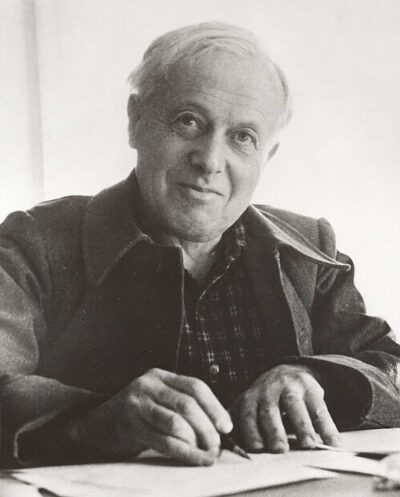
Eugen Rosenstock-Huessy
Eugen Rosenstock-Huessy was a German-American social philosopher. Born July 6, 1888, in Steglitz. Died February 24, 1973, in Norwich. Educated at University of Zurich and Heidelberg University. Awards include Commander's Cross of the Order of Merit of the Federal Republic of Germany.
Facts
25 facts · 2 confirmed by two sources · 7 cited · 16 from one source
Where this comes from
Papalocal keeps its own record. It started from these sources; what each one said is kept here as it was copied, so a change on their side never changes this page by itself. Tap one to read its version.
What Wikidata says · copied November 18, 2026 · revision 2568930227
- Described as
- German-American social philosopher (1888-1973)
- Born
- July 6, 1888 · 5 references
- Died
- February 24, 1973 · 1 reference
- Born in
- Steglitz · 2 references
- Died in
- Norwich · 1 reference
- Citizen of
- Germany; United States
- Occupation
- historian; sociologist · 1 reference; philosopher; writer; university teacher; jurist · 1 reference; philosopher of culture · 1 reference
- Worked for
- Harvard University; University of Wrocław; Leipzig University · 1 reference; Technical University of Darmstadt · 1 reference
- Education
- University of Zurich; Heidelberg University; Humboldt-Universität zu Berlin · 1 reference
- Awards
- Commander's Cross of the Order of Merit of the Federal Republic of Germany
- Field
- philosophy
- Spouse
- Margrit Rosenstock-Huessy · 1 reference
- Children
- Hans Rosenstock Huessy · 1 reference
- Religion
- Lutheranism
- Wikipedias with a page
- 14
Wikidata item Q66732 (wikidata.org/wiki/Q66732), public domain (CC0). Copied November 18, 2026.
What Wikipedia says · copied November 18, 2026 · revision 1363927700
Eugen Rosenstock-Huessy (German pronunciation: [ˈɔʏɡeːn ˈʁoːzn̩ʃtɔk ˈhʏsi, ˈɔʏɡn̩ -]; July 6, 1888 – February 24, 1973) was a historian and social philosopher, whose work spanned the disciplines of history, theology, sociology, linguistics and beyond. Born in Berlin, Germany into a non-observant Jewish family, the son of a prosperous banker, he converted to Christianity in his late teens, and thereafter the interpretation and reinterpretation of Christianity was a consistent theme in his writings. After graduating from High School, he served as a voluntary teacher at the Samsonschule in Wolfenbuettel. He met and married Margrit Hüssy in 1914. In 1925, the couple legally combined their names. They had a son, Hans, in 1921.
Rosenstock-Huessy served as an officer in the German army during World War I. His experience caused him to reexamine the foundations of liberal Western culture. He then pursued an academic career in Germany as a specialist in medieval law, which was disrupted by the rise of Nazism. In 1933, after Adolf Hitler became Chancellor of Germany, he emigrated to the United States where he began a new academic career, initially at Harvard University and then at Dartmouth College, where he taught from 1935 to 1957.
Although never part of the mainstream of intellectual discussion during his lifetime, his work drew the attention of W. H. Auden, Harold Berman, Martin Marty, Lewis Mumford, Page Smith, and others. Rosenstock-Huessy may be best known as the close friend of and correspondent with Franz Rosenzweig. Their exchange of letters is considered by scholars of religion and theology to be indispensable in the study of the modern encounter of Jews with Christianity. In his work, Rosenstock-Huessy discussed speech and language as the dominant shaper of human character and abilities in every social context. He is viewed as belonging to a group of thinkers who revived post-Nietzschean religious thought.
- Born, in its opening lines
- July 6, 1888
- Died, in its opening lines
- February 24, 1973
From the Wikipedia article “Eugen Rosenstock-Huessy” (en.wikipedia.org/wiki/Eugen_Rosenstock-Huessy), by its contributors, under CC BY-SA 4.0 (creativecommons.org/licenses/by-sa/4.0/). Copied November 18, 2026; not changed.
Confirmed Two sources agree. Cited One source, and it names where it got it. One source One source, without a reference of its own. Sources disagree The sources disagree. We show the best-supported value and keep theirs below.
