
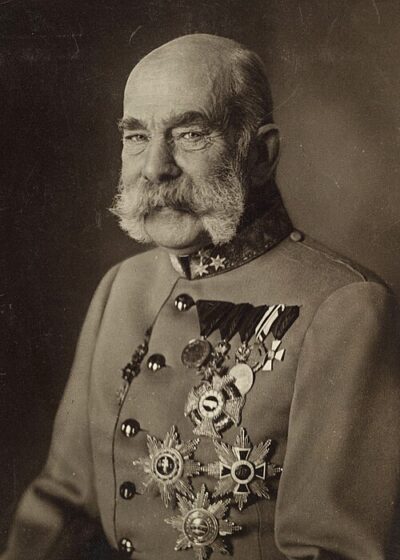
Franz Joseph I of Austria
Franz Joseph I of Austria was an Emperor of Austria and King of Hungary. Born August 18, 1830, in Schönbrunn Palace. Died November 21, 1916, in Schönbrunn Palace. Positions held include Emperor of Austria (1848–1916), Apostolic King of Hungary (1848–1916) and King of Bohemia (1848–1916). Awards include Pour le Mérite, Knight of the Order of the Golden Fleece and Grand Cross of the Military Order of Maria Theresa.
Facts
47 facts · 2 confirmed by two sources · 4 cited · 41 from one source
Where this comes from
Papalocal keeps its own record. It started from these sources; what each one said is kept here as it was copied, so a change on their side never changes this page by itself. Tap one to read its version.
What Wikidata says · copied November 16, 2026 · revision 2569174870
- Described as
- Emperor of Austria and King of Hungary (1830–1916)
- Other names
- Franz Joseph I, Francis Joseph I, Franz Josef I
- Born
- August 18, 1830 · 12 references
- Died
- November 21, 1916 · 10 references
- Born in
- Schönbrunn Palace · 1 reference
- Died in
- Schönbrunn Palace · 1 reference
- Buried in
- Imperial Crypt
- Cause of death
- pneumonia
- Citizen of
- Austrian Empire; Cisleithania
- Occupation
- politician; monarch
- Positions held
- Emperor of Austria (1848–1916); Apostolic King of Hungary (1848–1916); King of Bohemia (1848–1916); Head of the House of Habsburg; member of the Sejm of the Polish People's Republic · 1 reference
- Member of
- Franz Joseph I of Austria and Empress Elisabeth
- Awards
- Pour le Mérite; Knight of the Order of the Golden Fleece; Grand Cross of the Military Order of Maria Theresa; Order of the Black Eagle; Order of St. Andrew; Order of St. George, 4th class; Royal Victorian Chain (1904); Knight Grand Cross of the Military Order of William (1849); Knight Grand Cross of the Order of Saint Stephen of Hungary; Grand Cross of the Imperial Order of Leopold; Order of the Iron Crown (Kingdom of Italy); Grand Cross of the Order of Franz Joseph; Grand Cross of the Order of the Red Eagle; Grand Commander of the Royal House Order of Hohenzollern; Order of Saint Hubert
- Field
- politics · 1 reference
- Spouse
- Empress Elisabeth of Austria (1854–1898) · 1 reference
- Children
- Archduchess Sophie Friederike of Austria; Archduchess Gisela of Austria; Rudolf, Crown Prince of Austria; Archduchess Marie Valerie of Austria
- Father
- Archduke Franz Karl of Austria
- Mother
- Princess Sophie of Bavaria
- Siblings
- Archduchess Maria Anna of Austria; Maximilian I of Mexico; Archduke Karl Ludwig of Austria; Archduke Ludwig Viktor of Austria
- Religion
- Catholic Church
- Military rank
- field marshal
- Lived in
- Hofburg Palace · 1 reference; Buda Castle · 1 reference
- Wikipedias with a page
- 99
Wikidata item Q51056 (wikidata.org/wiki/Q51056), public domain (CC0). Copied November 16, 2026.
What Wikipedia says · copied November 16, 2026 · revision 1385667525
Franz Joseph I or Francis Joseph I (German: Franz Joseph Karl [fʁants ˈjoːzɛf ˈkaʁl]; Hungarian: Ferenc József Károly [ˈfɛrɛnt͡s ˈjoːʒɛf ˈkaːroj]; 18 August 1830 – 21 November 1916) was Emperor of Austria, King of Hungary, and the ruler of the other states of the Habsburg monarchy from 2 December 1848 until his death in 1916. In the early part of his reign, his realms and territories were referred to as the Austrian Empire, but in 1867 they were reconstituted as the dual monarchy of Austria-Hungary. From 1 May 1850 to 24 August 1866, he was also president of the German Confederation.
In December 1848, Franz Joseph's uncle Emperor Ferdinand I abdicated the throne at Olomouc as part of Minister President Felix zu Schwarzenberg's plan to end the Hungarian Revolution of 1848. Franz Joseph then ascended to the throne at the age of eighteen. In 1854, he married his first cousin Duchess Elisabeth in Bavaria, with whom he had four children: Sophie, Gisela, Rudolf, and Marie Valerie. Largely considered a reactionary, Franz Joseph spent his early reign resisting constitutionalism in his domains. The Austrian Empire was forced to cede its influence over Tuscany and most of its claim to Lombardy–Venetia to the Kingdom of Sardinia, following the Second Italian War of Independence in 1859 and the Third Italian War of Independence in 1866. Although Franz Joseph ceded no territory to the Kingdom of Prussia after the Austrian defeat in the Austro-Prussian War, the Peace of Prague (23 August 1866) settled the German Question in favour of Prussia, which prevented the unification of Germany from occurring under the House of Habsburg.
Franz Joseph was troubled by nationalism throughout his reign. He concluded the Austro-Hungarian Compromise of 1867, which both granted greater autonomy to Hungary and created the dual monarchy of Austria-Hungary. He ruled peacefully for the next 45 years, but suffered multiple personal tragedies: the execution of his brother Emperor Maximilian I of Mexico in 1867, the death by suicide of his son Rudolf in 1889, and the assassinations of first his wife Elisabeth in 1898 and then his nephew and heir presumptive, Archduke Franz Ferdinand, in 1914.
After the Austro-Prussian War, Austria-Hungary turned its attention to the Balkans, then a hotspot of international tension due to Austria's interests conflicting with both the Ottoman and Russian Empires. The Bosnian Crisis resulted from Franz Joseph's 1908 annexation of Bosnia and Herzegovina, already occupied by his troops since the Congress of Berlin (1878). On 28 June 1914, the assassination of Archduke Franz Ferdinand in Sarajevo resulted in Austria-Hungary's declaration of war against the Kingdom of Serbia, an ally of the Russian Empire. This activated a system of alliances declaring war on each other, resulting in World War I. After ruling his domains for almost 68 years, Franz Joseph died in 1916. He was succeeded by his grand-nephew Charles I & IV.
- Born, in its opening lines
- August 18, 1830
- Died, in its opening lines
- November 21, 1916
From the Wikipedia article “Franz Joseph I” (en.wikipedia.org/wiki/Franz_Joseph_I), by its contributors, under CC BY-SA 4.0 (creativecommons.org/licenses/by-sa/4.0/). Copied November 16, 2026; not changed.
Confirmed Two sources agree. Cited One source, and it names where it got it. One source One source, without a reference of its own. Sources disagree The sources disagree. We show the best-supported value and keep theirs below.
