
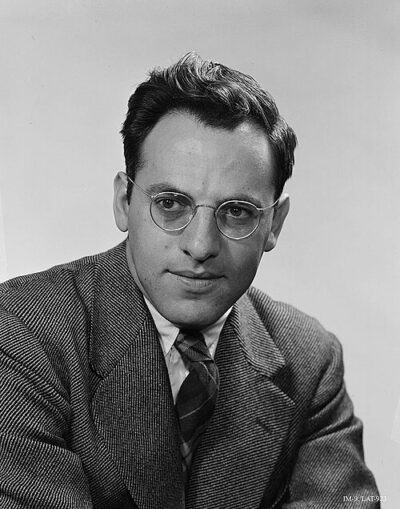
Frederick Reines
Frederick Reines was an American physicist. Born March 16, 1918, in Paterson. Died August 26, 1998, in Orange. Known for neutrino. Educated at New York University and Stevens Institute of Technology. Awards include Guggenheim Fellowship, Nobel Prize in Physics and National Medal of Science.
Facts
28 facts · 2 confirmed by two sources · 10 cited · 16 from one source
Where this comes from
Papalocal keeps its own record. It started from these sources; what each one said is kept here as it was copied, so a change on their side never changes this page by itself. Tap one to read its version.
What Wikidata says · copied November 13, 2026 · revision 2567377754
- Described as
- American physicist (1918–1998)
- Born
- March 16, 1918 · 7 references
- Died
- August 26, 1998 · 7 references
- Born in
- Paterson · 1 reference
- Died in
- Orange · 1 reference
- Citizen of
- United States
- Occupation
- physicist · 1 reference; university teacher; Nobel Prize winner
- Worked for
- Case Western Reserve University; University of California, Irvine; Los Alamos National Laboratory
- Education
- New York University; Stevens Institute of Technology; Union Hill High School
- Member of
- Russian Academy of Sciences; National Academy of Sciences; American Academy of Arts and Sciences; American Association for the Advancement of Science · 1 reference; American Physical Society · 1 reference
- Known for
- neutrino
- Awards
- Guggenheim Fellowship · 1 reference; Nobel Prize in Physics (1995) · 2 references; National Medal of Science (1983); J. Robert Oppenheimer Memorial Prize (1981) · 1 reference; Franklin Medal (1992) · 1 reference; Panofsky Prize (1992) · 1 reference; Eagle Scout · 1 reference
- Field
- physics
- Wikipedias with a page
- 68
Wikidata item Q191922 (wikidata.org/wiki/Q191922), public domain (CC0). Copied November 13, 2026.
What Wikipedia says · copied November 13, 2026 · revision 1371995780
Frederick Reines ( RY-nəs; March 16, 1918 – August 26, 1998) was an American physicist. He was awarded the 1995 Nobel Prize in Physics for his co-detection of the neutrino with Clyde Cowan in the neutrino experiment. He may be the only scientist in history "so intimately associated with the discovery of an elementary particle and the subsequent thorough investigation of its fundamental properties."
A graduate of Stevens Institute of Technology and New York University, Reines joined the Manhattan Project's Los Alamos Laboratory in 1944, working in the Theoretical Division in Richard Feynman's group. He became a group leader there in 1946. He participated in a number of nuclear tests, culminating in his becoming the director of the Operation Greenhouse test series in the Pacific in 1951.
In the early 1950s, working in Hanford and Savannah River Sites, Reines and Cowan developed the equipment and procedures with which they first detected the supposedly undetectable neutrinos in June 1956. Reines dedicated the major part of his career to the study of the neutrino's properties and interactions, which work would influence study of the neutrino for many researchers to come. This included the detection of neutrinos created in the atmosphere by cosmic rays, and the 1987 detection of neutrinos emitted from Supernova SN1987A, which inaugurated the field of neutrino astronomy.
- Born, in its opening lines
- March 16, 1918
- Died, in its opening lines
- August 26, 1998
From the Wikipedia article “Frederick Reines” (en.wikipedia.org/wiki/Frederick_Reines), by its contributors, under CC BY-SA 4.0 (creativecommons.org/licenses/by-sa/4.0/). Copied November 13, 2026; not changed.
Confirmed Two sources agree. Cited One source, and it names where it got it. One source One source, without a reference of its own. Sources disagree The sources disagree. We show the best-supported value and keep theirs below.
