
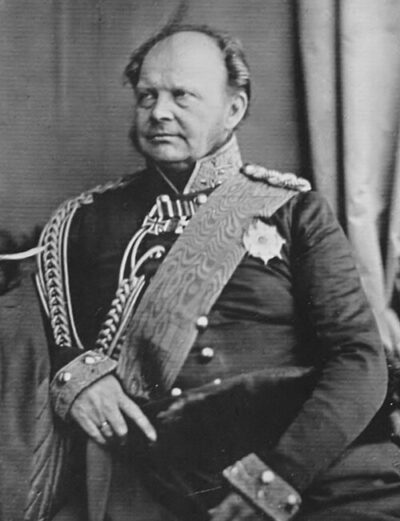
Frederick William IV of Prussia
Frederick William IV of Prussia was a King of Prussia. Born October 15, 1795, in Berlin. Died January 2, 1861, in Potsdam. Positions held include King of Prussia (1840–1861). Awards include Knight of the Order of the Holy Spirit, Knight of the Order of Saint Michael and Knight of the Order of the Golden Fleece.
Facts
39 facts · 2 confirmed by two sources · 7 cited · 29 from one source · 1 where the sources disagree
What’s different
- Buried in: we show mausoleum of Charlottenburg Park (Sources disagree). Wikidata also lists Church of Peace
Where this comes from
Papalocal keeps its own record. It started from these sources; what each one said is kept here as it was copied, so a change on their side never changes this page by itself. Tap one to read its version.
What Wikidata says · copied November 16, 2026 · revision 2566556165
- Described as
- King of Prussia (1795–1861)
- Other names
- Friedrich Wilhelm IV of Prussia, Friedrich Wilhelm Nikolaus Karl, Friedrich Wilhelm IV., Frederick-William IV., Frederick William IV
- Born
- October 15, 1795 · 11 references
- Died
- January 2, 1861 · 11 references
- Born in
- Berlin · 2 references
- Died in
- Potsdam · 2 references
- Buried in
- Church of Peace; mausoleum of Charlottenburg Park · 1 reference
- Cause of death
- stroke
- Citizen of
- Kingdom of Prussia
- Occupation
- sovereign
- Positions held
- King of Prussia (1840–1861)
- Member of
- Saint Petersburg Academy of Sciences; Russian Academy of Sciences; Royal Society of London (1842–) · 1 reference
- Awards
- Knight of the Order of the Holy Spirit; Knight of the Order of Saint Michael; Knight of the Order of the Golden Fleece; Order of the Black Eagle; Order of the White Eagle; Order of St. Andrew; Knight Grand Cross of the Military Order of William (1842); Order of the Red Eagle 1st Class; Royal Fellow of the Royal Society (1842) · 1 reference; Pour le Mérite · 1 reference; Iron Cross (1813), 2nd class (1813) · 2 references; Grand Cross of the Legion of Honour · 1 reference; Order of the Garter · 1 reference; Royal Order of the Seraphim · 1 reference; Knight of the Order of the Elephant (1840)
- Spouse
- Elisabeth Ludovika of Bavaria (1823–1861) · 1 reference
- Father
- Frederick William III of Prussia
- Mother
- Louise of Mecklenburg-Strelitz · 1 reference
- Siblings
- Alexandra Feodorovna; Princess Louise of Prussia; Princess Alexandrine of Prussia; Wilhelm I · 1 reference; Prince Charles of Prussia; Prince Albert of Prussia; Princess Frederica of Prussia; Prince Ferdinand of Prussia
- Religion
- Prussian Union of Churches
- Wikipedias with a page
- 66
Wikidata item Q57180 (wikidata.org/wiki/Q57180), public domain (CC0). Copied November 16, 2026.
What Wikipedia says · copied November 16, 2026 · revision 1385084082
Frederick William IV (German: Friedrich Wilhelm IV.; 15 October 1795 – 2 January 1861) was King of Prussia from 7 June 1840 until his death in 1861. Also referred to as the "romanticist on the throne", he was deeply religious and believed that he ruled by divine right. He feared revolutions, and his ideal state was one governed by the Christian estates of the realm rather than a constitutional monarchy.
In spite of his conservative political philosophy, he initially pursued a moderate policy of easing press censorship, releasing political prisoners and reconciling with the Catholic population of the kingdom. During the German revolutions of 1848–1849, he was initially forced to accommodate the people's revolutionary sentiments, although he rejected the title of Emperor of the Germans offered by the Frankfurt Parliament in 1849, believing that it did not have the right to make such an offer. In December 1848, he dissolved the Prussian National Assembly when he found its constitutional proposals too radical. At the urging of his ministry, which wanted to prevent a renewal of unrest, he imposed a constitution with a parliament and a strong monarch. He then used the Prussian military to help put down revolutionary forces throughout the German Confederation.
Frederick William IV had an artistic nature and an interest in architecture. He extended the building ensembles of the Berlin-Potsdam Residence Landscape, Museum Island, and the cultural landscape of the Upper Middle Rhine Valley, and he supported the completion of the Cologne Cathedral. All are now UNESCO World Heritage Sites.
From 1857 to 1861, he suffered several strokes and was left incapacitated until his death. His brother and heir presumptive Wilhelm served as regent after 1858 and then succeeded him as king.
- Born, in its opening lines
- October 15, 1795
- Died, in its opening lines
- January 2, 1861
From the Wikipedia article “Frederick William IV” (en.wikipedia.org/wiki/Frederick_William_IV), by its contributors, under CC BY-SA 4.0 (creativecommons.org/licenses/by-sa/4.0/). Copied November 16, 2026; not changed.
Confirmed Two sources agree. Cited One source, and it names where it got it. One source One source, without a reference of its own. Sources disagree The sources disagree. We show the best-supported value and keep theirs below.
