
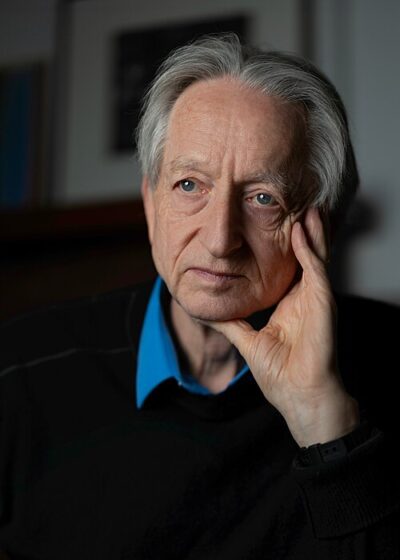
Geoffrey Hinton
Geoffrey Hinton is a British-Canadian computer scientist and psychologist. Born December 6, 1947, in Wimbledon. Educated at University of Edinburgh and King's College. Awards include Fellow of the Royal Society, IEEE Frank Rosenblatt Award and Rumelhart Prize.
Facts
46 facts · 1 confirmed by two sources · 34 cited · 11 from one source
Where this comes from
Papalocal keeps its own record. It started from these sources; what each one said is kept here as it was copied, so a change on their side never changes this page by itself. Tap one to read its version.
What Wikidata says · copied November 13, 2026 · revision 2568211374
- Described as
- British-Canadian computer scientist and psychologist
- Other names
- Geoff Hinton, G. E. Hinton, Geoffrey Everest Hinton, Geoffrey E. Hinton
- Born
- December 6, 1947 · 1 reference
- Born in
- Wimbledon
- Citizen of
- United Kingdom · 1 reference; Canada · 1 reference
- Occupation
- computer scientist · 1 reference; artificial intelligence researcher; university teacher · 1 reference; neuroscientist · 1 reference; psychologist · 2 references
- Worked for
- University of Toronto; Google (2013–2023) · 2 references; Carnegie Mellon University · 1 reference
- Education
- University of Edinburgh (–1978) · 1 reference; King's College (–1970) · 1 reference
- Member of
- Royal Society of London (1999–); American Academy of Arts and Sciences; Association for the Advancement of Artificial Intelligence · 1 reference; Royal Society of Canada (1996–); National Academy of Engineering (2016–); European Laboratory for Learning and Intelligent Systems · 1 reference; Association for Computing Machinery (2024–) · 1 reference; National Academy of Sciences (2023–) · 1 reference
- Awards
- Fellow of the Royal Society (1998) · 1 reference; IEEE Frank Rosenblatt Award (2014) · 1 reference; Rumelhart Prize (2001) · 1 reference; IJCAI Award for Research Excellence (2005) · 1 reference; BBVA Foundation Frontiers of Knowledge Award (2016) · 1 reference; AAAI Fellow (1990) · 1 reference; Fellow of the Cognitive Science Society (2003) · 1 reference; Gerhard Herzberg Canada Gold Medal for Science and Engineering (2010) · 1 reference; Companion of the Order of Canada (2018) · 1 reference; Fellow of the Royal Society of Canada (1996) · 1 reference; Turing Award (2018) · 1 reference; Honda Prize (2019) · 1 reference; IEEE Neural Networks Pioneer Award (1998) · 1 reference; Princess of Asturias Award for Technical and Scientific Research (2022) · 1 reference; Dickson Prize in Science (2021) · 1 reference
- Field
- deep learning; machine learning; neuroscience · 1 reference; artificial neural network · 1 reference; applied psychology · 1 reference; artificial intelligence · 1 reference
- Father
- Howard Everest Hinton · 1 reference
- Lived in
- Canada (1987–) · 1 reference
- Website
- https://www.cs.toronto.edu/~hinton
- Wikipedias with a page
- 71
Wikidata item Q92894 (wikidata.org/wiki/Q92894), public domain (CC0). Copied November 13, 2026.
What Wikipedia says · copied November 13, 2026 · revision 1385350722
Geoffrey Everest Hinton (born 6 December 1947) is a British-Canadian computer scientist, cognitive scientist, cognitive psychologist and Nobel Prize laureate known for his work on artificial neural networks, which earned him the title "the Godfather of AI". He is University Professor Emeritus at the University of Toronto.
From 2013 to 2023, Hinton divided his time working for Google Brain and the University of Toronto before publicly announcing his departure from Google in May 2023, citing concerns about the many risks of artificial intelligence (AI) technology. In 2017, he co-founded and became the chief scientific advisor of the Vector Institute in Toronto. He is also a strategic advisor to the Schwartz Reisman Institute for Technology and Society.
With David Rumelhart and Ronald J. Williams, Hinton co-authored a highly cited paper published in 1986 that popularised the backpropagation algorithm for training multi-layer neural networks, although they were not the first to propose the approach. Hinton is viewed as a leading figure in the deep learning community. The image-recognition neural network AlexNet, designed in collaboration with his students Alex Krizhevsky and Ilya Sutskever, won the ImageNet challenge in 2012 and was a breakthrough in computer vision.
Hinton received the 2018 Turing Award, together with Yoshua Bengio and Yann LeCun, for their work on deep learning. They are sometimes referred to as the "Godfathers of Deep Learning". He was also awarded, along with John Hopfield, the 2024 Nobel Prize in Physics for "foundational discoveries and inventions that enable machine learning with artificial neural networks".
In May 2023, Hinton announced his resignation from Google to be able to "freely speak out about the risks of AI". He has voiced concerns about deliberate misuse by malicious actors, technological unemployment, and existential risk from artificial general intelligence. He noted that establishing safety guidelines will require cooperation among those competing in use of AI in order to avoid the worst outcomes. After receiving the Nobel Prize, he called for urgent research into AI safety to figure out how to control AI systems smarter than humans.
- Born, in its opening lines
- December 6, 1947
From the Wikipedia article “Geoffrey Hinton” (en.wikipedia.org/wiki/Geoffrey_Hinton), by its contributors, under CC BY-SA 4.0 (creativecommons.org/licenses/by-sa/4.0/). Copied November 13, 2026; not changed.
Confirmed Two sources agree. Cited One source, and it names where it got it. One source One source, without a reference of its own. Sources disagree The sources disagree. We show the best-supported value and keep theirs below.
