
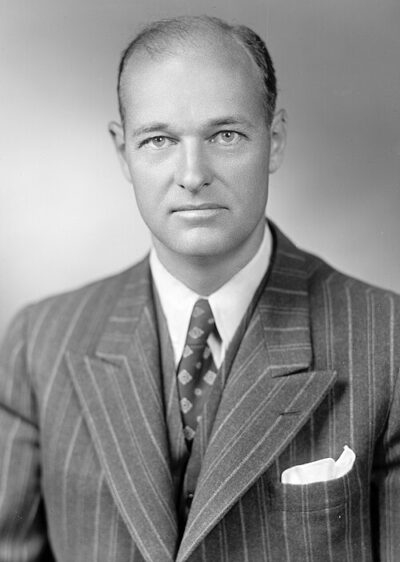
George F. Kennan
George F. Kennan was an American advisor, diplomat, political scientist and historian. Born February 16, 1904, in Milwaukee. Died March 17, 2005, in Princeton. Positions held include United States Ambassador to Yugoslavia (1961–1963), United States Ambassador to the Soviet Union (1952) and ambassador. Known for X Article and Long Telegram. Educated at Princeton University and Humboldt-Universität zu Berlin. Awards include Pulitzer Prize for History, Presidential Medal of Freedom and Pour le Mérite for Sciences and Arts order.
Facts
42 facts · 2 confirmed by two sources · 19 cited · 21 from one source
Where this comes from
Papalocal keeps its own record. It started from these sources; what each one said is kept here as it was copied, so a change on their side never changes this page by itself. Tap one to read its version.
What Wikidata says · copied November 13, 2026 · revision 2557892088
- Described as
- American advisor, diplomat, political scientist and historian (1904-2005)
- Other names
- George Frost Kennan, George Kennan
- Born
- February 16, 1904 · 12 references
- Died
- March 17, 2005 · 13 references
- Born in
- Milwaukee · 6 references
- Died in
- Princeton · 4 references
- Buried in
- Princeton Cemetery · 1 reference
- Citizen of
- United States · 2 references
- Occupation
- diplomat · 2 references; historian · 1 reference; geopolitical analyst; political scientist; writer · 3 references; university teacher; politician · 1 reference
- Positions held
- United States Ambassador to Yugoslavia (1961–1963); United States Ambassador to the Soviet Union (1952); ambassador
- Worked for
- Institute for Advanced Study
- Education
- Princeton University; Humboldt-Universität zu Berlin; St. John's Northwestern Military Academy · 1 reference
- Member of
- American Academy of Arts and Sciences; American Academy of Arts and Letters; American Philosophical Society (1952–)
- Known for
- X Article; Long Telegram
- Awards
- Pulitzer Prize for History (1957) · 1 reference; Presidential Medal of Freedom (1989) · 1 reference; Pour le Mérite for Sciences and Arts order; Pulitzer Prize for Biography (1968) · 1 reference; Bancroft Prize (1957) · 1 reference; Francis Parkman Prize (1957) · 1 reference; Four Freedoms Award – Freedom from Fear (1987) · 1 reference; Pacem in Terris Award; Library of Congress Living Legend (2000–) · 1 reference; Peace Prize of the German Publishers' and Booksellers' Association (1982) · 1 reference; Albert Einstein Peace Prize (1981); Order of the Cross of Terra Mariana, 1st Class (1996); Annenberg Award for Excellence in Diplomacy; National Book Award (2 times) (1957, 1968) · 1 reference; Toynbee Prize (1994) · 1 reference
- Field
- international relations
- Father
- Kossuth Kent Kennan · 1 reference
- Wikipedias with a page
- 63
Wikidata item Q156058 (wikidata.org/wiki/Q156058), public domain (CC0). Copied November 13, 2026.
What Wikipedia says · copied November 13, 2026 · revision 1379726423
George Frost Kennan (February 16, 1904 – March 17, 2005) was an American diplomat and historian. He was best known as an advocate of a policy of containment of Soviet expansion during the Cold War. He lectured widely and wrote scholarly histories of the relations between the USSR and the United States. He was also one of the group of foreign policy elders known as "The Wise Men".
During the late 1940s, his writings confirmed the Truman Doctrine and inspired the U.S. foreign policy of containing the USSR. His "Long Telegram" from Moscow in 1946 and the subsequent 1947 article "The Sources of Soviet Conduct" argued that the Soviet regime was inherently expansionist and that its influence had to be "contained" in areas of vital strategic importance to the United States. These texts provided justification for the Truman administration's new anti-Soviet policy. Kennan played a major role in the development of definitive Cold War programs and institutions, notably the Marshall Plan.
Soon after his concepts had become U.S. policy, Kennan began to criticize the foreign policies that he had helped articulate. By late 1948, Kennan became confident that the US could commence positive dialogue with the Soviet government. His proposals were dismissed by the Truman administration, and Kennan's influence waned, particularly after Dean Acheson was appointed Secretary of State in 1949. Soon thereafter, U.S. Cold War strategy assumed a more assertive and militaristic quality, causing Kennan to lament what he believed was an abrogation of his previous assessments.
In 1950, Kennan left the State Department—except for a brief ambassadorial stint in Moscow and a longer one in Yugoslavia—and became a realist critic of U.S. foreign policy. He continued to analyze international affairs as a faculty member of the Institute for Advanced Study from 1956 until his death in 2005 at age 101.
- Born, in its opening lines
- February 16, 1904
- Died, in its opening lines
- March 17, 2005
From the Wikipedia article “George F. Kennan” (en.wikipedia.org/wiki/George_F._Kennan), by its contributors, under CC BY-SA 4.0 (creativecommons.org/licenses/by-sa/4.0/). Copied November 13, 2026; not changed.
Confirmed Two sources agree. Cited One source, and it names where it got it. One source One source, without a reference of its own. Sources disagree The sources disagree. We show the best-supported value and keep theirs below.
