
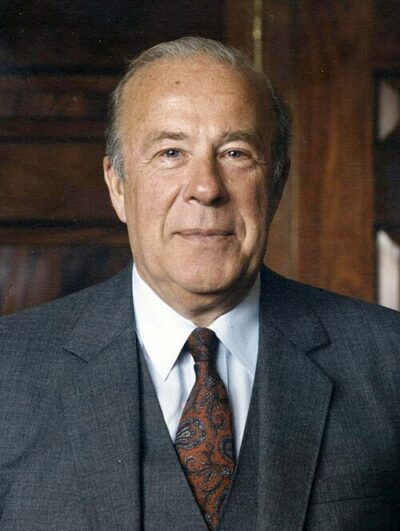
George Shultz
George Shultz was an American politician. Born December 13, 1920, in New York City. Died February 6, 2021, in Stanford. Positions held include United States Secretary of State (1982–1989), United States Secretary of the Treasury (1972–1974) and Director of the Office of Management and Budget (1970–1972). Educated at Princeton University and Massachusetts Institute of Technology. Awards include Presidential Medal of Freedom, Democracy Service Medal and Order of the Rising Sun with Paulownia Flowers, 1st class.
Facts
53 facts · 2 confirmed by two sources · 15 cited · 36 from one source
Where this comes from
Papalocal keeps its own record. It started from these sources; what each one said is kept here as it was copied, so a change on their side never changes this page by itself. Tap one to read its version.
What Wikidata says · copied November 13, 2026 · revision 2562945261
- Described as
- American politician (1920–2021)
- Other names
- George Pratt Shultz, George P. Shultz, George Schultz
- Born
- December 13, 1920 · 8 references
- Died
- February 6, 2021 · 2 references
- Born in
- New York City · 1 reference
- Died in
- Stanford · 1 reference
- Buried in
- Dawes Cemetery · 1 reference
- Citizen of
- United States
- Occupation
- economist · 1 reference; military personnel; diplomat; university teacher · 1 reference; politician · 1 reference; entrepreneur · 1 reference
- Positions held
- United States Secretary of State (1982–1989) · 1 reference; United States Secretary of the Treasury (1972–1974) · 1 reference; Director of the Office of Management and Budget (1970–1972) · 1 reference; United States Secretary of Labor (1969–1970) · 1 reference
- Political party
- Republican Party
- Worked for
- Massachusetts Institute of Technology; Stanford University; University of Chicago; MIT Sloan School of Management; Office of Management and Budget; United States Department of the Treasury; Bechtel; United States Department of Labor
- Education
- Princeton University · 1 reference; Massachusetts Institute of Technology; Dwight-Englewood School; Princeton School of Public and International Affairs
- Member of
- American Academy of Arts and Sciences; Mont Pelerin Society
- Awards
- Presidential Medal of Freedom (1989) · 1 reference; Democracy Service Medal; Order of the Rising Sun with Paulownia Flowers, 1st class; California Hall of Fame (2010); Rumford Prize (2008) · 1 reference; Sylvanus Thayer Award (1992); Distinguished Fellow of the American Economic Association; doctor honoris causa of Keiō University; Fellow of the American Academy of Arts and Sciences; honorary doctor of the Peking University (2007) · 1 reference; Honorary Officer of the Order of Australia (2011) · 1 reference; Financial Times Person of the Year (1982); Annenberg Award for Excellence in Diplomacy; New Jersey Hall of Fame (2023) · 1 reference
- Field
- economics · 1 reference; politics · 1 reference; entrepreneurship · 1 reference
- Spouse
- Charlotte Mailliard Shultz (1997–)
- Religion
- Episcopal Church
- Military branch
- United States Marine Corps
- Military rank
- finance minister · 1 reference
- Lived in
- Westmoreland Hills · 1 reference
- Wikipedias with a page
- 51
Wikidata item Q313411 (wikidata.org/wiki/Q313411), public domain (CC0). Copied November 13, 2026.
What Wikipedia says · copied November 13, 2026 · revision 1383052324
George Pratt Shultz ( SHUULTS; December 13, 1920 – February 6, 2021) was an American economist, businessman, diplomat, and statesman who served in various positions under presidents Richard Nixon and Ronald Reagan. A member of the Republican Party, he is one of only two persons to have held four different Cabinet-level posts, the other being Elliot Richardson. As the 60th United States secretary of state, Shultz played a major role in shaping the foreign policy of the Reagan administration, and conservative foreign policy thought thereafter.
Born in New York City, Shultz grew up in Englewood, New Jersey. After graduating from Princeton University, he served in the United States Marine Corps during World War II. After the war, Shultz earned a Doctor of Philosophy in industrial economics from the Massachusetts Institute of Technology (MIT). He taught at MIT from 1948 to 1957, taking a leave of absence in 1955 to take a position on President Dwight D. Eisenhower's Council of Economic Advisers. After serving as dean of the University of Chicago Graduate School of Business, he accepted President Nixon's appointment as United States Secretary of Labor.
As secretary of Labor, Shultz imposed the Philadelphia Plan on construction contractors who refused to accept black members, marking the first use of racial quotas by the federal government. In 1970, he became the first director of the Office of Management and Budget, and he served in that position until his appointment as United States Secretary of the Treasury in 1972. In that role, Shultz supported the Nixon shock, which sought to revive the ailing economy in part by abolishing the gold standard, and presided over the end of the Bretton Woods system. Shultz left Nixon's administration in May 1974 to become an executive at Bechtel. After becoming president and director of that company, he accepted President Reagan's offer to serve as secretary of state, holding that office from 1982 to 1989. Shultz pushed for Reagan to establish relations with Soviet leader Mikhail Gorbachev, which led to a thaw between the United States and the Soviet Union. He opposed the U.S. aid to Contras trying to overthrow the Sandinistas by using funds from an illegal sale of weapons to Iran. This aid led to the Iran–Contra affair.
Shultz retired from public office in 1989, upon the end of his tenure as secretary of State, but remained active in business and politics. He had already been an executive of the Bechtel Group, an engineering and services company, from 1974 to 1982. Shultz served as an informal adviser to George W. Bush and helped formulate the Bush Doctrine of preemptive war. He served on the Global Commission on Drug Policy, California governor Arnold Schwarzenegger's Economic Recovery Council, and on the boards of Bechtel and the Charles Schwab Corporation. Beginning in 2013, Shultz advocated for a revenue-neutral carbon fee and dividend as the most economically sound means of mitigating anthropogenic climate change. He was a member of the Hoover Institution, the Institute for International Economics, the Washington Institute for Near East Policy, and other groups. Shultz was also a board member of Theranos, with his grandson Tyler Shultz working at the company before becoming a whistleblower about its fraudulent technology. Shultz died at the age of 100 in February 2021.
- Born, in its opening lines
- December 13, 1920
- Died, in its opening lines
- February 6, 2021
From the Wikipedia article “George Shultz” (en.wikipedia.org/wiki/George_Shultz), by its contributors, under CC BY-SA 4.0 (creativecommons.org/licenses/by-sa/4.0/). Copied November 13, 2026; not changed.
Confirmed Two sources agree. Cited One source, and it names where it got it. One source One source, without a reference of its own. Sources disagree The sources disagree. We show the best-supported value and keep theirs below.
