
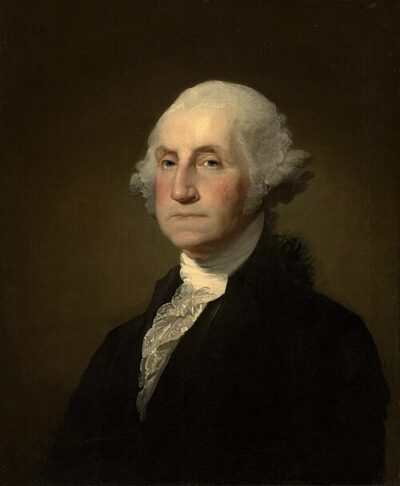
George Washington
George Washington was a Founding Father and first U.S. president. Born February 22, 1732, in George Washington Birthplace National Monument. Died December 14, 1799, in Mount Vernon. Positions held include President of the United States (1789–1797), Commanding General of the United States Army (2 times) (1775–1799) and chairperson (1783–1799). Awards include Congressional Gold Medal and Fellow of the American Academy of Arts and Sciences.
Facts
58 facts · 2 confirmed by two sources · 19 cited · 37 from one source
Where this comes from
Papalocal keeps its own record. It started from these sources; what each one said is kept here as it was copied, so a change on their side never changes this page by itself. Tap one to read its version.
What Wikidata says · copied November 13, 2026 · revision 2568827550
- Described as
- Founding Father and first U.S. president (1732–1799)
- Other names
- Father of the United States, American Fabius, American Cincinnatus, Washington
- Born
- February 22, 1732 · 13 references
- Died
- December 14, 1799 · 13 references
- Born in
- George Washington Birthplace National Monument
- Died in
- Mount Vernon · 5 references
- Buried in
- Washington's Tomb (1831–) · 6 references
- Cause of death
- acute laryngitis · 1 reference
- Citizen of
- Kingdom of Great Britain (–1776); United States (1776–)
- Occupation
- politician · 5 references; farmer · 1 reference; cartographer; geometer; engineer; statesperson; revolutionary; writer · 1 reference
- Positions held
- President of the United States (1789–1797) · 1 reference; Commanding General of the United States Army (2 times) (1775–1799); chairperson (1783–1799); President-elect of the United States (1789); member of the Virginia House of Burgesses (1758–1776) · 1 reference; Delegate to the United States Constitutional Convention (1787) · 1 reference; member of the Virginia House of Delegates · 1 reference
- Political party
- Federalist Party (1798–)
- Member of
- Freemasonry; American Philosophical Society (1780–); American Academy of Arts and Sciences (1781–) · 1 reference; Société d'agriculture de Paris · 1 reference; Society of the Cincinnati
- Awards
- Congressional Gold Medal (1776); Fellow of the American Academy of Arts and Sciences (1781) · 1 reference
- Field
- politics of the United States · 1 reference; foreign relations of the United States · 1 reference
- Spouse
- Martha Washington (1759–1799) · 2 references
- Father
- Augustine Washington · 1 reference
- Mother
- Mary Ball Washington · 1 reference
- Siblings
- Betty Washington Lewis · 1 reference; Samuel Washington · 1 reference; John Augustine Washington · 1 reference; Charles Washington; Mildred Washington; Butler Washington; Lawrence Washington; Augustine Washington Jr.; Jane Washington
- Religion
- Episcopal Church
- Military branch
- Continental Army (1775–1783); United States Army
- Military rank
- major general (1775–1798); lieutenant general (1798–1976); General of the Armies of the United States (1976–)
- Lived in
- Philadelphia; Westmoreland County; New York City; Mount Vernon
- Nickname
- American Fabius; American Cincinnatus
- Height
- 1.88 m (6 ft 2 in) · 1 reference
- Wikipedias with a page
- 275
Wikidata item Q23 (wikidata.org/wiki/Q23), public domain (CC0). Copied November 13, 2026.
What Wikipedia says · copied November 13, 2026 · revision 1384980937
George Washington (February 22, 1732 [O.S. February 11, 1731] – December 14, 1799) was a Founding Father and the first president of the United States, serving from 1789 to 1797. As commander of the Continental Army, Washington led Patriot forces to victory in the American Revolutionary War against the British Empire. He is commonly known as the Father of His Country for his role in bringing about American independence.
Born in the Colony of Virginia, Washington became the commander of the Virginia Regiment during the French and Indian War from 1754 to 1763. He was later elected to the Virginia House of Burgesses, and opposed the oppression of the American colonists by the British Crown. When the American Revolutionary War against the British began in 1775, Washington was appointed commander-in-chief of the Continental Army. He directed a poorly organized and equipped force against disciplined British troops.
Washington and his army achieved an early victory at the siege of Boston in March 1776 but were forced to retreat from New York City in November. Washington crossed the Delaware River and won the battles of Trenton in late 1776 and of Princeton in early 1777, then lost the battles of Brandywine and Germantown later that year. He faced criticism of his command, low troop morale, and a lack of provisions for his forces as the war continued. Ultimately Washington led a combined French and American force to a decisive victory over the British at Yorktown in 1781. In the resulting Treaty of Paris in 1783, the British acknowledged the sovereign independence of the United States. Washington then served as president of the Constitutional Convention in 1787, which drafted the current Constitution of the United States.
Washington was unanimously elected the first U.S. president by the Electoral College in 1789 and 1792. He established a strong, well-financed national government while remaining impartial in the fierce rivalry that emerged within his cabinet between Thomas Jefferson and Alexander Hamilton. During the French Revolution, he adopted a policy of neutrality while supporting the Jay Treaty with Britain. Washington set enduring precedents for the office of president, including republicanism, a peaceful transfer of power, the use of the title "Mr. President", and the two-term tradition. His 1796 farewell address became a preeminent statement on republicanism: Washington wrote about the importance of national unity and the dangers that regionalism, partisanship, and foreign influence pose to it. As a planter of tobacco and wheat at Mount Vernon, Washington owned many slaves. He began opposing slavery near the end of his life, and provided in his will for the eventual manumission of his slaves.
Washington's image is an icon of American culture and he has been extensively memorialized. His namesakes include the national capital and the State of Washington. In both popular and scholarly polls, he is consistently considered one of the greatest presidents in American history.
- Born, in its opening lines
- February 22, 1732
- Died, in its opening lines
- December 14, 1799
From the Wikipedia article “George Washington” (en.wikipedia.org/wiki/George_Washington), by its contributors, under CC BY-SA 4.0 (creativecommons.org/licenses/by-sa/4.0/). Copied November 13, 2026; not changed.
Confirmed Two sources agree. Cited One source, and it names where it got it. One source One source, without a reference of its own. Sources disagree The sources disagree. We show the best-supported value and keep theirs below.
