
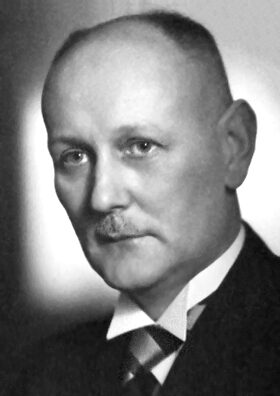
Gerhard Domagk
Gerhard Domagk was a German bacteriologist. Born October 30, 1895, in Łagów. Died April 24, 1964, in Königsfeld im Schwarzwald. Educated at Kiel University. Awards include Pour le Mérite for Sciences and Arts order, Nobel Prize in Physiology or Medicine and Paul Ehrlich and Ludwig Darmstaedter Prize.
Facts
32 facts · 2 confirmed by two sources · 9 cited · 21 from one source
Where this comes from
Papalocal keeps its own record. It started from these sources; what each one said is kept here as it was copied, so a change on their side never changes this page by itself. Tap one to read its version.
What Wikidata says · copied November 16, 2026 · revision 2569004139
- Described as
- German bacteriologist (1895-1964)
- Other names
- Gerhard Johannes Paul Domagk, Discovery of sulfonamides such as Prontosil as antibiotics[2]
- Born
- October 30, 1895 · 8 references
- Died
- April 24, 1964 · 9 references
- Born in
- Łagów · 1 reference
- Died in
- Königsfeld im Schwarzwald · 2 references
- Buried in
- Lauheide Forest Cemetery
- Name at birth
- Gerhard Johannes Paul Domagk
- Citizen of
- Germany
- Occupation
- biochemist; physician; university teacher; pathologist · 1 reference; chemist; bacteriologist · 1 reference; scientist · 1 reference
- Worked for
- University of Münster; University of Greifswald
- Education
- Kiel University
- Member of
- Royal Society of London (1959–); German Academy of Sciences Leopoldina; North Rhine-Westphalia Academy for Sciences and Arts; Royal Academy of Medicine of Catalonia
- Awards
- Pour le Mérite for Sciences and Arts order (1952); Nobel Prize in Physiology or Medicine (1939) · 2 references; Paul Ehrlich and Ludwig Darmstaedter Prize (1956); Aronson Prize (1940); Emil Fischer Medal (1937) · 1 reference; Fresenius Prize (1937) · 1 reference; Grand Cross of the Order of Civil Health (1954) · 1 reference; Knight Commander's Cross of the Order of Merit of the Federal Republic of Germany; Foreign Member of the Royal Society (1959) · 1 reference; Cameron Prize of the University of Edinburgh (1939)
- Field
- pathology
- Wikipedias with a page
- 69
Wikidata item Q57192 (wikidata.org/wiki/Q57192), public domain (CC0). Copied November 16, 2026.
What Wikipedia says · copied November 16, 2026 · revision 1383104982
Gerhard Johannes Paul Domagk (German pronunciation: [ˈɡeːɐ̯haʁt ˈdoːmak] ; 30 October 1895 – 24 April 1964) was a German pathologist and bacteriologist.
He is credited with the discovery of sulfonamidochrysoidine (KL730) as an antibiotic for which he received the 1939 Nobel Prize in Physiology or Medicine. The drug became the first commercially available antibiotic and marketed under the brand name Prontosil.
While working in the pathology department of the University of Münster, Domagk was invited to join the IG Farben branch at Elberfeld (later Wuppertal) in 1927. His duty was to test chemical compounds prepared at the IG Farben laboratory for potential drugs. A novel compound synthesised by Fritz Mietzsch and Joseph Klarer, a benzene derivative of azo dye attached with sulphonamide group as a side chain was found to have antibacterial activity against human bacterium Streptococcus pyogenes. In 1935, Domagk's only daughter, Hildegarde, injured herself and contracted a streptococcal infection. In a desperate attempt to save his daughter's arm from amputation and her life, Domagk used the new compound that eventually cured the infection. Given the brand name Prontosil, the new drug became the first antibiotic commercially available for bacterial infections.
Domagk was chosen to receive the 1939 Nobel Prize in Physiology or Medicine "for the discovery of the antibacterial effects of prontosil," but the Nazi government prohibited him from receiving the award. In 1947, after the fall of Nazi Germany, he was officially given the Nobel diploma and delivered the Nobel lecture.
- Born, in its opening lines
- October 30, 1895
- Died, in its opening lines
- April 24, 1964
From the Wikipedia article “Gerhard Domagk” (en.wikipedia.org/wiki/Gerhard_Domagk), by its contributors, under CC BY-SA 4.0 (creativecommons.org/licenses/by-sa/4.0/). Copied November 16, 2026; not changed.
Confirmed Two sources agree. Cited One source, and it names where it got it. One source One source, without a reference of its own. Sources disagree The sources disagree. We show the best-supported value and keep theirs below.
