
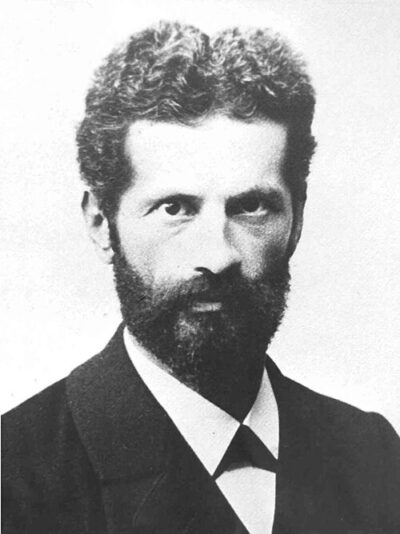
Gottlieb Haberlandt
Gottlieb Haberlandt was an Austrian botanist. Born November 28, 1854, in Magyaróvár. Died January 30, 1945, in Berlin. Educated at University of Vienna.
Facts
23 facts · 2 confirmed by two sources · 5 cited · 16 from one source
Where this comes from
Papalocal keeps its own record. It started from these sources; what each one said is kept here as it was copied, so a change on their side never changes this page by itself. Tap one to read its version.
What Wikidata says · copied November 18, 2026 · revision 2568779791
- Described as
- Austrian botanist (1854-1945)
- Other names
- G. Haberlandt
- Born
- November 28, 1854 · 4 references
- Died
- January 30, 1945 · 4 references
- Born in
- Magyaróvár · 1 reference
- Died in
- Berlin · 2 references
- Buried in
- Wilmersdorf Cemetery
- Citizen of
- Austria; Austria–Hungary (–1918)
- Occupation
- botanist · 1 reference; university teacher; plant physiologist
- Worked for
- Humboldt-Universität zu Berlin; University of Graz · 1 reference; Graz University of Technology · 1 reference
- Education
- University of Vienna
- Member of
- German Academy of Sciences Leopoldina; Academy of Sciences of the USSR; Royal Swedish Academy of Sciences; Russian Academy of Sciences · 1 reference; Royal Prussian Academy of Sciences; Bavarian Academy of Sciences and Humanities
- Field
- botany · 1 reference
- Father
- Friedrich J. Haberlandt · 1 reference
- Siblings
- Michael Haberlandt · 1 reference
- Wikipedias with a page
- 20
Wikidata item Q700321 (wikidata.org/wiki/Q700321), public domain (CC0). Copied November 18, 2026.
What Wikipedia says · copied November 18, 2026 · revision 1372000882
Gottlieb Haberlandt (28 November 1854 – 30 January 1945) was an Austrian botanist. He was the son of European 'soybean' pioneer Professor Friedrich J. Haberlandt. His son Ludwig Haberlandt was an early reproductive physiologist now given credit as the 'grandfather' of the birth control pill.
Haberlandt first pointed out the possibilities of the culture of isolated tissues, plant tissue culture. He suggested that the potentialities of individual cells via tissue culture and also suggested that the reciprocal influences of tissues on one another could be determined by this method. Since Haberlandt's original assertions methods for tissue and cell culture have been realized, it has led to significant discoveries in Biology and Medicine. His original idea presented in 1902 was called totipotentiality (now termed as totipotency): “Theoretically all plant cells are able to give rise to a complete plant.” In his 1905 work "Die lichtsinnesorgane der laubblätter" Haberlandt suggested that plants might be able to see using organs on the upper surface of the leaf.
The more efficient C-4 photosynthesis in land plants depends on a specialized Kranz (German for wreath) leaf anatomy first described by Gottlieb Haberlandt in 1904.
- Born, in its opening lines
- November 28, 1854
- Died, in its opening lines
- January 30, 1945
From the Wikipedia article “Gottlieb Haberlandt” (en.wikipedia.org/wiki/Gottlieb_Haberlandt), by its contributors, under CC BY-SA 4.0 (creativecommons.org/licenses/by-sa/4.0/). Copied November 18, 2026; not changed.
Confirmed Two sources agree. Cited One source, and it names where it got it. One source One source, without a reference of its own. Sources disagree The sources disagree. We show the best-supported value and keep theirs below.
