
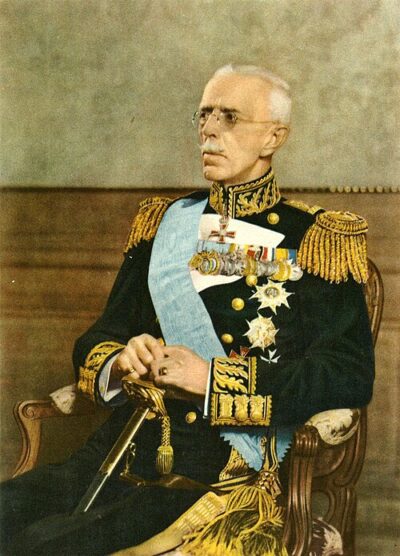
Gustaf V of Sweden
Gustaf V served as the King of Sweden from 1907 until his passing in 1950. Born in 1858, he reigned for nearly 43 years, making him the longest-reigning Swedish monarch at the time of his death at age 92. He was the eldest son of King Oscar II. Gustaf V was the last Swedish monarch to wield significant royal authority, though these powers were formally removed with constitutional changes in 1974. Notably, he was the first Swedish king since the High Middle Ages not to undergo a coronation ceremony.
Facts
45 facts · 2 confirmed by two sources · 3 cited · 40 from one source
Where this comes from
Papalocal keeps its own record. It started from these sources; what each one said is kept here as it was copied, so a change on their side never changes this page by itself. Tap one to read its version.
What Wikipedia says · copied November 13, 2026 · revision 1384342974
Gustaf V (Oscar Gustaf Adolf; 16 June 1858 – 29 October 1950) was King of Sweden from 8 December 1907 until his death in 1950. He was the eldest son of King Oscar II and Sophia of Nassau, a half-sister of Adolphe, Grand Duke of Luxembourg. Reigning from the death of his father Oscar II in 1907 to his own death nearly 43 years later, he holds the record of being the oldest monarch of Sweden, dying at the age of 92. Gustaf also had the third-longest reign of a Swedish monarch after Magnus IV (1319–1364) and his own great-grandson, Carl XVI Gustaf (1973–present). He was also the last Swedish monarch to exercise his royal prerogatives, which largely died with him, although abolished only with the remaking of the Swedish constitution in 1974. He was the first Swedish king since the High Middle Ages not to have a coronation and so never wore the king's crown, a practice that has continued since.
Gustaf's early reign saw the rise of parliamentary rule in Sweden, although the leadup to World War I induced his dismissal of Liberal Prime Minister Karl Staaff in 1914, replacing him with his own figurehead, Hjalmar Hammarskjöld, the father of Dag Hammarskjöld, for most of the war. However, after the Liberals and Social Democrats secured a parliamentary majority under Staaff's successor, Nils Edén, he allowed Edén to form a new government which de facto stripped the monarchy of virtually all powers and enacted universal and equal suffrage, including for women, by 1919. Bowing to the principles of parliamentary democracy, he remained a popular figurehead for the remaining 31 years of his rule, although not completely without influence. Gustaf V had pro-German and anti-Communist stances which were outwardly expressed during World War I and the Russian Civil War. During World War II, he allegedly urged Per Albin Hansson's coalition government to accept requests from Nazi Germany for logistics support, arguing that refusing might provoke an invasion, an intervention which remains controversial. While sympathetic to military action against the Soviet Union, he personally pressured Miklos Horthy to halt deportations of Jews in the summer of 1944 and aided Raoul Wallenberg's efforts.
An avid hunter and sportsman, Gustaf presided over the 1912 Olympic Games and chaired the Swedish Association of Sports from 1897 to 1907. Most notably, he represented Sweden (under the alias of Mr G.) as a competitive tennis player, keeping up competitive tennis until his eighties, when his eyesight deteriorated rapidly. He was succeeded by his son, Gustaf VI Adolf.
- Born, in its opening lines
- June 16, 1858
- Died, in its opening lines
- October 29, 1950
From the Wikipedia article “Gustaf V” (en.wikipedia.org/wiki/Gustaf_V), by its contributors, under CC BY-SA 4.0 (creativecommons.org/licenses/by-sa/4.0/). Copied November 13, 2026; not changed.
What Wikidata says · copied November 14, 2026 · revision 2569021287
- Described as
- King of Sweden from 1907 to 1950
- Other names
- King Gustaf V of Sweden, Oscar Gustaf Adolf of Sweden, Mr G., King Gustaf V
- Born
- June 16, 1858 · 12 references
- Died
- October 29, 1950 · 11 references
- Born in
- Drottningholm Palace · 2 references
- Died in
- Drottningholm Palace · 1 reference
- Buried in
- Bernadotte crypt · 1 reference
- Cause of death
- influenza
- Name at birth
- Oscar Gustav Adolf Bernadotte
- Citizen of
- Sweden
- Occupation
- monarch; aristocrat; tennis player
- Positions held
- Monarch of Sweden (1907–1950); crown prince (1872–1907); heir apparent (1872–1907)
- Education
- Uppsala University
- Member of
- Royal Swedish Academy of Sciences; Russian Academy of Sciences (1901–) · 1 reference; Royal Swedish Academy of Letters, History and Antiquities
- Sport
- tennis
- Awards
- Knight of the Order of the Golden Fleece; Order of the Black Eagle; Knight Grand Cross of the Royal Victorian Order; Order of the White Eagle; Order of the Three Stars, 1st Class; Order of Saint Anna, 1st class; Order of Saint Stanislaus, 1st class; Order of St. Vladimir, 1st class; Order of Saint Alexander Nevsky; Order of the Star of Romania; Order of St. Andrew; International Tennis Hall of Fame; Royal Victorian Chain (1908); Order of the White Star, Collar Class; Silver Wolf Award
- Spouse
- Victoria of Baden (1881–1930) · 1 reference
- Children
- Gustaf VI Adolf of Sweden; Prince Erik, Duke of Västmanland; Prince Wilhelm, Duke of Södermanland
- Father
- Oscar II of Sweden
- Mother
- Sophia of Nassau
- Siblings
- Prince Oscar Bernadotte; Prince Carl, Duke of Västergötland; Prince Eugen, Duke of Närke
- Religion
- Lutheranism
- Military rank
- general
- Wikipedias with a page
- 69
Wikidata item Q52890 (wikidata.org/wiki/Q52890), public domain (CC0). Copied November 14, 2026.
Confirmed Two sources agree. Cited One source, and it names where it got it. One source One source, without a reference of its own. Sources disagree The sources disagree. We show the best-supported value and keep theirs below.
