
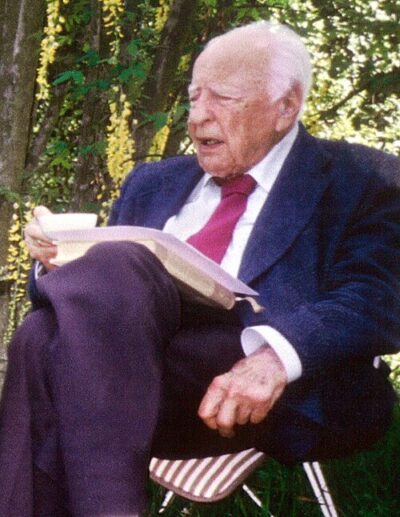
Hans-Georg Gadamer
Hans-Georg Gadamer was a German philosopher. Born February 11, 1900, in Marburg. Died March 13, 2002, in Heidelberg. Known for Truth and Method and The Relevance of the Beautiful and Other Essays. Educated at University of Wrocław and University of Marburg. Awards include Pour le Mérite for Sciences and Arts order, Order of Merit of Baden-Württemberg and Hanns Martin Schleyer Prize.
Facts
48 facts · 2 confirmed by two sources · 8 cited · 38 from one source
What’s different
- Died: we show March 13, 2002 (Confirmed). Wikidata also lists March 15, 2002
Where this comes from
Papalocal keeps its own record. It started from these sources; what each one said is kept here as it was copied, so a change on their side never changes this page by itself. Tap one to read its version.
What Wikidata says · copied November 16, 2026 · revision 2568959708
- Described as
- German philosopher (1900–2002)
- Other names
- Gadamer, Hans Georg Gadamer
- Born
- February 11, 1900 · 16 references
- Died
- March 13, 2002 · 16 references; March 15, 2002 · 1 reference
- Born in
- Marburg · 2 references
- Died in
- Heidelberg · 3 references
- Buried in
- Heidelberg
- Citizen of
- Germany
- Occupation
- philosopher · 1 reference; university teacher · 1 reference
- Worked for
- Heidelberg University (1949–2002); Goethe University Frankfurt (1948–1949); University of Marburg (1928–1938); Leipzig University (1938–1948)
- Education
- University of Wrocław (1918–1919); University of Marburg (1919–1922)
- Member of
- Saxon Academy of Sciences and Humanities (1940–); German Academy for Language and Literature; American Academy of Arts and Sciences; Hungarian Academy of Sciences; Heidelberg Academy of Sciences and Humanities (1950–) · 1 reference; Academy of Sciences of Turin (1980–) · 1 reference; Accademia Nazionale dei Lincei (1973–) · 1 reference; Academy of Athens
- Known for
- Truth and Method; The Relevance of the Beautiful and Other Essays
- Awards
- Pour le Mérite for Sciences and Arts order (1971); Order of Merit of Baden-Württemberg (1976); Hanns Martin Schleyer Prize (1987); Karl Jaspers Prize (1986); Hegel Prize (1979) · 1 reference; Sigmund Freud Prize (1979) · 1 reference; Reuchlin Prize (1971); honorary doctor of the Charles University of Prague (1997); honorary citizen of Palermo (2000); Grand Cross 1st class of the Order of Merit of the Federal Republic of Germany (1993) · 1 reference; Honorary doctor of the University of Ottawa; honorary doctor of the University of Bamberg; honorary doctor of the Leipzig University (1996); honorary doctor of the University of Warsaw; honorary doctor of the University of Wrocław (1995)
- Field
- philosophy; aesthetics · 1 reference; ontology · 1 reference; epistemology · 1 reference; language · 1 reference; hermeneutics · 1 reference
- Spouse
- Käte Gadamer
- Father
- Johannes Gadamer
- Lived in
- Germany · 1 reference
- Wikipedias with a page
- 79
Wikidata item Q76356 (wikidata.org/wiki/Q76356), public domain (CC0). Copied November 16, 2026.
What Wikipedia says · copied November 16, 2026 · revision 1384715866
Hans-Georg Gadamer (; German: [ˈɡaːdamɐ]; 11 February 1900 – 13 March 2002) was a German philosopher of the continental tradition best known for his work on hermeneutics, including Truth and Method (Wahrheit und Methode, 1960), which argues that understanding is shaped by history, language, and dialogue rather than by the application of objective method.
- Born, in its opening lines
- February 11, 1900
- Died, in its opening lines
- March 13, 2002
From the Wikipedia article “Hans-Georg Gadamer” (en.wikipedia.org/wiki/Hans-Georg_Gadamer), by its contributors, under CC BY-SA 4.0 (creativecommons.org/licenses/by-sa/4.0/). Copied November 16, 2026; not changed.
Confirmed Two sources agree. Cited One source, and it names where it got it. One source One source, without a reference of its own. Sources disagree The sources disagree. We show the best-supported value and keep theirs below.
