
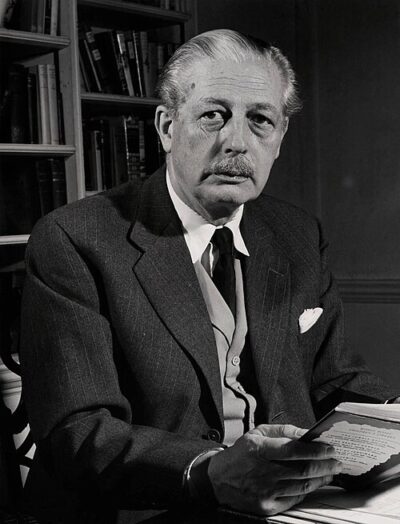
Harold Macmillan
Harold Macmillan was a Prime Minister of the United Kingdom from 1957 to 1963. Born February 10, 1894, in Chelsea. Died December 29, 1986, in Horsted Keynes. Positions held include Prime Minister of the United Kingdom (1957–1963), Leader of the Conservative Party (1957–1963) and Chancellor of the Exchequer (1955–1957). Educated at Balliol College and Eton College. Awards include Four Freedoms Award – Freedom Medal, Order of Merit and Inter-Allied Victory Medals.
Facts
48 facts · 2 confirmed by two sources · 16 cited · 30 from one source
Where this comes from
Papalocal keeps its own record. It started from these sources; what each one said is kept here as it was copied, so a change on their side never changes this page by itself. Tap one to read its version.
What Wikidata says · copied November 16, 2026 · revision 2562991860
- Described as
- Prime Minister of the United Kingdom from 1957 to 1963
- Other names
- Maurice Harold Macmillan, Lord Stockton, Earl of Stockton, 1st Earl of Stockton, Supermac
- Born
- February 10, 1894 · 16 references
- Died
- December 29, 1986 · 14 references
- Born in
- Chelsea
- Died in
- Horsted Keynes
- Buried in
- Sussex
- Citizen of
- United Kingdom
- Occupation
- politician · 2 references; diplomat; military personnel; leader (1957–1963)
- Positions held
- Prime Minister of the United Kingdom (1957–1963); Leader of the Conservative Party (1957–1963); Chancellor of the Exchequer (1955–1957); Secretary of State for Foreign and Commonwealth Affairs (1955); Minister of Defence (1954–1955); Secretary of State for Air (1945); Under-Secretary of State for the Colonies (1942); Member of the Privy Council of the United Kingdom; member of the 42nd Parliament of the United Kingdom (1959–1964) · 1 reference; member of the 41st Parliament of the United Kingdom (1955–1959) · 1 reference; member of the 40th Parliament of the United Kingdom (1951–1955) · 1 reference; member of the 39th Parliament of the United Kingdom (1950–1951) · 1 reference; member of the 38th Parliament of the United Kingdom (1945–1950) · 1 reference; member of the 37th Parliament of the United Kingdom (1935–1945) · 1 reference; member of the 36th Parliament of the United Kingdom (1931–1935) · 1 reference
- Political party
- Conservative Party
- Education
- Balliol College; Eton College; Summer Fields School
- Member of
- Royal Society of London (1962–); Parliamentary Assembly of the Council of Europe
- Awards
- Four Freedoms Award – Freedom Medal (1984) · 2 references; Order of Merit; Inter-Allied Victory Medals; Benjamin Franklin Medal (1976); Grand Cross of the Order of Isabella the Catholic (1986) · 1 reference
- Spouse
- Dorothy Macmillan (1920–1966) · 2 references
- Children
- Maurice Macmillan · 1 reference; Caroline Faber · 2 references; Catherine Macmillan · 2 references; Sarah Heath · 1 reference
- Father
- Maurice Crawford Macmillan · 1 reference
- Mother
- Helen Artie Tarleton Belles · 2 references
- Siblings
- Daniel Macmillan · 1 reference
- Religion
- Anglicanism; Church of England
- Military branch
- British Army
- Military rank
- captain
- Wikipedias with a page
- 96
Wikidata item Q128985 (wikidata.org/wiki/Q128985), public domain (CC0). Copied November 16, 2026.
What Wikipedia says · copied November 16, 2026 · revision 1382517110
Maurice Harold Macmillan, 1st Earl of Stockton (10 February 1894 – 29 December 1986) was Prime Minister of the United Kingdom and Leader of the Conservative Party from 1957 to 1963. Nicknamed "Supermac", he was known for his pragmatism, wit, and unflappability.
Educated at Eton and Oxford, Macmillan was seriously injured as a captain of the Grenadier Guards during the First World War and suffered pain and partial immobility for the rest of his life. After the war he joined his family's book-publishing business, then entered the Commons at the 1924 general election representing Stockton-on-Tees. Losing his seat in 1929, he regained it in 1931 as a supporter of economic planning. He opposed the appeasement of Nazi Germany practised by the government and entered the Cabinet soon after the Second World War broke out as a protégé of Prime Minister Winston Churchill.
In the 1950s Macmillan served as Foreign Secretary and Chancellor of the Exchequer under Anthony Eden. When Eden resigned in 1957 following the Suez Crisis, Macmillan succeeded him as prime minister and Leader of the Conservative Party. He was a One Nation Tory of the Disraelian tradition and supported the post-war consensus of the welfare state and the mixed economy, with some nationalised industries and strong trade unions. He championed a Keynesian strategy of deficit spending to maintain demand and pursued corporatist policies to develop the domestic market as the engine of growth. Benefiting from favourable international conditions, he presided over an age of affluence, marked by low unemployment and high—if uneven—growth, as well as modest social reforms. In July 1957, Macmillan told the nation it had "never had it so good", but warned of the dangers of inflation, summing up the fragile prosperity of the 1950s. He led the Conservatives to success in 1959 with an increased majority.
In international affairs, Macmillan worked to rebuild the Special Relationship with the United States after Suez—of which he had been one of the architects—and, citing the "wind of change blowing across the continent", presided over much of the decolonisation of Africa, beginning with the Gold Coast (Ghana) in 1957. Reconfiguring the nation's defences amid the Cold War, Macmillan ended National Service, strengthened the nuclear forces by acquiring Polaris, and pioneered the Nuclear Test Ban with the United States and the Soviet Union. After the Skybolt Crisis undermined the Anglo-American strategic relationship, he sought a more active role for Britain in Europe, but his unwillingness to disclose US nuclear secrets to France contributed to a French veto of the United Kingdom's entry into the European Economic Community, and the independent French acquisition of atomic weapons in 1960.
Beginning in the 1960s, Macmillan's government was rocked by the Vassall Tribunal and the Profumo affair, which to cultural conservatives and supporters of opposing parties alike seemed to symbolise the moral decay of the British establishment. Amid declining Conservative Party popularity, Macmillan fumbled a controversial Cabinet reshuffle before resigning the premiership in October 1963 and his seat in Parliament shortly thereafter, citing ill health. He was succeeded by Foreign Secretary Lord Home, who was defeated by Labour in the 1964 election. Following his resignation, Macmillan lived out a long retirement as an active member of the House of Lords before dying in December 1986 aged 92.
- Born, in its opening lines
- February 10, 1894
- Died, in its opening lines
- December 29, 1986
From the Wikipedia article “Harold Macmillan” (en.wikipedia.org/wiki/Harold_Macmillan), by its contributors, under CC BY-SA 4.0 (creativecommons.org/licenses/by-sa/4.0/). Copied November 16, 2026; not changed.
Confirmed Two sources agree. Cited One source, and it names where it got it. One source One source, without a reference of its own. Sources disagree The sources disagree. We show the best-supported value and keep theirs below.
