
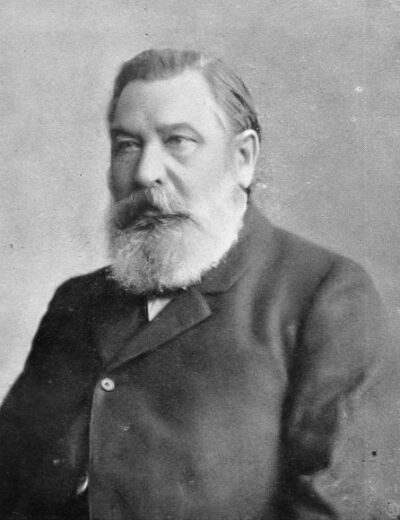
Heinrich von Treitschke
Heinrich von Treitschke was a German historian and political writer. Born September 15, 1834, in Dresden. Died April 28, 1896, in Berlin. Positions held include member of the Reichstag of the German Empire (1871–1884), Historiographer of the Prussian state (1886–) and Geheimrat. Educated at University of Bonn and Leipzig University. Awards include Pour le Mérite for Sciences and Arts order and Verdun Award.
Facts
51 facts · 2 confirmed by two sources · 33 cited · 16 from one source
Where this comes from
Papalocal keeps its own record. It started from these sources; what each one said is kept here as it was copied, so a change on their side never changes this page by itself. Tap one to read its version.
What Wikidata says · copied November 16, 2026 · revision 2568743142
- Described as
- German historian and political writer (1834-1896)
- Other names
- Heinrich Gotthard Freiherr von Treitschke
- Born
- September 15, 1834 · 6 references
- Died
- April 28, 1896 · 5 references
- Born in
- Dresden · 3 references
- Died in
- Berlin · 2 references
- Buried in
- Alter St.-Matthäus-Kirchhof Berlin · 1 reference
- Name at birth
- Heinrich Gotthard von Treitschke · 1 reference
- Citizen of
- Kingdom of Saxony · 1 reference
- Occupation
- historian of Modern Age; historian · 2 references; university teacher; politician · 1 reference; writer · 2 references; opinion journalist · 2 references
- Positions held
- member of the Reichstag of the German Empire (1871–1884) · 1 reference; Historiographer of the Prussian state (1886–); Geheimrat · 1 reference
- Political party
- National Liberal Party · 1 reference
- Worked for
- University of Freiburg (1863–1866) · 1 reference; Frederick William University Berlin (1874–) · 1 reference; Kiel University (1866–1867) · 1 reference; Heidelberg University (1867–1874); Humboldt-Universität zu Berlin; Leipzig University · 1 reference
- Education
- University of Bonn (1851–1854) · 1 reference; Leipzig University (1852–1853) · 1 reference; Kreuzschule (1846–1851) · 1 reference; University of Tübingen (1854–) · 1 reference; University of Freiburg · 1 reference; Heidelberg University (1854–1855) · 1 reference
- Member of
- Hellenic Philological Society of Constantinople (1885–); Royal Prussian Academy of Sciences; Bonner Burschenschaft Frankonia (1851–) · 2 references; Verein Deutscher Studenten · 1 reference; Deutscher Kolonialverein
- Awards
- Pour le Mérite for Sciences and Arts order (1887) · 1 reference; Verdun Award (1884)
- Field
- politics · 1 reference; history · 1 reference; opinion journalism · 1 reference; literature · 1 reference; political science · 1 reference
- Spouse
- Emma von Treitschke (1867–) · 1 reference
- Children
- Maria von Treitschke · 1 reference; Clara von Tungeln · 1 reference
- Father
- Eduard Heinrich von Treitschke · 1 reference
- Religion
- Lutheranism · 1 reference
- Lived in
- Dresden (1855) · 1 reference; Göttingen (1855–1857) · 1 reference; Leipzig (1857–1863); Munich (1861); Freiburg im Breisgau (1863–)
- Wikipedias with a page
- 34
Wikidata item Q62400 (wikidata.org/wiki/Q62400), public domain (CC0). Copied November 16, 2026.
What Wikipedia says · copied November 16, 2026 · revision 1383582906
Heinrich Gotthard von Treitschke (German: [ˈhaɪnʁɪç fɔn ˈtʁaɪt͡ʃkə]; 15 September 1834 – 28 April 1896) was a German historian, political writer and National Liberal member of the Reichstag during the time of the German Empire.
He was an extreme nationalist, who favored German colonialism and opposed the British Empire. He also opposed Catholics, Poles, Jews and socialists inside Germany. According to Hans Kohn, Treitschke's "prominent position as a national scholar and popular prophet gave to anti-Semitism in Germany a recognized standing."
- Born, in its opening lines
- September 15, 1834
- Died, in its opening lines
- April 28, 1896
From the Wikipedia article “Heinrich von Treitschke” (en.wikipedia.org/wiki/Heinrich_von_Treitschke), by its contributors, under CC BY-SA 4.0 (creativecommons.org/licenses/by-sa/4.0/). Copied November 16, 2026; not changed.
Confirmed Two sources agree. Cited One source, and it names where it got it. One source One source, without a reference of its own. Sources disagree The sources disagree. We show the best-supported value and keep theirs below.
