
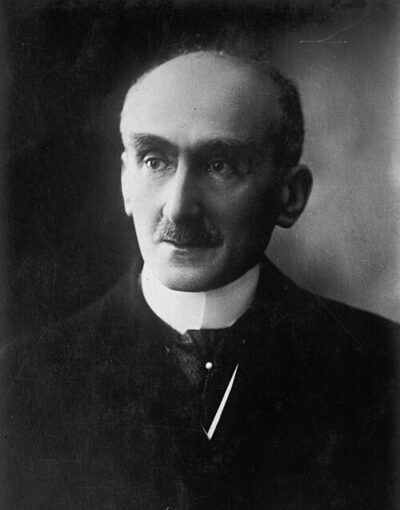
Henri Bergson
Henri Bergson was a French philosopher. Born October 18, 1859, in Paris. Died January 4, 1941, in Paris. Positions held include Member of the Académie française (1914–1941) and president (1922–1925). Educated at Lycée Condorcet and École Normale Supérieure. Awards include Nobel Prize in Literature, Grand Cross of the Legion of Honour and Concours général.
Facts
42 facts · 2 confirmed by two sources · 11 cited · 29 from one source
Where this comes from
Papalocal keeps its own record. It started from these sources; what each one said is kept here as it was copied, so a change on their side never changes this page by itself. Tap one to read its version.
What Wikidata says · copied November 16, 2026 · revision 2569289309
- Described as
- French philosopher (1859–1941)
- Other names
- Berxon, Henri Louis Bergson, H. Bergson, Henry Bergson, Henri-Louis Bergson, Bergson
- Born
- October 18, 1859 · 17 references
- Died
- January 4, 1941 · 13 references
- Born in
- Paris · 4 references
- Died in
- Paris · 4 references
- Buried in
- Cemetery of Garches
- Cause of death
- bronchitis
- Citizen of
- France
- Occupation
- philosopher · 3 references; professor · 1 reference; sociologist; writer · 1 reference; university teacher · 1 reference
- Positions held
- Member of the Académie française (1914–1941) · 1 reference; president (1922–1925)
- Worked for
- Collège de France (1900–1904) · 1 reference; lycée David d'Angers · 1 reference
- Education
- Lycée Condorcet; École Normale Supérieure; University of Paris
- Member of
- Académie Française (1914–1941) · 1 reference; Royal Swedish Academy of Sciences; American Academy of Arts and Sciences · 1 reference; Académie des Sciences Morales et Politiques · 1 reference; Accademia Nazionale dei Lincei (1911–) · 1 reference; Academy of Sciences of Turin (1914–) · 1 reference
- Awards
- Nobel Prize in Literature (1927) · 2 references; Grand Cross of the Legion of Honour; Concours général; Fellow of the American Academy of Arts and Sciences; Honorary Doctorate from the National Autonomous University of Mexico (1924); Honorary doctor of the University of Oxford; honorary doctorate from the University of Cambridge
- Field
- philosophy; metaphysics · 1 reference; epistemology · 1 reference; irrationalism · 1 reference; philosophy of language · 1 reference; philosophy of mathematics · 1 reference
- Spouse
- Louise Neuberger
- Father
- Michał Bergson
- Siblings
- Moina Mathers
- Religion
- Judaism
- Wikipedias with a page
- 138
Wikidata item Q42156 (wikidata.org/wiki/Q42156), public domain (CC0). Copied November 16, 2026.
What Wikipedia says · copied November 16, 2026 · revision 1382255901
Henri-Louis Bergson (; French: [bɛʁksɔn]; 18 October 1859 – 4 January 1941) was a French philosopher who was influential in the traditions of analytic philosophy and continental philosophy, especially during the first half of the 20th century until the Second World War, but also after 1966 when Gilles Deleuze published Le Bergsonisme.
Bergson is known for his arguments that processes of immediate experience and intuition are more significant than abstract rationalism and science for understanding reality. Bergson was awarded the 1927 Nobel Prize in Literature "in recognition of his rich and vitalizing ideas and the brilliant skill with which they have been presented". In 1930, France awarded him its highest honour, the Grand-Croix de la Legion d'honneur. Bergson's great popularity created a controversy in France, where his views were seen as opposing the "secular and scientific" attitude adopted by the Republic's officials.
- Born, in its opening lines
- October 18, 1859
- Died, in its opening lines
- January 4, 1941
From the Wikipedia article “Henri Bergson” (en.wikipedia.org/wiki/Henri_Bergson), by its contributors, under CC BY-SA 4.0 (creativecommons.org/licenses/by-sa/4.0/). Copied November 16, 2026; not changed.
Confirmed Two sources agree. Cited One source, and it names where it got it. One source One source, without a reference of its own. Sources disagree The sources disagree. We show the best-supported value and keep theirs below.
