
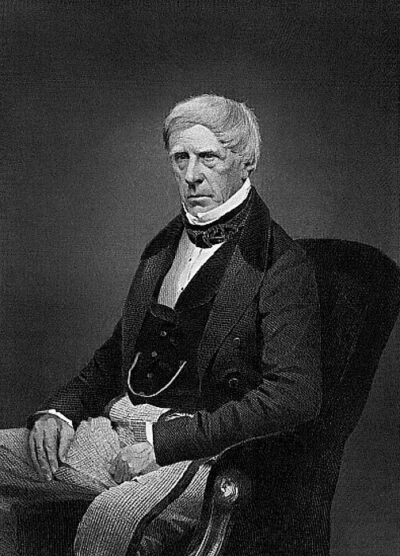
Henry Brougham, 1st Baron Brougham and Vaux
Henry Brougham, 1st Baron Brougham and Vaux was an English barrister, politician, and Lord Chancellor of Great Britain. Born September 19, 1778, in Cowgate. Died May 7, 1868, in Cannes. Positions held include member of the 4th Parliament of the United Kingdom (1810–1812), Lord Chancellor (1830–1834) and Member of the Privy Council of the United Kingdom. Educated at University of Edinburgh and Royal High School. Awards include Fellow of the Royal Society.
Facts
39 facts · 2 confirmed by two sources · 21 cited · 16 from one source
Where this comes from
Papalocal keeps its own record. It started from these sources; what each one said is kept here as it was copied, so a change on their side never changes this page by itself. Tap one to read its version.
What Wikidata says · copied November 17, 2026 · revision 2567366121
- Described as
- English barrister, politician, and Lord Chancellor of Great Britain (1778-1868)
- Other names
- Henry Peter Brougham, Henry Brougham, Baron Brougham And Vaux, Henry Brougham, Lord Brougham and Vaux, Lord Broham
- Born
- September 19, 1778 · 5 references
- Died
- May 7, 1868 · 5 references
- Born in
- Cowgate
- Died in
- Cannes · 1 reference
- Buried in
- Cannes (Grand Jas) Cemetery
- Citizen of
- United Kingdom of Great Britain and Ireland; Kingdom of Great Britain (–1801)
- Occupation
- politician · 2 references; writer · 2 references; judge; philosopher · 1 reference; statesperson · 1 reference; jurist · 2 references; scholar · 1 reference
- Positions held
- member of the 4th Parliament of the United Kingdom (1810–1812) · 1 reference; Lord Chancellor (1830–1834); Member of the Privy Council of the United Kingdom; member of the 5th Parliament of the United Kingdom (1815–1818) · 1 reference; member of the 6th Parliament of the United Kingdom (1818–1820) · 1 reference; member of the 7th Parliament of the United Kingdom (1820–1826) · 1 reference; member of the 8th Parliament of the United Kingdom (1826–1830) · 1 reference; member of the 9th Parliament of the United Kingdom (1830) · 1 reference; member of the House of Lords (1830–1868) · 1 reference; Rector of Marischal College, Aberdeen (1838–1839)
- Political party
- Whigs
- Education
- University of Edinburgh; Royal High School; University of Edinburgh School of Law
- Member of
- Royal Society of London; Royal Swedish Academy of Sciences
- Awards
- Fellow of the Royal Society
- Field
- political science · 1 reference; law · 1 reference
- Spouse
- Mary Anne Eden (1819–) · 3 references
- Children
- Sarah Eleanor Brougham · 1 reference; Eleanor Louisa Brougham · 1 reference
- Father
- Henry Brougham · 2 references
- Mother
- Eleanor Syme · 2 references
- Siblings
- William Brougham, 2nd Baron Brougham and Vaux · 1 reference
- Wikipedias with a page
- 25
Wikidata item Q333220 (wikidata.org/wiki/Q333220), public domain (CC0). Copied November 17, 2026.
What Wikipedia says · copied November 17, 2026 · revision 1370595118
Henry Peter Brougham, 1st Baron Brougham and Vaux, (; 19 September 1778 – 7 May 1868) was a British statesman who became Lord High Chancellor of Great Britain and played a prominent role in passing the Reform Act 1832 and Slavery Abolition Act 1833.
Born in Edinburgh, Brougham helped found the Edinburgh Review in 1802 before moving to London, where he qualified as a barrister in 1808. Elected to the House of Commons in 1810 as a Whig, he was Member of Parliament for various constituencies until becoming a peer in 1830.
Brougham won popular renown for helping defeat the 1820 Pains and Penalties Bill, an attempt by the widely disliked George IV to annul his marriage to Caroline of Brunswick. He became an advocate of liberal causes including abolition of the slave trade, free trade and parliamentary reform. Appointed Lord Chancellor in 1830, he made a number of reforms intended to speed up legal cases and established the Central Criminal Court. He never regained government office after 1834 and although he played an active role in the House of Lords, he often did so in opposition to his former colleagues.
Education was another area of interest. He helped establish the Society for the Diffusion of Useful Knowledge.
He also was a founder of University College London, as well as holding some academic posts, including Rector, University of Edinburgh. In later years he spent much of his time in the French town of Cannes, making it a popular resort for the British upper-classes; he died there in 1868.
- Born, in its opening lines
- September 19, 1778
- Died, in its opening lines
- May 7, 1868
From the Wikipedia article “Henry Brougham, 1st Baron Brougham and Vaux” (en.wikipedia.org/wiki/Henry_Brougham,_1st_Baron_Brougham_and_Vaux), by its contributors, under CC BY-SA 4.0 (creativecommons.org/licenses/by-sa/4.0/). Copied November 17, 2026; not changed.
Confirmed Two sources agree. Cited One source, and it names where it got it. One source One source, without a reference of its own. Sources disagree The sources disagree. We show the best-supported value and keep theirs below.
