
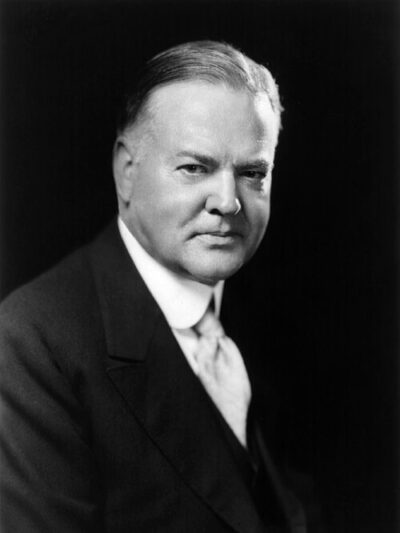
Herbert Hoover
Herbert Hoover was a president of the United States from 1929 to 1933. Born August 10, 1874, in Herbert Hoover National Historic Site. Died October 20, 1964, in Waldorf-Astoria Hotel (New York, N.Y.). Positions held include President of the United States (1929–1933), United States Secretary of Commerce (1921–1928) and Governor-General of the Philippines. Educated at George Fox University and Stanford University. Awards include John Fritz Medal, Horatio Alger Award and Hoover Medal.
Facts
46 facts · 2 confirmed by two sources · 17 cited · 26 from one source · 1 where the sources disagree
What’s different
- Cause of death: we show internal bleeding (Sources disagree). Wikidata also lists colorectal cancer
Where this comes from
Papalocal keeps its own record. It started from these sources; what each one said is kept here as it was copied, so a change on their side never changes this page by itself. Tap one to read its version.
What Wikidata says · copied November 13, 2026 · revision 2567578640
- Described as
- president of the United States from 1929 to 1933 (1874–1964)
- Other names
- H. Hoover, Herbert Clark Hoover, H. C. Hoover, Herbert C. Hoover, President Hoover
- Born
- August 10, 1874 · 15 references
- Died
- October 20, 1964 · 15 references
- Born in
- Herbert Hoover National Historic Site · 1 reference
- Died in
- Waldorf-Astoria Hotel (New York, N.Y.) · 1 reference
- Buried in
- Herbert Hoover Presidential Library and Museum
- Cause of death
- internal bleeding; colorectal cancer
- Name at birth
- Herbert Clark Hoover
- Citizen of
- United States
- Occupation
- politician · 2 references; engineer; writer; mining engineer · 1 reference; geologist; businessperson; statesperson; author · 1 reference
- Positions held
- President of the United States (1929–1933); United States Secretary of Commerce (1921–1928); Governor-General of the Philippines; President-elect of the United States (1928–1929); president · 1 reference
- Political party
- Republican Party
- Education
- George Fox University; Stanford University (1891–1895)
- Member of
- National Academy of Sciences; American Philosophical Society (1918–)
- Awards
- John Fritz Medal (1929) · 1 reference; Horatio Alger Award (1953) · 1 reference; Hoover Medal (1930); NAS Public Welfare Medal (1920) · 1 reference; honorary citizen of Tallinn (1920); Memorial medal of the Winter War · 1 reference; Washington Award (1919) · 1 reference; American Library Association Honorary Membership (1929) · 2 references; honorary doctor of the University of Lille (1938) · 1 reference; Honorary doctor of the University of Liège (1919) · 1 reference
- Spouse
- Lou Henry Hoover (1899–1944) · 1 reference
- Children
- Herbert Hoover, Jr. · 1 reference; Allan Hoover · 1 reference
- Father
- Jesse Hoover · 1 reference
- Mother
- Hulda Randall Minthorn · 1 reference
- Siblings
- Theodore Jesse Hoover
- Religion
- Episcopal Church
- Lived in
- Stanford; Hoover–Minthorn House · 1 reference
- Height
- 1.82 m (6 ft 0 in) · 1 reference
- Wikipedias with a page
- 164
Wikidata item Q35236 (wikidata.org/wiki/Q35236), public domain (CC0). Copied November 13, 2026.
What Wikipedia says · copied November 13, 2026 · revision 1384392939
Herbert Clark Hoover (August 10, 1874 – October 20, 1964) was the 31st president of the United States from 1929 to 1933. A member of the Republican Party, his presidency was dominated by the Great Depression, and his ineffectual response to the growing economic crisis made him widely unpopular. He lost reelection to Democratic nominee Franklin D. Roosevelt in 1932.
In 1895, Hoover became one of the first graduates of the new Stanford University. He took a position with a London-based mining company working in Australia and China. Hoover rapidly became a wealthy mining engineer and businessman. In 1914, during World War I, he organized and headed the Commission for Relief in Belgium, an international organization that provided food to occupied Belgium. When the U.S. entered the war in 1917, President Woodrow Wilson appointed Hoover to lead the United States Food Administration. He became famous as his country's "food dictator". After the war, Hoover led the American Relief Administration, which fed starving millions in Central and Eastern Europe, especially Russia. His wartime service made him a favorite of many progressives, and he unsuccessfully sought the Republican nomination in the 1920 United States presidential election.
Hoover served as Secretary of Commerce under presidents Warren G. Harding and Calvin Coolidge. Hoover was an unusually active and visible Cabinet member, becoming known as "Secretary of Commerce and Under-Secretary of all other departments." He was influential in the development of air travel and radio. Hoover led the federal response to the Great Mississippi Flood of 1927. He won the Republican nomination in the 1928 presidential election and defeated Democratic candidate Al Smith in a landslide. In 1929, Hoover assumed the presidency. However, during his first year in office, the stock market crashed, signaling the onset of the Great Depression. His response, including the Mexican Repatriation and the Smoot–Hawley Tariff Act, was widely seen as timid and inadequate. As the Depression deepened year after year and Hoovervilles formed around the country, he lost in a landslide to Democratic nominee Franklin D. Roosevelt in the 1932 presidential election.
Hoover's retirement lasted more than 31 years, one of the longest presidential retirements. He authored numerous works and became increasingly conservative, strongly criticizing Roosevelt's foreign policy and the New Deal. In the 1940s and 1950s, public opinion of Hoover improved, largely due to his service in various assignments for presidents Harry S. Truman and Dwight D. Eisenhower, including chairing the influential Hoover Commission for the reorganization of the federal bureaucracy.
Assessments of his presidency by historians and political scientists generally rank him as amongst the worst American presidents due to his inability to stabilize the economy, despite his effectiveness as a humanitarian and administrator.
- Born, in its opening lines
- August 10, 1874
- Died, in its opening lines
- October 20, 1964
From the Wikipedia article “Herbert Hoover” (en.wikipedia.org/wiki/Herbert_Hoover), by its contributors, under CC BY-SA 4.0 (creativecommons.org/licenses/by-sa/4.0/). Copied November 13, 2026; not changed.
Confirmed Two sources agree. Cited One source, and it names where it got it. One source One source, without a reference of its own. Sources disagree The sources disagree. We show the best-supported value and keep theirs below.
