
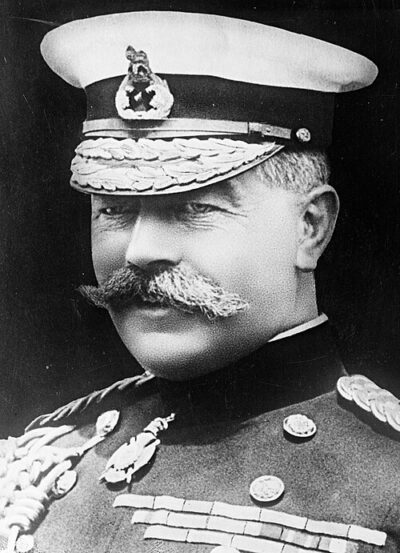
Horatio Kitchener, 1st Earl Kitchener
Horatio Kitchener, 1st Earl Kitchener was an Irish officer and colonial administrator in the British Army. Born June 24, 1850, in Ballylongford. Died June 5, 1916, in North Sea. Positions held include member of the House of Lords, Secretary of State for War (1914–1916) and Member of the Privy Council of the United Kingdom. Known for A trigonometrical survey of the island of Cyprus. Educated at Royal Military Academy, Woolwich. Awards include Knight of the Legion of Honour, Knight Grand Cross of the Order of the Bath and Knight Grand Cross of the Order of St Michael and St George.
Facts
40 facts · 2 confirmed by two sources · 18 cited · 20 from one source
Where this comes from
Papalocal keeps its own record. It started from these sources; what each one said is kept here as it was copied, so a change on their side never changes this page by itself. Tap one to read its version.
What Wikidata says · copied November 16, 2026 · revision 2567356385
- Described as
- Irish officer and colonial administrator in the British Army (1850–1916)
- Other names
- Horatio Herbert, Lord Kitchener of Khartoum, Horatio Kitchener, Horatio Herbert Kitchener, 1st Earl Kitchener, Lord Kitchener
- Born
- June 24, 1850 · 5 references
- Died
- June 5, 1916 · 5 references
- Born in
- Ballylongford · 2 references
- Died in
- North Sea
- Name at birth
- Horatio Herbert Kitchener
- Citizen of
- United Kingdom of Great Britain and Ireland
- Occupation
- politician · 1 reference; diplomat; engineer; military officer · 1 reference; director of land survey; army officer; Generalfeldmarschall · 1 reference; minister · 1 reference
- Positions held
- member of the House of Lords; Secretary of State for War (1914–1916); Member of the Privy Council of the United Kingdom; ambassador; defence minister · 1 reference
- Education
- Royal Military Academy, Woolwich (–1870) · 1 reference
- Known for
- A trigonometrical survey of the island of Cyprus
- Awards
- Knight of the Legion of Honour; Knight Grand Cross of the Order of the Bath · 1 reference; Knight Grand Cross of the Order of St Michael and St George · 1 reference; Order of the Garter · 1 reference; Livingstone Medal; Knight of St. Patrick · 1 reference; Knight Grand Commander of the Order of the Star of India · 1 reference; Knight Grand Commander of the Order of the Indian Empire · 1 reference; Grand Cross of the Legion of Honour · 1 reference; 1st class, Order of the Medjidie · 1 reference; 2nd class, Order of the Medjidie · 1 reference
- Father
- Henry Horatio Kitchener · 2 references
- Mother
- Frances Anne Chevallier · 2 references
- Siblings
- Frances Emily Jane Kitchener · 1 reference; Walter Kitchener
- Religion
- Anglicanism
- Military branch
- British Army · 1 reference
- Military rank
- field marshal · 1 reference; general · 1 reference
- Wikipedias with a page
- 56
Wikidata item Q216129 (wikidata.org/wiki/Q216129), public domain (CC0). Copied November 16, 2026.
What Wikipedia says · copied November 16, 2026 · revision 1385361580
Field Marshal Horatio Herbert Kitchener, 1st Earl Kitchener (; 24 June 1850 – 5 June 1916) was a British Army officer and colonial administrator. Kitchener came to prominence for his imperial campaigns, his involvement in the Second Boer War, and his central role in the early part of the First World War.
Kitchener was credited in 1898 for having won the Battle of Omdurman and securing control of the Sudan, for which he was made Baron Kitchener of Khartoum. As Chief of Staff (1900–1902) in the Second Boer War he played a key role in Lord Roberts' conquest of the Boer Republics, then succeeded Roberts as commander-in-chief – by which time Boer forces had taken to guerrilla fighting and British forces imprisoned Boer and African civilians in concentration camps. His term as commander-in-chief (1902–1909) of the Army in India saw him quarrel with another eminent proconsul, the viceroy Lord Curzon, who eventually resigned. Kitchener then returned to Egypt as British agent and consul-general (de facto administrator).
In 1914, at the start of the First World War, Kitchener became secretary of state for war, a cabinet minister. One of the few to foresee a long war, lasting for at least three years, and having the authority to act effectively on that perception, he organised the largest volunteer army that Britain had seen, and oversaw a significant expansion of material production to fight on the Western Front. Despite having warned of the difficulty of provisioning for a long war, he was blamed for the shortage of shells in the spring of 1915 – one of the events leading to the formation of a coalition government – and stripped of his control over munitions and strategy.
On 5 June 1916, Kitchener was making his way to Russia on HMS Hampshire to attend negotiations with Emperor Nicholas II when in bad weather the ship struck a German mine 1.5 miles (2.4 km) west of Orkney, Scotland, and sank. Kitchener was among 737 who died.
- Born, in its opening lines
- June 24, 1850
- Died, in its opening lines
- June 5, 1916
From the Wikipedia article “Herbert Kitchener, 1st Earl Kitchener” (en.wikipedia.org/wiki/Herbert_Kitchener,_1st_Earl_Kitchener), by its contributors, under CC BY-SA 4.0 (creativecommons.org/licenses/by-sa/4.0/). Copied November 16, 2026; not changed.
Confirmed Two sources agree. Cited One source, and it names where it got it. One source One source, without a reference of its own. Sources disagree The sources disagree. We show the best-supported value and keep theirs below.
