
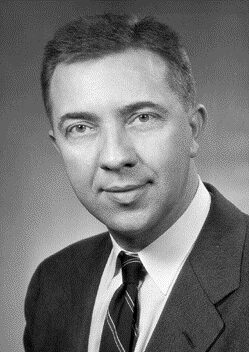
James A. Van Allen
James A. Van Allen was an American astrophysicist. Born September 7, 1914, in Mount Pleasant. Died August 9, 2006, in Iowa City. Known for Van Allen radiation belt and radio proximity fuze. Educated at University of Iowa and Iowa Wesleyan University. Awards include Guggenheim Fellowship, Elliott Cresson Medal and William Procter Prize for Scientific Achievement.
Facts
43 facts · 2 confirmed by two sources · 22 cited · 19 from one source
Where this comes from
Papalocal keeps its own record. It started from these sources; what each one said is kept here as it was copied, so a change on their side never changes this page by itself. Tap one to read its version.
What Wikidata says · copied November 13, 2026 · revision 2558472058
- Described as
- American astrophysicist (1914–2006)
- Other names
- James Alfred Van Allen, James Van Allen, J. A. Van Allen
- Born
- September 7, 1914 · 9 references
- Died
- August 9, 2006 · 11 references
- Born in
- Mount Pleasant · 1 reference
- Died in
- Iowa City · 1 reference
- Buried in
- Southampton Cemetery · 1 reference
- Cause of death
- heart failure
- Citizen of
- United States
- Occupation
- physicist · 2 references; astronomer; nuclear physicist; university teacher; earth scientist · 1 reference
- Worked for
- Carnegie Science (1939–1942) · 2 references; University of Iowa (1951–1985); Applied Physics Laboratory · 1 reference
- Education
- University of Iowa (1935–1939) · 1 reference; Iowa Wesleyan University (–1935) · 1 reference; Mount Pleasant Community High School · 1 reference
- Member of
- Royal Swedish Academy of Sciences; American Academy of Arts and Sciences; American Philosophical Society (1961–) · 1 reference; American Astronomical Society · 1 reference; American Physical Society · 1 reference; National Academy of Sciences (1959–) · 1 reference; International Astronomical Union
- Known for
- Van Allen radiation belt; radio proximity fuze · 1 reference
- Awards
- Guggenheim Fellowship (1946) · 1 reference; Elliott Cresson Medal (1961) · 1 reference; William Procter Prize for Scientific Achievement (1987) · 1 reference; Gold Medal of the Royal Astronomical Society (1978); National Medal of Science (1987); William Bowie Medal (1977) · 2 references; Gerard P. Kuiper Prize (1994) · 1 reference; Richtmyer Memorial Lecture Award (1960) · 1 reference; Time Person of the Year (1960); Vannevar Bush Award (1991); Crafoord Prize in Geosciences (1989) · 1 reference; John Adam Fleming Medal (1963) · 1 reference; International Space Hall of Fame (1984) · 2 references; Nevada Medal (1990) · 1 reference; Philip Hauge Abelson Prize (1985) · 1 reference
- Field
- astrophysics
- Wikipedias with a page
- 51
Wikidata item Q271963 (wikidata.org/wiki/Q271963), public domain (CC0). Copied November 13, 2026.
What Wikipedia says · copied November 13, 2026 · revision 1385462781
James Alfred Van Allen (September 7, 1914 – August 9, 2006) was an American space physicist at the University of Iowa who was instrumental in establishing the field of magnetospheric research in space. His discovery of the Van Allen radiation belts in 1958, zones of energetic charged particles trapped by Earth's magnetic field, was the first major scientific finding of the Space Age. As principal investigator for scientific instruments on 24 Earth satellites and planetary missions, Van Allen provided the first in situ measurements of the magnetospheres of Jupiter and Saturn, pioneered the use of energetic particle absorption signatures to detect planetary rings and satellites, and carried out a multi-decade program of cosmic ray observations that established the radial gradient of galactic cosmic ray intensity from 1 AU to beyond 65 AU in the heliosphere.
A member of the National Academy of Sciences (elected 1959), the American Philosophical Society, and the American Academy of Arts and Sciences, Van Allen received the National Medal of Science (1987), the Crafoord Prize from the Royal Swedish Academy of Sciences (1989), the Gold Medal of the Royal Astronomical Society (1978), and the Vannevar Bush Award (1991). Time magazine named him one of its Men of the Year in 1960. He led the scientific community in putting research instruments on space satellites and was a leading advocate for unmanned planetary exploration, chairing the Outer Space Panel that developed the scientific rationale for the Pioneer 10 and Pioneer 11 missions to the outer planets. He was also an outspoken critic of human spaceflight programs, arguing that robotic spacecraft yielded far greater scientific returns per dollar spent.
- Born, in its opening lines
- September 7, 1914
- Died, in its opening lines
- August 9, 2006
From the Wikipedia article “James Van Allen” (en.wikipedia.org/wiki/James_Van_Allen), by its contributors, under CC BY-SA 4.0 (creativecommons.org/licenses/by-sa/4.0/). Copied November 13, 2026; not changed.
Confirmed Two sources agree. Cited One source, and it names where it got it. One source One source, without a reference of its own. Sources disagree The sources disagree. We show the best-supported value and keep theirs below.
