
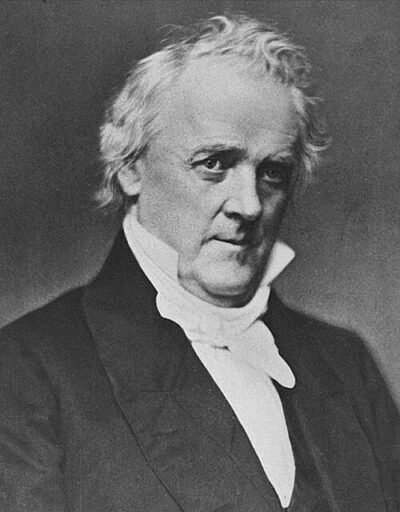
James Buchanan
James Buchanan was a president of the United States from 1857 to 1861. Born April 23, 1791, in Stony Batter. Died June 1, 1868, in Lancaster. Positions held include President of the United States (1857–1861), United States representative (1821–1831) and member of the Pennsylvania House of Representatives (1814–1816). Educated at Dickinson College.
Facts
31 facts · 2 confirmed by two sources · 9 cited · 20 from one source
Where this comes from
Papalocal keeps its own record. It started from these sources; what each one said is kept here as it was copied, so a change on their side never changes this page by itself. Tap one to read its version.
What Wikidata says · copied November 13, 2026 · revision 2567581871
- Described as
- president of the United States from 1857 to 1861
- Other names
- President Buchanan, J. Buchanan, James Buchanan, Jr., J. Buchanan, Jr.
- Born
- April 23, 1791 · 9 references
- Died
- June 1, 1868 · 9 references
- Born in
- Stony Batter · 1 reference
- Died in
- Lancaster · 2 references
- Buried in
- Woodward Hill Cemetery
- Cause of death
- respiratory failure
- Name at birth
- James Buchanan, Jr.
- Citizen of
- United States
- Occupation
- politician · 1 reference; diplomat · 1 reference; lawyer; statesperson; ambassador · 1 reference
- Positions held
- President of the United States (1857–1861); United States representative (1821–1831); member of the Pennsylvania House of Representatives (1814–1816); United States ambassador to the Russian Empire (1832–1833); United States Secretary of State (1845–1849); United States senator (1834–1845) · 1 reference; President-elect of the United States (1856–1857); senator · 1 reference
- Political party
- Democratic Party
- Education
- Dickinson College
- Field
- politics · 1 reference
- Father
- James Buchanan, Sr.
- Mother
- Elizabeth Speer Buchanan · 1 reference
- Siblings
- Edward Young Buchanan
- Religion
- Presbyterianism
- Military branch
- Pennsylvania National Guard (1814)
- Lived in
- Lancaster
- Height
- 1.83 m (6 ft 0 in) · 1 reference
- Wikipedias with a page
- 144
Wikidata item Q12325 (wikidata.org/wiki/Q12325), public domain (CC0). Copied November 13, 2026.
What Wikipedia says · copied November 13, 2026 · revision 1380954442
James Buchanan Jr. (April 23, 1791 – June 1, 1868) was the 15th president of the United States, serving from 1857 to 1861. A Democrat from Pennsylvania, he upheld a pro-slavery interpretation of the U.S. Constitution that did little to reverse the sectional crisis between the North and South. In his final months in office, seven Southern states seceded, forming the Confederacy. On April 12, 1861, Confederate forces attacked Fort Sumter, starting the American Civil War.
During his time as a member of the Federalist Party, Buchanan was elected to the Pennsylvania House of Representatives. He won five terms in the U.S. House of Representatives, aligning with the Democratic Party of Andrew Jackson. Buchanan was appointed Minister to Russia by President Jackson in 1832 and became a U.S. senator in 1834. Serving in the Senate until 1845, he became the 17th U.S. secretary of state under President James K. Polk, and served as Minister to Britain under President Franklin Pierce from 1853 to 1856.
Beginning in 1844, Buchanan became a regular contender for the Democratic Party's presidential nomination. He was nominated and won the 1856 presidential election. Before taking office as president, Buchanan intervened with the Supreme Court case of Dred Scott v. Sandford to secure its pro-slavery ruling, and this verdict was released two days after his inauguration. He supported efforts to admit the Kansas Territory into the Union as a slave state under the Lecompton Constitution. Buchanan honored his pledge to serve only one term and supported his vice president John C. Breckinridge's unsuccessful candidacy in the 1860 presidential election. He did not reconcile the fractured Democratic Party amid divisions involving Stephen A. Douglas, contributing to the election of Republican and former congressman Abraham Lincoln.
Buchanan's leadership during his lame duck period, before the American Civil War, has been widely criticized. He faced criticism from both the North and South during the secession crisis. Buchanan supported the Corwin Amendment in an effort to reconcile the country. He made an unsuccessful attempt to reinforce Fort Sumter, but otherwise took limited action to prepare the military. His failure to forestall the Civil War has been widely criticized, and he spent his last years defending his reputation. Historians and scholars rank him among the worst presidents in American history.
- Born, in its opening lines
- April 23, 1791
- Died, in its opening lines
- June 1, 1868
From the Wikipedia article “James Buchanan” (en.wikipedia.org/wiki/James_Buchanan), by its contributors, under CC BY-SA 4.0 (creativecommons.org/licenses/by-sa/4.0/). Copied November 13, 2026; not changed.
Confirmed Two sources agree. Cited One source, and it names where it got it. One source One source, without a reference of its own. Sources disagree The sources disagree. We show the best-supported value and keep theirs below.
