
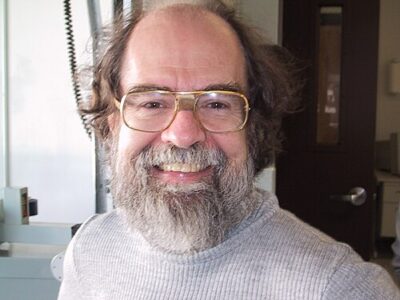
James E. Gunn is an American astronomer. Born October 21, 1938, in Livingston. Educated at California Institute of Technology and Rice University. Awards include Gruber Prize in Cosmology, Petrie Prize Lecture and Henry Norris Russell Lectureship.
Facts
26 facts · 1 confirmed by two sources · 17 cited · 8 from one source
Where this comes from
Papalocal keeps its own record. It started from these sources; what each one said is kept here as it was copied, so a change on their side never changes this page by itself. Tap one to read its version.
What Wikidata says · copied November 18, 2026 · revision 2559018502
- Described as
- American astronomer
- Other names
- James Gunn, James Edward Gunn, J. E. Gunn, J E Gunn, J.E. Gunn, JE Gunn, J. Gunn
- Born
- October 21, 1938 · 1 reference
- Born in
- Livingston · 1 reference
- Citizen of
- United States · 3 references
- Occupation
- astronomer; astrophysicist; university teacher
- Worked for
- Princeton University; University of California, Berkeley
- Education
- California Institute of Technology (–1966) · 1 reference; Rice University
- Member of
- National Academy of Sciences (1977–) · 1 reference; American Academy of Arts and Sciences (1977–) · 1 reference; International Astronomical Union
- Awards
- Gruber Prize in Cosmology (2005) · 1 reference; Petrie Prize Lecture (2001) · 1 reference; Henry Norris Russell Lectureship (2005) · 1 reference; Gold Medal of the Royal Astronomical Society (1994) · 1 reference; National Medal of Science (2008) · 1 reference; MacArthur Fellows Program (1983) · 1 reference; Dannie Heineman Prize for Astrophysics (1988) · 1 reference; Joseph Weber Award for Astronomical Instrumentation (2002) · 1 reference; Bruce Medal (2013) · 1 reference; Crafoord Prize in Astronomy (2005) · 1 reference; Kyoto Prize in Basic Sciences (2019) · 1 reference; Pilgrim Award (1976) · 1 reference
- Spouse
- Gillian R. Knapp
- Wikipedias with a page
- 17
Wikidata item Q1152925 (wikidata.org/wiki/Q1152925), public domain (CC0). Copied November 18, 2026.
What Wikipedia says · copied November 18, 2026 · revision 1381444421
James Edward Gunn (born October 21, 1938) is the Eugene Higgins Professor of Astronomy at Princeton University. Gunn's early theoretical work in astronomy has helped establish the current understanding of how galaxies form, and the properties of the space between galaxies. He also suggested important observational tests to confirm the presence of dark matter in galaxies, and predicted the existence of a Gunn–Peterson trough in the spectra of distant quasars.
Much of Gunn's later work has involved leadership in major observational projects. He developed plans for one of the first uses of digital camera technology for space observation, a project that led to the Sloan Digital Sky Survey, the most extensive three-dimensional mapping of the universe ever undertaken. He also played a major role with the Wide Field and Planetary Camera on the Hubble Space Telescope.
Gunn graduated from A.C. Jones High School in Beeville, Texas in 1957. He earned his bachelor's degree at Rice University in Houston, Texas, in 1961, and his Ph.D. from the California Institute of Technology (Caltech) in 1965. He joined the faculty of Princeton University two years later. Subsequently, he worked at the University of California at Berkeley and Caltech before returning to Princeton. He is married to the astronomer Gillian Knapp and they have two children, Humberto and Marleny Gunn.
- Born, in its opening lines
- October 21, 1938
From the Wikipedia article “James Gunn (astronomer)” (en.wikipedia.org/wiki/James_Gunn_(astronomer)), by its contributors, under CC BY-SA 4.0 (creativecommons.org/licenses/by-sa/4.0/). Copied November 18, 2026; not changed.
Confirmed Two sources agree. Cited One source, and it names where it got it. One source One source, without a reference of its own. Sources disagree The sources disagree. We show the best-supported value and keep theirs below.
