
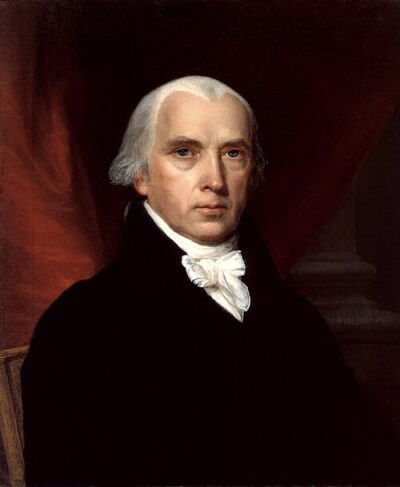
James Madison
James Madison was a President of the United States from 1809 to 1817. Born March 16, 1751, in Port Conway. Died June 28, 1836, in Montpelier. Positions held include Speaker of the United States House of Representatives (1793–1797), President of the United States (1809–1817) and Member of the United States House of Representatives from Virginia. Known for Federalist Papers. Educated at Princeton University. Awards include Fellow of the American Academy of Arts and Sciences.

Facts
37 facts · 2 confirmed by two sources · 11 cited · 24 from one source
Where this comes from
Papalocal keeps its own record. It started from these sources; what each one said is kept here as it was copied, so a change on their side never changes this page by itself. Tap one to read its version.
What Wikidata says · copied November 13, 2026 · revision 2567583775
- Described as
- President of the United States from 1809 to 1817 (1751–1836)
- Other names
- James Madison Jr., President Madison, President James Madison, James Madison, Jr.
- Born
- March 16, 1751 · 4 references
- Died
- June 28, 1836 · 8 references
- Born in
- Port Conway · 1 reference
- Died in
- Montpelier
- Buried in
- Montpelier
- Cause of death
- heart failure
- Name at birth
- James Madison, Jr.
- Citizen of
- United States
- Occupation
- politician · 2 references; writer · 1 reference; diplomat; philosopher; lawyer; statesperson; plantation owner · 1 reference
- Positions held
- Speaker of the United States House of Representatives (1793–1797); President of the United States (1809–1817); Member of the United States House of Representatives from Virginia; United States Secretary of State (1801–1809); President-elect of the United States (1808–1809); United States representative · 1 reference; member of the Virginia House of Delegates · 1 reference; Delegate to the United States Constitutional Convention (1787) · 1 reference
- Political party
- Democratic-Republican Party
- Education
- Princeton University (1769–1771)
- Member of
- American Philosophical Society (1785–); American Academy of Arts and Sciences; American Antiquarian Society
- Known for
- Federalist Papers
- Awards
- Fellow of the American Academy of Arts and Sciences
- Spouse
- Dolley Madison (1794–1836) · 2 references
- Father
- James Madison, Sr. · 1 reference
- Mother
- Eleanor Rose Conway · 2 references
- Siblings
- Ambrose Madison · 1 reference
- Religion
- Episcopal Church; deism · 1 reference
- Height
- 1.63 m (5 ft 4 in); 1.63 m (5 ft 4 in) · 1 reference
- Wikipedias with a page
- 177
Wikidata item Q11813 (wikidata.org/wiki/Q11813), public domain (CC0). Copied November 13, 2026.
What Wikipedia says · copied November 13, 2026 · revision 1384294529
James Madison (March 16, 1751 [O.S. March 5, 1750] – June 28, 1836) was a Founding Father and the fourth president of the United States from 1809 to 1817. Before his presidency, Madison was a statesman and diplomat. Madison was popularly acclaimed as the "Father of the Constitution" for his pivotal role in drafting and promoting the Constitution of the United States and the Bill of Rights.
Madison was born into a prominent slave-owning planter family in Virginia. In 1774, strongly opposed to British taxation, Madison joined with the Patriots. He was a member of both the Virginia House of Delegates and the Continental Congress during and after the American Revolutionary War. Dissatisfied with the weak national government established by the Articles of Confederation, he helped organize the Constitutional Convention, which produced a new constitution designed to strengthen republican government against democratic assembly. Madison's Virginia Plan was the basis for the convention's deliberations. He became one of the leaders in the movement to ratify the Constitution and joined Alexander Hamilton and John Jay in writing The Federalist Papers, a series of pro-ratification essays that remain prominent among works of political science in American history.
Madison emerged as an important leader in the House of Representatives and was a close adviser to President George Washington. During the early 1790s, Madison opposed the economic program and the accompanying centralization of power favored by Secretary of the Treasury Hamilton. Alongside Thomas Jefferson, he organized the Democratic–Republican Party in opposition to Hamilton's Federalist Party. Madison served as Jefferson's Secretary of State from 1801 to 1809, during which time he helped convince Jefferson to submit the Louisiana Purchase Treaty for approval by the Senate.
Madison was elected president in 1808. Motivated by a desire to acquire land held by Britain, Spain, and Native Americans, and after diplomatic protests with a trade embargo failed to end British seizures of American-shipped goods, Madison led the United States into the War of 1812. Madison was re-elected in the 1812 election, which was held during wartime. The war convinced Madison of the necessity of a stronger federal government. Although the war ended inconclusively in 1815, many Americans viewed it as a successful "second war of independence" against Britain which bolstered Madison's popularity. He presided over the creation of the Second Bank of the United States and the enactment of the protective Tariff of 1816. The United States acquired
26,000,000 acres (110,000 km2) of land through treaties or war from Native American tribes during Madison's presidency.
Retiring from public office at the end of his presidency in 1817, Madison returned to his plantation, Montpelier, where he died in 1836. Madison was a slave owner; he freed one slave in 1783 to prevent a slave rebellion at Montpelier but did not free any in his will. Historians regard Madison as one of the most significant Founding Fathers of the United States, and have generally ranked him as an above-average president, although they are critical of his endorsement of slavery and his leadership during the War of 1812. Madison's name is commemorated in many landmarks across the nation, with prominent examples including Madison Square Garden, James Madison University, the James Madison Memorial Building, the capital city of Wisconsin, and the USS James Madison.
- Born, in its opening lines
- March 16, 1751
- Died, in its opening lines
- June 28, 1836
From the Wikipedia article “James Madison” (en.wikipedia.org/wiki/James_Madison), by its contributors, under CC BY-SA 4.0 (creativecommons.org/licenses/by-sa/4.0/). Copied November 13, 2026; not changed.
Confirmed Two sources agree. Cited One source, and it names where it got it. One source One source, without a reference of its own. Sources disagree The sources disagree. We show the best-supported value and keep theirs below.
