
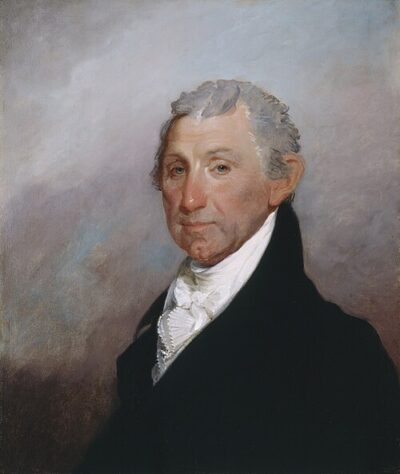
James Monroe
James Monroe was a president of the United States from 1817 to 1825. Born April 28, 1758, in Monroe Hall. Died July 4, 1831, in New York City. Positions held include President of the United States (1817–1825), United States Secretary of War (1814–1815) and United States Secretary of State (1811–1817). Educated at College of William & Mary.
Facts
37 facts · 2 confirmed by two sources · 15 cited · 20 from one source
Where this comes from
Papalocal keeps its own record. It started from these sources; what each one said is kept here as it was copied, so a change on their side never changes this page by itself. Tap one to read its version.
What Wikipedia says · copied November 13, 2026 · revision 1384362497
James Monroe (April 28, 1758 – July 4, 1831) was a Founding Father and the fifth president of the United States, serving from 1817 to 1825. He was the last Founding Father to serve as president. A member of the Democratic-Republican Party, his presidency coincided with the Era of Good Feelings, in which the First Party System of American politics ended with the collapse of the Federalist Party. He also issued the Monroe Doctrine, which deemed any form of foreign interference in the Western Hemisphere as a hostile act against the United States, and his doctrine continues to be denounced, reinstated, and reinterpreted into the 21st century.
During the American Revolutionary War, he served in the Continental Army. From 1780 to 1783, Monroe studied law under Thomas Jefferson and subsequently served as a delegate to both the Continental Congress and the Virginia Ratifying Convention. He opposed the ratification of the United States Constitution. In 1790, Monroe won election to the Senate where he became a leader of the Democratic-Republican Party. He left the Senate in 1794 to serve as President George Washington's ambassador to France but was recalled by Washington in 1796. Monroe won the election as Governor of Virginia in 1799 and strongly supported Jefferson's candidacy in the 1800 presidential election.
As President Jefferson's special envoy, Monroe helped negotiate the Louisiana Purchase, through which the United States nearly doubled in size. Monroe fell out with his longtime friend James Madison after Madison rejected the Monroe–Pinkney Treaty that Monroe negotiated with Britain. He unsuccessfully challenged Madison for the Democratic-Republican nomination in the 1808 presidential election, and he joined Madison's administration as Secretary of State in 1811. During the later stages of the War of 1812, Monroe simultaneously served as Madison's Secretary of State and Secretary of War. Monroe's wartime leadership established him as Madison's heir apparent, and he easily defeated Federalist candidate Rufus King in the 1816 presidential election.
During Monroe's tenure as president, the Federalist Party collapsed as a national political force and Monroe was re-elected, virtually unopposed, in 1820. As president, he signed the Missouri Compromise, which admitted Missouri as a slave state and banned slavery from territories north of the 36°30′ parallel. In foreign affairs, Monroe and Secretary of State John Quincy Adams favored a policy of conciliation with Britain and a policy of expansionism against the Spanish Empire. In the 1819 Adams–Onís Treaty with Spain, the United States secured Florida and established its western border with New Spain. In 1823, Monroe announced the United States' opposition to any European intervention in the recently independent countries of the Americas with the Monroe Doctrine, which became a landmark in American foreign policy. Monroe was a member of the American Colonization Society which supported the colonization of Africa by freed slaves, and Liberia's capital of Monrovia is named in his honor. Following his retirement in 1825, he was plagued by financial difficulties and died on July 4, 1831, in New York City. Historians have generally ranked him as an above-average president.
- Born, in its opening lines
- April 28, 1758
- Died, in its opening lines
- July 4, 1831
From the Wikipedia article “James Monroe” (en.wikipedia.org/wiki/James_Monroe), by its contributors, under CC BY-SA 4.0 (creativecommons.org/licenses/by-sa/4.0/). Copied November 13, 2026; not changed.
What Wikidata says · copied November 14, 2026 · revision 2568914031
- Described as
- president of the United States from 1817 to 1825 (1758–1831)
- Other names
- J. Monroe, President Monroe
- Born
- April 28, 1758 · 10 references
- Died
- July 4, 1831 · 10 references
- Born in
- Monroe Hall · 1 reference
- Died in
- New York City · 2 references
- Buried in
- Hollywood Cemetery · 1 reference
- Cause of death
- tuberculosis
- Citizen of
- United States
- Occupation
- politician · 3 references; lawyer; diplomat; farmer; statesperson; writer · 1 reference; governor · 1 reference
- Positions held
- President of the United States (1817–1825); United States Secretary of War (1814–1815); United States Secretary of State (1811–1817); Governor of Virginia (1799–1802); United States Ambassador to the United Kingdom (1803–1807); United States Ambassador to France (1794–1796); United States senator (1790–1794) · 1 reference; President-elect of the United States (1816–1817); member of the Virginia House of Delegates · 1 reference
- Political party
- Democratic-Republican Party
- Education
- College of William & Mary
- Member of
- American Antiquarian Society
- Spouse
- Elizabeth Monroe (1786–1830) · 2 references
- Children
- Maria Hester Monroe Gouverneur · 1 reference; Eliza Kortright Monroe Hay · 2 references; James Spence Monroe · 2 references
- Father
- Spence Monroe · 1 reference
- Mother
- Elizabeth Jones · 2 references
- Siblings
- Andrew Monroe · 1 reference
- Religion
- Episcopal Church
- Military branch
- Continental Army
- Military rank
- Major · 1 reference
- Height
- 1.82 m (6 ft 0 in)
- Wikipedias with a page
- 158
Wikidata item Q11815 (wikidata.org/wiki/Q11815), public domain (CC0). Copied November 14, 2026.
Confirmed Two sources agree. Cited One source, and it names where it got it. One source One source, without a reference of its own. Sources disagree The sources disagree. We show the best-supported value and keep theirs below.
