
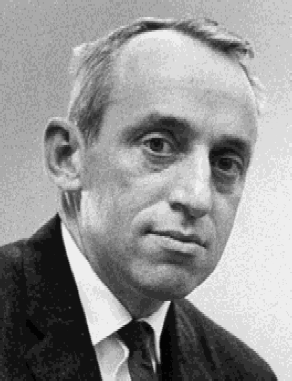
James Tobin
James Tobin was an American economist. Born March 5, 1918, in Champaign. Died March 11, 2002, in New Haven. Positions held include president (1971–1972). Educated at Harvard University and University Laboratory High School. Awards include Adam Smith Award, John Bates Clark Medal and Harvard Centennial Medal.
Facts
39 facts · 2 confirmed by two sources · 12 cited · 25 from one source
Where this comes from
Papalocal keeps its own record. It started from these sources; what each one said is kept here as it was copied, so a change on their side never changes this page by itself. Tap one to read its version.
What Wikidata says · copied November 13, 2026 · revision 2564337104
- Described as
- American economist (1918–2002)
- Born
- March 5, 1918 · 7 references
- Died
- March 11, 2002 · 8 references
- Born in
- Champaign · 1 reference
- Died in
- New Haven · 4 references
- Buried in
- Saint Lukes Cemetery · 1 reference
- Cause of death
- cerebrovascular disease
- Citizen of
- United States · 2 references
- Occupation
- economist · 1 reference; statistician; professor · 3 references; military personnel; university teacher · 1 reference
- Positions held
- president (1971–1972)
- Worked for
- Yale University
- Education
- Harvard University (–1947) · 2 references; University Laboratory High School · 1 reference; University of Illinois Urbana-Champaign · 1 reference
- Member of
- American Academy of Arts and Sciences; National Academy of Sciences; Econometric Society (1952–) · 1 reference; American Philosophical Society (1959–)
- Awards
- Adam Smith Award (1990); John Bates Clark Medal (1955); Harvard Centennial Medal; Prize in Economic Sciences in Memory of Alfred Nobel (1981) · 1 reference; Sterling Professor; Order of the Sacred Treasure; Distinguished Fellow of the American Economic Association; Fellow of the Econometric Society (1952) · 1 reference; Fellow of the American Statistical Association (1958) · 1 reference; honorary doctor from the NOVA University Lisbon; National Book Critics Circle Award in Biography (1997); Fisher-Schultz Lecture
- Field
- economics; macroeconomics · 1 reference
- Children
- Christina Tobin
- Military branch
- United States Navy
- Military rank
- soldier
- Lived in
- Champaign
- Wikipedias with a page
- 61
Wikidata item Q211776 (wikidata.org/wiki/Q211776), public domain (CC0). Copied November 13, 2026.
What Wikipedia says · copied November 13, 2026 · revision 1379800342
James Tobin (March 5, 1918 – March 11, 2002) was an American economist who served on the Council of Economic Advisers and consulted with the Board of Governors of the Federal Reserve System, and taught at Yale University. He contributed to the development of key ideas in the Keynesian economics of his generation and advocated government intervention in particular to stabilize output and avoid recessions. His academic work included pioneering contributions to the study of investment, monetary and fiscal policy and financial markets. He also proposed an econometric model for censored dependent variables, the well-known tobit model.
Along with fellow neo-Keynesian economist James Meade in 1977, Tobin proposed nominal GDP targeting as a monetary policy rule in 1980. Tobin received the Nobel Memorial Prize in Economic Sciences in 1981 for "creative and extensive work on the analysis of financial markets and their relations to expenditure decisions, employment, production and prices."
Outside academia, Tobin was widely known for his suggestion of a tax on foreign exchange transactions, now known as the "Tobin tax." This was designed to reduce speculation in the international currency markets, which he saw as dangerous and unproductive.
- Born, in its opening lines
- March 5, 1918
- Died, in its opening lines
- March 11, 2002
From the Wikipedia article “James Tobin” (en.wikipedia.org/wiki/James_Tobin), by its contributors, under CC BY-SA 4.0 (creativecommons.org/licenses/by-sa/4.0/). Copied November 13, 2026; not changed.
Confirmed Two sources agree. Cited One source, and it names where it got it. One source One source, without a reference of its own. Sources disagree The sources disagree. We show the best-supported value and keep theirs below.
