
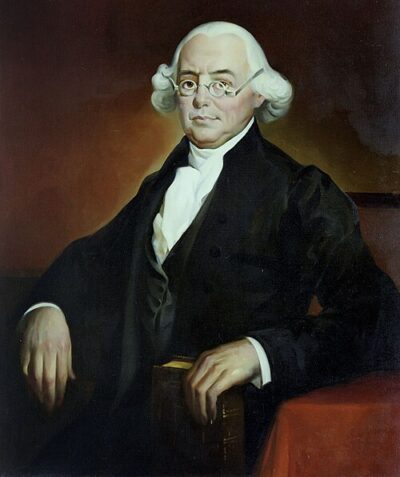
James Wilson
James Wilson was a Justice on the US Supreme Court. Born September 14, 1742, in Ceres. Died August 21, 1798, in Edenton. Positions held include Associate Justice of the Supreme Court of the United States (1790–1795) and Delegate to the United States Constitutional Convention (1787). Educated at University of Edinburgh and University of Glasgow.
Facts
19 facts · 2 confirmed by two sources · 6 cited · 11 from one source
Where this comes from
Papalocal keeps its own record. It started from these sources; what each one said is kept here as it was copied, so a change on their side never changes this page by itself. Tap one to read its version.
What Wikidata says · copied November 15, 2026 · revision 2554031245
- Described as
- Justice on the US Supreme Court (1742-1798)
- Born
- September 14, 1742 · 4 references
- Died
- August 21, 1798 · 2 references
- Born in
- Ceres
- Died in
- Edenton
- Buried in
- Christ Church
- Cause of death
- stroke
- Citizen of
- United States · 3 references
- Occupation
- judge · 1 reference; politician · 1 reference; jurist · 1 reference
- Positions held
- Associate Justice of the Supreme Court of the United States (1790–1795) · 1 reference; Delegate to the United States Constitutional Convention (1787) · 1 reference
- Political party
- Federalist Party
- Worked for
- University of Pennsylvania
- Education
- University of Edinburgh; University of Glasgow; University of St Andrews
- Member of
- American Philosophical Society
- Spouse
- Hannah Gray Wilson Bartlett
- Wikipedias with a page
- 27
Wikidata item Q365181 (wikidata.org/wiki/Q365181), public domain (CC0). Copied November 15, 2026.
What Wikipedia says · copied November 15, 2026 · revision 1383145179
James Wilson (September 14, 1742 – August 21, 1798) was a Scottish American Founding Father, legal scholar, jurist, and statesman who served as an associate justice of the United States Supreme Court from 1789 to 1798. Wilson was elected twice to the Continental Congress, and was a signatory of the Declaration of Independence. In 1787 he was a major participant in drafting the U.S. Constitution, and became one of only six people to sign both documents. A leading legal theorist, he was one of the first four Associate Justices appointed to the Supreme Court by George Washington.
In his capacity as the first professor of law at the College of Philadelphia (a year after he was appointed as a professor at the College of Philadelphia, the college merged with University of the State of Pennsylvania to become the University of Pennsylvania), he taught the first course on the new Constitution to President Washington and his Cabinet in 1789 and 1790 and continued as a professor of law at Penn until his death in 1798.
Born near Leven, Fife, Scotland, Wilson immigrated to Philadelphia in 1766 and became a teacher at the College of Philadelphia. After studying law under John Dickinson, he was admitted to the bar and set up legal practice in Reading, Pennsylvania. He wrote a well-received pamphlet arguing that the British Parliament's taxation of the Thirteen Colonies was illegitimate because the colonies lacked representation in Parliament. In 1775, he was elected to the Continental Congress, where he signed the Declaration of Independence the next year. In addition to his roles in public service, Wilson served as president of the Illinois-Wabash Company, a land speculation venture.
Wilson was a delegate to the 1787 Constitutional Convention in Philadelphia, where he was a member of the Committee of Detail which produced the first draft of the Constitution. He was the principal architect of the executive branch of the federal government and was an outspoken supporter of greater participatory democracy, a strong national government, and proportional legislative representation based on population. Along with Roger Sherman and Charles Pinckney, he proposed the Three-fifths Compromise, which counted three-fifths of each state's slave population toward that state's total population for the purposes of representation in the United States House of Representatives. While preferring the direct election of the president through a national popular vote, he proposed the use of an electoral college, which provided the basis of the Electoral College system ultimately adopted by the convention. Following the convention, Wilson campaigned for the Constitution's ratification, and his "speech in the statehouse yard" was reprinted in newspapers throughout the country. However, he opposed the Bill of Rights. Wilson also played a major role in drafting the 1790 Pennsylvania Constitution.
In 1789, Wilson joined the Supreme Court and also was named a professor of law on the faculty at the College of Philadelphia. Wilson experienced financial ruin in the Panic of 1796–1797 and was sent to debtors' prison on two occasions. In August 1798, he suffered a stroke, becoming the first U.S. Supreme Court justice to die.
- Born, in its opening lines
- September 14, 1742
- Died, in its opening lines
- August 21, 1798
From the Wikipedia article “James Wilson (Founding Father)” (en.wikipedia.org/wiki/James_Wilson_(Founding_Father)), by its contributors, under CC BY-SA 4.0 (creativecommons.org/licenses/by-sa/4.0/). Copied November 15, 2026; not changed.
Confirmed Two sources agree. Cited One source, and it names where it got it. One source One source, without a reference of its own. Sources disagree The sources disagree. We show the best-supported value and keep theirs below.
