
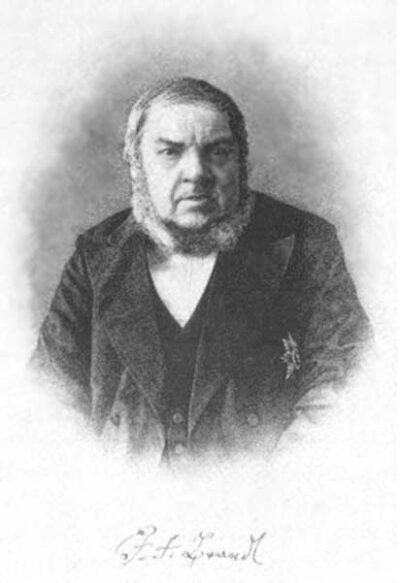
Johann Friedrich von Brandt
Johann Friedrich von Brandt was a German naturalist. Born May 25, 1802, in Jüterbog. Died July 3, 1879, in Meriküla. Educated at Humboldt-Universität zu Berlin and Martin Luther University Halle-Wittenberg. Awards include Order of Saint Anna, 1st class, Order of Saint Anna, 2nd class and Order of the White Eagle.
Facts
43 facts · 1 confirmed by two sources · 18 cited · 23 from one source · 1 where the sources disagree
What’s different
- Died: we show July 3, 1879 (Sources disagree). Wikipedia says July 15, 1879
Where this comes from
Papalocal keeps its own record. It started from these sources; what each one said is kept here as it was copied, so a change on their side never changes this page by itself. Tap one to read its version.
What Wikidata says · copied November 16, 2026 · revision 2569127635
- Described as
- German naturalist (1802–1879)
- Born
- May 25, 1802 · 5 references
- Died
- July 3, 1879 · 3 references
- Born in
- Jüterbog · 4 references
- Died in
- Meriküla · 3 references
- Buried in
- Smolensky Lutheran Cemetery · 1 reference
- Citizen of
- Kingdom of Prussia; Russian Empire
- Occupation
- ornithologist; zoologist · 1 reference; botanist · 1 reference; naturalist · 1 reference; entomologist; university teacher; carcinologist; ichthyologist
- Worked for
- Humboldt-Universität zu Berlin; Zoological Museum of the Zoological Institute of the Russian Academy of Sciences (1831–1879) · 1 reference; Main Pedagogical Institute (1843–1859) · 1 reference; S. M. Kirov Military Medical Academy (1857–1869) · 1 reference
- Education
- Humboldt-Universität zu Berlin; Martin Luther University Halle-Wittenberg · 1 reference
- Member of
- German Academy of Sciences Leopoldina (1833–) · 1 reference; Russian Academy of Sciences · 1 reference; French Academy of Sciences; Royal Prussian Academy of Sciences; Academy of Sciences of Turin (1840–) · 1 reference
- Awards
- Order of Saint Anna, 1st class; Order of Saint Anna, 2nd class; Order of the White Eagle; Order of Saint Stanislaus, 1st class; Order of Saint Stanislaus, 2nd class; Order of St. Vladimir, 4th class; Order of St. Vladimir, 3rd class; Order of St. Vladimir, 2nd class
- Field
- zoology; natural science · 1 reference; medicine · 1 reference; botany · 1 reference
- Spouse
- Auguste Brandt · 1 reference
- Children
- Alexander Brandt · 1 reference; Roman Brandt · 1 reference; Marie Amalie Radde · 1 reference; Emilie von Harold · 1 reference
- Wikipedias with a page
- 38
Wikidata item Q57361 (wikidata.org/wiki/Q57361), public domain (CC0). Copied November 16, 2026.
What Wikipedia says · copied November 16, 2026 · revision 1378756050
Johann Friedrich von Brandt (25 May 1802 – 15 July 1879) was a German-Russian naturalist, who worked mostly in Russia.
Brandt was born in Jüterbog and educated at a gymnasium in Wittenberg and the University of Berlin.
In 1831 he emigrated to Russia, and soon was appointed director of the Zoological Museum of the St Petersburg Academy of Sciences. Brandt encouraged the collection of native animals, many of which were not represented in the museum. Many specimens began to arrive from the expeditions of Severtzov, Przhevalsky, Middendorff, Schrenck and Gustav Radde.
He described several birds collected by Russian explorers off the Pacific Coast of North America, including Brandt's cormorant, red-legged kittiwake and spectacled eider.
As a paleontologist, Brandt ranks among the best. He was also an entomologist, specialising in Coleoptera (beetles) and Diplopoda (millipedes).
He died in Merreküll, Governorate of Estonia.
He is also commemorated in Brandt's bat, Brandt's hedgehog, three other species of mammals, and the lizard Iranolacerta brandtii.
- Born, in its opening lines
- May 25, 1802
- Died, in its opening lines
- July 15, 1879
From the Wikipedia article “Johann Friedrich von Brandt” (en.wikipedia.org/wiki/Johann_Friedrich_von_Brandt), by its contributors, under CC BY-SA 4.0 (creativecommons.org/licenses/by-sa/4.0/). Copied November 16, 2026; not changed.
Confirmed Two sources agree. Cited One source, and it names where it got it. One source One source, without a reference of its own. Sources disagree The sources disagree. We show the best-supported value and keep theirs below.
