
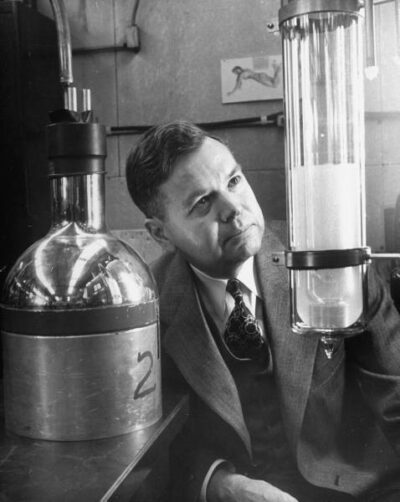
John C. Slater
John C. Slater was an American physicist. Born December 22, 1900, in Oak Park. Died July 25, 1976, in Sanibel. Educated at Harvard University and University of Rochester. Awards include Guggenheim Fellowship, National Medal of Science and Josiah Willard Gibbs Lectureship.
Facts
28 facts · 2 confirmed by two sources · 11 cited · 15 from one source
Where this comes from
Papalocal keeps its own record. It started from these sources; what each one said is kept here as it was copied, so a change on their side never changes this page by itself. Tap one to read its version.
What Wikidata says · copied November 15, 2026 · revision 2530905778
- Described as
- American physicist (1900–1976)
- Other names
- John Slater, John Clarke Slater, John Clarks Slater, J. C. Slater
- Born
- December 22, 1900 · 4 references
- Died
- July 25, 1976 · 2 references
- Born in
- Oak Park · 2 references
- Died in
- Sanibel
- Citizen of
- United States
- Occupation
- physicist · 1 reference; university teacher; theoretical chemist; chemist · 2 references
- Worked for
- University of Florida; Massachusetts Institute of Technology · 1 reference; Harvard University · 1 reference
- Education
- Harvard University (1923) · 1 reference; University of Rochester · 1 reference
- Member of
- Royal Swedish Academy of Sciences; International Academy of Quantum Molecular Science; American Academy of Arts and Sciences; National Academy of Sciences; American Philosophical Society (1940–)
- Awards
- Guggenheim Fellowship (1929) · 1 reference; National Medal of Science (1970); Josiah Willard Gibbs Lectureship (1945); Richtmyer Memorial Lecture Award (1951) · 1 reference; Fellow of the American Physical Society; Irving Langmuir Award in Chemical Physics (1967) · 2 references
- Field
- physics · 1 reference; chemistry · 1 reference
- Spouse
- Rose Mooney-Slater
- Wikipedias with a page
- 25
Wikidata item Q711519 (wikidata.org/wiki/Q711519), public domain (CC0). Copied November 15, 2026.
What Wikipedia says · copied November 15, 2026 · revision 1380517372
John Clarke Slater (December 22, 1900 – July 25, 1976) was an American physicist who advanced the theory of the electronic structure of atoms, molecules and solids. He also made major contributions to microwave electronics. He received a B.S. in physics from the University of Rochester in 1920 and a Ph.D. in physics from Harvard University in 1923, then did post-doctoral work at the universities of Cambridge (briefly) and Copenhagen. On his return to the U.S. he joined the physics department at Harvard.
In 1930, Karl Compton, the president of the Massachusetts Institute of Technology, appointed Slater as chairman of MIT's department of physics. He recast the undergraduate physics curriculum, wrote 14 books between 1933 and 1968, and built a department of international prestige. During World War II, his work on microwave transmission, done partly at the Bell Laboratories and in association with the MIT Radiation Laboratory, was significant in the development of radar.
In 1950, Slater founded the Solid State and Molecular Theory Group (SSMTG) within the physics department. The following year, he resigned the chairmanship of the department and spent a year at the Brookhaven National Laboratory of the Atomic Energy Commission. He was appointed Institute Professor of Physics and continued to direct work in the SSMTG until he retired from MIT in 1965, at the mandatory retirement age of 65.
He then joined the Quantum Theory Project of the University of Florida as research professor, where the retirement age allowed him to work for another five years. The SSMTG has been regarded as the precursor of the MIT Center for Materials Science and Engineering (CMSE). His scientific autobiography and three interviews present his views on research, education and the role of science in society.
Slater was nominated for the Nobel Prize, in both physics and chemistry, multiple times, and received the National Medal of Science in 1970. In 1964, Slater and his then-92-year-old father, who had headed the Department of English at the University of Rochester many years earlier, were awarded honorary degrees by that university. Slater's name is part of the terms Bohr–Kramers–Slater theory, Slater determinant and Slater orbital.
- Born, in its opening lines
- December 22, 1900
- Died, in its opening lines
- July 25, 1976
From the Wikipedia article “John C. Slater” (en.wikipedia.org/wiki/John_C._Slater), by its contributors, under CC BY-SA 4.0 (creativecommons.org/licenses/by-sa/4.0/). Copied November 15, 2026; not changed.
Confirmed Two sources agree. Cited One source, and it names where it got it. One source One source, without a reference of its own. Sources disagree The sources disagree. We show the best-supported value and keep theirs below.
