
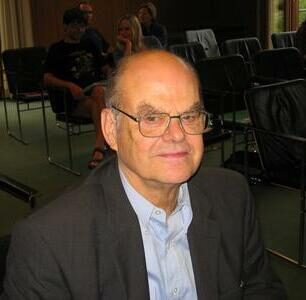
John G. Thompson
John G. Thompson is an American mathematician. Born October 13, 1932, in Ottawa. Positions held include Rouse Ball Professor of Mathematics (1971–1993). Known for Feit–Thompson theorem, Feit–Thompson conjecture and Thompson uniqueness theorem. Educated at Yale University and University of Chicago. Awards include Fields medal, Fellow of the Royal Society and Abel Prize.
Facts
38 facts · 1 confirmed by two sources · 15 cited · 22 from one source
Where this comes from
Papalocal keeps its own record. It started from these sources; what each one said is kept here as it was copied, so a change on their side never changes this page by itself. Tap one to read its version.
What Wikidata says · copied November 13, 2026 · revision 2566837864
- Described as
- American mathematician
- Other names
- John Griggs Thompson
- Born
- October 13, 1932 · 3 references
- Born in
- Ottawa
- Name at birth
- John Griggs Thompson · 1 reference
- Citizen of
- United States
- Occupation
- mathematician · 1 reference; university teacher
- Positions held
- Rouse Ball Professor of Mathematics (1971–1993) · 1 reference
- Worked for
- Harvard University (1959–1962) · 2 references; University of Chicago (1962–1968) · 1 reference; University of Cambridge (1968–1993) · 1 reference; University of Florida (1993–) · 1 reference
- Education
- Yale University (–1955) · 1 reference; University of Chicago (1955–1959) · 1 reference; Ottawa High School · 1 reference
- Member of
- Royal Society of London (1979–); Norwegian Academy of Science and Letters; National Academy of Sciences (1971–); American Academy of Arts and Sciences; Accademia Nazionale dei Lincei (1985–) · 1 reference
- Known for
- Feit–Thompson theorem; Feit–Thompson conjecture; Thompson uniqueness theorem; Thompson transitivity theorem; Thompson factorization; Thompson order formula; Thompson subgroup
- Awards
- Fields medal (1970) · 1 reference; Fellow of the Royal Society (1979) · 1 reference; Abel Prize (2008) · 1 reference; National Medal of Science (2000) · 1 reference; De Morgan Medal (2013); Cole Prize in Algebra (1965) · 1 reference; Sylvester Medal (1985); Henri Poincaré Prize (1992); Wolf Prize in Mathematics (1992) · 1 reference; Senior Berwick Prize (1982) · 1 reference
- Field
- group theory; mathematics
- Wikipedias with a page
- 41
Wikidata item Q313168 (wikidata.org/wiki/Q313168), public domain (CC0). Copied November 13, 2026.
What Wikipedia says · copied November 13, 2026 · revision 1372023113
John Griggs Thompson (born October 13, 1932) is an American mathematician at the University of Florida noted for his work in the field of finite groups. He was awarded the Fields Medal in 1970, the Wolf Prize in 1992, and the Abel Prize in 2008.
- Born, in its opening lines
- October 13, 1932
From the Wikipedia article “John G. Thompson” (en.wikipedia.org/wiki/John_G._Thompson), by its contributors, under CC BY-SA 4.0 (creativecommons.org/licenses/by-sa/4.0/). Copied November 13, 2026; not changed.
Confirmed Two sources agree. Cited One source, and it names where it got it. One source One source, without a reference of its own. Sources disagree The sources disagree. We show the best-supported value and keep theirs below.
