
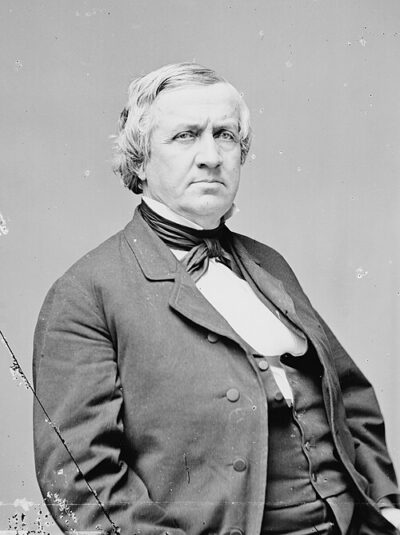
John P. Hale
John P. Hale was an American politician. Born March 31, 1806, in Rochester. Died November 19, 1873, in Dover. Positions held include United States representative (1843–1845), United States Ambassador to Spain (1865–1869) and member of the New Hampshire House of Representatives. Educated at Bowdoin College and Phillips Exeter Academy.
Facts
24 facts · 2 confirmed by two sources · 7 cited · 15 from one source
Where this comes from
Papalocal keeps its own record. It started from these sources; what each one said is kept here as it was copied, so a change on their side never changes this page by itself. Tap one to read its version.
What Wikidata says · copied November 18, 2026 · revision 2540652463
- Described as
- American politician (1806-1873)
- Other names
- John Parker Hale
- Born
- March 31, 1806 · 5 references
- Died
- November 19, 1873 · 4 references
- Born in
- Rochester
- Died in
- Dover
- Buried in
- Pine Hill Cemetery · 1 reference
- Citizen of
- United States
- Occupation
- politician · 1 reference; lawyer; diplomat; jurist · 1 reference
- Positions held
- United States representative (1843–1845); United States Ambassador to Spain (1865–1869); member of the New Hampshire House of Representatives; United States senator (2 times) (1847–1865) · 1 reference
- Political party
- Democratic Party; Republican Party; Liberty Party; Free Soil Party
- Education
- Bowdoin College; Phillips Exeter Academy
- Field
- law · 1 reference; politics · 1 reference
- Children
- Lucy Lambert Hale · 1 reference
- Father
- John Parker Hale, Sr. · 1 reference
- Wikipedias with a page
- 15
Wikidata item Q716927 (wikidata.org/wiki/Q716927), public domain (CC0). Copied November 18, 2026.
What Wikipedia says · copied November 18, 2026 · revision 1365845251
John Parker Hale (March 31, 1806 – November 19, 1873) was an American politician and lawyer from New Hampshire. He served in the United States House of Representatives from 1843 to 1845 and in the United States Senate from 1847 to 1853 and again from 1855 to 1865. He began his congressional career as a Democrat, but helped establish the anti-slavery Free Soil Party and eventually joined the Republican Party.
Born in Rochester, New Hampshire, Hale established a legal practice in Dover, New Hampshire after graduating from Bowdoin College. Hale won election to the New Hampshire House of Representatives in 1832 and served as the United States Attorney for New Hampshire under President Andrew Jackson and President Martin Van Buren. He won election to the United States House of Representatives in 1842 but was denied the party's nomination in 1844 due to his opposition to the annexation of Texas. After losing his seat, he continued to campaign against slavery and won election to the Senate in 1846 as an Independent Democrat. In the Senate, he strongly opposed the Mexican–American War and continued to speak against slavery.
Hale helped establish the anti-slavery Free Soil Party. At the 1847 Liberty National Convention, he was selected as its nominee for president in the 1848 election; but after the 1848 Free Soil Convention instead nominated former President Van Buren, he withdrew in support of the Free Soil ticket. He won the party's presidential nomination in 1852, receiving 4.9% of the popular vote in the general election. After the passage of the Kansas–Nebraska Act, Hale joined the nascent Republican Party and returned to the Senate. He served until 1865, at which point he accepted an appointment from President Abraham Lincoln to serve as the Minister to Spain. He held that post until he was recalled in April 1869, at which point he retired from public office.
- Born, in its opening lines
- March 31, 1806
- Died, in its opening lines
- November 19, 1873
From the Wikipedia article “John P. Hale” (en.wikipedia.org/wiki/John_P._Hale), by its contributors, under CC BY-SA 4.0 (creativecommons.org/licenses/by-sa/4.0/). Copied November 18, 2026; not changed.
Confirmed Two sources agree. Cited One source, and it names where it got it. One source One source, without a reference of its own. Sources disagree The sources disagree. We show the best-supported value and keep theirs below.
