
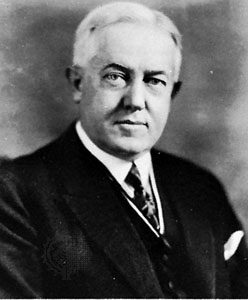
John William Davis
John William Davis was an American politician, presidential candidate. Born April 13, 1873, in Clarksburg. Died March 24, 1955, in Charleston. Positions held include United States representative, Solicitor General of the United States and ambassador. Educated at Washington and Lee University and Washington and Lee University School of Law. Awards include Knight Grand Cross of the Order of the British Empire and William E. Harmon Foundation award for distinguished achievement among Negroes.
Facts
23 facts · 2 confirmed by two sources · 3 cited · 18 from one source
Where this comes from
Papalocal keeps its own record. It started from these sources; what each one said is kept here as it was copied, so a change on their side never changes this page by itself. Tap one to read its version.
What Wikidata says · copied November 16, 2026 · revision 2569590883
- Described as
- American politician, presidential candidate (1873-1955)
- Other names
- John W. Davis, John Davis
- Born
- April 13, 1873 · 4 references
- Died
- March 24, 1955 · 4 references
- Born in
- Clarksburg
- Died in
- Charleston
- Buried in
- Locust Valley Cemetery
- Citizen of
- United States
- Occupation
- politician · 1 reference; lawyer; diplomat · 1 reference; jurist · 1 reference
- Positions held
- United States representative; Solicitor General of the United States; ambassador
- Political party
- Democratic Party
- Worked for
- Washington and Lee University School of Law
- Education
- Washington and Lee University; Washington and Lee University School of Law
- Member of
- American Philosophical Society (1924–)
- Awards
- Knight Grand Cross of the Order of the British Empire; William E. Harmon Foundation award for distinguished achievement among Negroes
- Spouse
- Ellen Graham Bassel
- Children
- Julia Davis Adams
- Father
- John J. Davis
- Wikipedias with a page
- 20
Wikidata item Q1332779 (wikidata.org/wiki/Q1332779), public domain (CC0). Copied November 16, 2026.
What Wikipedia says · copied November 16, 2026 · revision 1385210870
John William Davis (April 13, 1873 – March 24, 1955) was an American politician, diplomat, and lawyer. He served under President Woodrow Wilson as the Solicitor General of the United States and the United States Ambassador to the United Kingdom. He was the Democratic nominee for president in 1924, losing to Republican incumbent Calvin Coolidge.
Davis was born and raised in West Virginia, where his father, John James Davis, had been a delegate to the Wheeling Convention and served in the U.S. House of Representatives in the 1870s. Davis joined his father's legal practice and adopted many of his father's political views, including opposition to anti-lynching legislation and support for states' rights. Davis served in the U.S. House from 1911 to 1913, helping to write the Clayton Antitrust Act. He held the position of Solicitor General of the United States from 1913 to 1918, during which time he successfully argued for the unconstitutionality of the grandfather clause in Oklahoma's constitution, which had a discriminatory effect against African-American voters, in Guinn v. United States.
While serving as ambassador to Britain from 1918 to 1921, Davis was a dark horse candidate for the 1920 Democratic presidential nomination. After he left office, Davis helped establish the Council on Foreign Relations and advocated for the repeal of Prohibition. The 1924 Democratic National Convention nominated Davis for president after 103 ballots. He remains the only major party presidential nominee from West Virginia. Running on a ticket with Charles W. Bryan, Davis lost in a landslide to incumbent President Coolidge. Davis did not seek public office again after 1924. He continued as a prominent attorney, associated with several law firms over the years, and represented many of the largest companies in the United States from the 1920s onwards. Davis argued 140 cases before the U.S. Supreme Court.
In addition to his legal work, Davis was also involved in the New York City Bar Association, serving as its president from 1931 to 1933. In 1933, he represented J. P. Morgan Jr. and his companies during a Senate investigation into private banking and the causes of the Great Depression. During the last two decades of his career, Davis represented businesses before the Supreme Court, challenging the constitutionality and application of New Deal legislation. He lost many of these cases but scored a major victory for "Little Steel" in Youngstown Sheet & Tube Co. v. Sawyer (1952), in which the Supreme Court ruled against President Harry Truman's seizure of the steel mills. Davis unsuccessfully defended the "separate but equal" doctrine in Briggs v. Elliott (1952), one of the companion cases to the landmark school desegregation case Brown v. Board of Education (1954).
- Born, in its opening lines
- April 13, 1873
- Died, in its opening lines
- March 24, 1955
From the Wikipedia article “John W. Davis” (en.wikipedia.org/wiki/John_W._Davis), by its contributors, under CC BY-SA 4.0 (creativecommons.org/licenses/by-sa/4.0/). Copied November 16, 2026; not changed.
Confirmed Two sources agree. Cited One source, and it names where it got it. One source One source, without a reference of its own. Sources disagree The sources disagree. We show the best-supported value and keep theirs below.
