
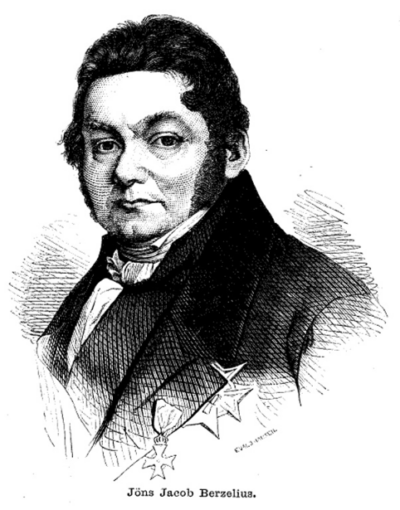
Jöns Jacob Berzelius
Jöns Jacob Berzelius was a Swedish chemist. Born August 20, 1779, in Väfversunda. Died August 7, 1848, in Adolf Fredriks parish. Positions held include seat 5 of the Swedish Academy (1837–1848). Known for Undersökning af några i trakten kring Fahlun funna fossilier, och af deras lagerställen. Educated at Uppsala University and Katedralskolan. Awards include Copley Medal, Pour le Mérite for Sciences and Arts order and Honorary Fellow of the Royal Society of Edinburgh.
Facts
39 facts · 2 confirmed by two sources · 9 cited · 28 from one source
Where this comes from
Papalocal keeps its own record. It started from these sources; what each one said is kept here as it was copied, so a change on their side never changes this page by itself. Tap one to read its version.
What Wikidata says · copied November 16, 2026 · revision 2567720626
- Described as
- Swedish chemist (1779–1848)
- Other names
- Jons Jacob Berzelius, Johann Jakob Berzelius, Jacob Berzelius, Berzelius J J, Johan Jakob Berzelius, Berzelius
- Born
- August 20, 1779 · 14 references
- Died
- August 7, 1848 · 15 references
- Born in
- Väfversunda · 1 reference
- Died in
- Adolf Fredriks parish · 1 reference
- Buried in
- Solna cemetery · 2 references
- Citizen of
- Sweden · 1 reference
- Occupation
- chemist · 1 reference; non-fiction writer; university teacher; physician; pharmacist
- Positions held
- seat 5 of the Swedish Academy (1837–1848) · 1 reference
- Worked for
- Karolinska Institutet; Uppsala University · 1 reference
- Education
- Uppsala University; Katedralskolan
- Member of
- Royal Society of London; Academy of Science for Public Utility; German Academy of Sciences Leopoldina; Royal Swedish Academy of Sciences; French Academy of Sciences; Saint Petersburg Academy of Sciences; Swedish Academy · 1 reference; American Academy of Arts and Sciences; Royal Prussian Academy of Sciences; Royal Netherlands Academy of Arts and Sciences
- Known for
- Undersökning af några i trakten kring Fahlun funna fossilier, och af deras lagerställen
- Awards
- Copley Medal (1836) · 1 reference; Pour le Mérite for Sciences and Arts order; Honorary Fellow of the Royal Society of Edinburgh; Fellow of the American Academy of Arts and Sciences; Foreign Member of the Royal Society (1813) · 1 reference; Order of Saint Stanislaus, 1st class; Knight of the Order of the Polar Star (1815); Commander of the Order of Vasa (1821); honorary member of the Physics Association (Frankfurt am Main, Germany) (1835) · 1 reference
- Field
- chemistry · 1 reference
- Spouse
- Elisabeth Berzelius (1835–1848) · 1 reference
- Father
- Samuel Berzelius
- Wikipedias with a page
- 90
Wikidata item Q151911 (wikidata.org/wiki/Q151911), public domain (CC0). Copied November 16, 2026.
What Wikipedia says · copied November 16, 2026 · revision 1382388936
Jöns Jacob Berzelius (Swedish: [jœ̌ns ˈjɑ̂ːkɔb bæˈʂěːlɪɵs]; 20 August 1779 – 7 August 1848) was a Swedish chemist. Berzelius is considered, along with Robert Boyle, John Dalton, and Antoine Lavoisier, to be one of the founders of modern chemistry. Berzelius became a member of the Royal Swedish Academy of Sciences in 1808 and served from 1818 as its principal functionary. He is known in Sweden as the "Father of Swedish Chemistry". During his lifetime he did not customarily use his first given name, and was universally known simply as Jacob Berzelius.
Although Berzelius began his career as a physician, his enduring contributions were in the fields of electrochemistry, chemical bonding and stoichiometry. In particular, he is noted for his determination of atomic weights and his experiments that led to a more complete understanding of the principles of stoichiometry, which is the branch of chemistry pertaining to the quantitative relationships between elements in chemical compounds and chemical reactions and that these occur in definite proportions. This understanding came to be known as the "Law of Constant Proportions".
Berzelius was a strict empiricist, expecting that any new theory must be consistent with the sum of contemporary chemical knowledge. He developed improved methods of chemical analysis, which were required to develop the basic data in support of his work on stoichiometry. He investigated isomerism, allotropy, and catalysis, phenomena that owe their names to him. Berzelius was among the first to articulate the differences between inorganic compounds and organic compounds. Among the many minerals and elements he studied, he is credited with discovering cerium and selenium, and with being the first to isolate silicon and thorium. Following on his interest in mineralogy, Berzelius synthesized and chemically characterized new compounds of these and other elements.
Berzelius demonstrated the use of an electrochemical cell to decompose certain chemical compounds into pairs of electrically opposite constituents. From this research, he articulated a theory that came to be known as electrochemical dualism, contending that chemical compounds are oxide salts, bonded together by electrostatic interactions. This theory, while useful in some contexts, came to be seen as insufficient. Berzelius's work with atomic weights and his theory of electrochemical dualism led to his development of a modern system of chemical formula notation that showed the composition of any compound both qualitatively and quantitatively. His system abbreviated the Latin names of the elements with one or two letters and applied superscripts to designate the number of atoms of each element present in the compound. Later, chemists changed to use of subscripts rather than superscripts.
- Born, in its opening lines
- August 20, 1779
- Died, in its opening lines
- August 7, 1848
From the Wikipedia article “Jöns Jacob Berzelius” (en.wikipedia.org/wiki/Jöns_Jacob_Berzelius), by its contributors, under CC BY-SA 4.0 (creativecommons.org/licenses/by-sa/4.0/). Copied November 16, 2026; not changed.
Confirmed Two sources agree. Cited One source, and it names where it got it. One source One source, without a reference of its own. Sources disagree The sources disagree. We show the best-supported value and keep theirs below.
