
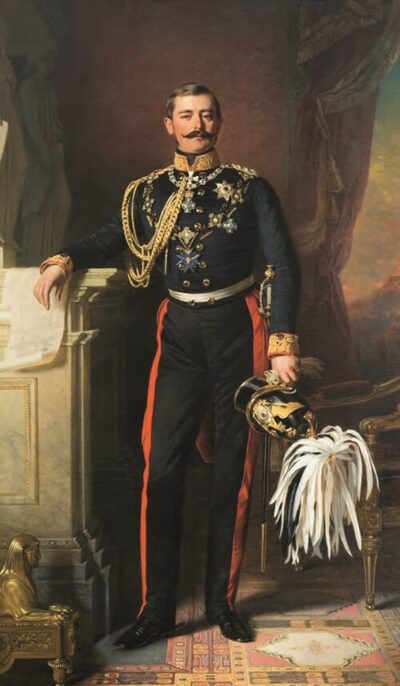
Karl Anton, Prince of Hohenzollern
Karl Anton, Prince of Hohenzollern was a Prince of Hohenzollern-Sigmaringen. Born September 7, 1811, in Krauchenwies. Died June 2, 1885, in Sigmaringen. Positions held include member of the Prussian House of Lords. Educated at University of Geneva and University of Tübingen. Awards include Knight Grand Cross of the Order of Friedrich I, Order of St. Andrew and Order of the Black Eagle.
Facts
37 facts · 2 confirmed by two sources · 22 cited · 13 from one source
Where this comes from
Papalocal keeps its own record. It started from these sources; what each one said is kept here as it was copied, so a change on their side never changes this page by itself. Tap one to read its version.
What Wikidata says · copied November 17, 2026 · revision 2569163994
- Described as
- Prince of Hohenzollern-Sigmaringen (1811–1885)
- Born
- September 7, 1811 · 4 references
- Died
- June 2, 1885 · 4 references
- Born in
- Krauchenwies · 1 reference
- Died in
- Sigmaringen · 1 reference
- Buried in
- Sigmaringen
- Name at birth
- Karl Anton Joachim Zephyrin Friedrich Meinrad von Hohenzollern-Sigmaringen · 1 reference
- Citizen of
- Kingdom of Prussia · 1 reference
- Occupation
- politician · 1 reference; jurist · 1 reference
- Positions held
- member of the Prussian House of Lords
- Political party
- independent politician · 1 reference
- Education
- University of Geneva · 1 reference; University of Tübingen · 1 reference; University of Göttingen · 1 reference; Frederick William University Berlin · 1 reference
- Awards
- Knight Grand Cross of the Order of Friedrich I (1832); Order of St. Andrew; Order of the Black Eagle; Order of the Red Eagle 1st Class; Pour le Mérite; Order of Fidelity (1831); Knight Grand Cross of the Order of the Zähringer Lion (1834); Knight Grand Cross of the Order of the Crown (1845); honorary citizen of Düsseldorf (1856)
- Spouse
- Josephine of Baden (1834–1885) · 2 references
- Children
- Prince Leopold, Prince of Hohenzollern · 1 reference; Stephanie of Hohenzollern-Sigmaringen · 1 reference; Carol I of Romania · 1 reference; Prince Anton of Hohenzollern-Sigmaringen · 1 reference; Prince Friedrich of Hohenzollern · 1 reference; Princess Marie of Hohenzollern-Sigmaringen · 1 reference
- Father
- Charles, Prince of Hohenzollern-Sigmaringen · 1 reference
- Mother
- Marie Antoinette Murat · 1 reference
- Siblings
- Princess Karoline of Hohenzollern-Sigmaringen · 1 reference; Princess Amalie of Hohenzollern-Sigmaringen · 1 reference; Princess Friederike of Hohenzollern-Sigmaringen · 1 reference
- Military rank
- colonel general
- Wikipedias with a page
- 26
Wikidata item Q58012 (wikidata.org/wiki/Q58012), public domain (CC0). Copied November 17, 2026.
What Wikipedia says · copied November 17, 2026 · revision 1362786474
Karl Anton, Prince of Hohenzollern-Sigmaringen (German: Karl Anton Joachim Zephyrinus Friedrich Meinrad Fürst von Hohenzollern-Sigmaringen; 7 September 1811 – 2 June 1885) was the last reigning prince of Hohenzollern-Sigmaringen before the territory was annexed by the Kingdom of Prussia in 1849. Afterwards, he continued to be titular prince of his house and – with the death of the last prince of Hohenzollern-Hechingen in 1869 – of the entire Swabian branch of the House of Hohenzollern. He served as Minister President of Prussia from 1858 to 1862, the only Hohenzollern prince to hold that post. His second son, Karl, became king of Romania. The offer of the throne of Spain to his eldest son, Leopold, was one of the causes of the Franco-Prussian War, which led to the unification of Germany and the creation of the German Empire.
- Born, in its opening lines
- September 7, 1811
- Died, in its opening lines
- June 2, 1885
From the Wikipedia article “Karl Anton, Prince of Hohenzollern (born 1811)” (en.wikipedia.org/wiki/Karl_Anton,_Prince_of_Hohenzollern_(born_1811)), by its contributors, under CC BY-SA 4.0 (creativecommons.org/licenses/by-sa/4.0/). Copied November 17, 2026; not changed.
Confirmed Two sources agree. Cited One source, and it names where it got it. One source One source, without a reference of its own. Sources disagree The sources disagree. We show the best-supported value and keep theirs below.
