
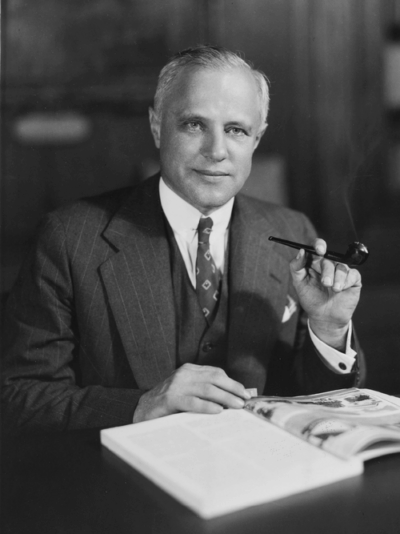
Karl Taylor Compton
Karl Taylor Compton was an American physicist and university president. Born September 14, 1887, in Wooster. Died June 22, 1954, in New York City. Educated at Princeton University and College of Wooster. Awards include William Procter Prize for Scientific Achievement, Rumford Prize and Hoover Medal.
Facts
21 facts · 2 confirmed by two sources · 10 cited · 9 from one source
Where this comes from
Papalocal keeps its own record. It started from these sources; what each one said is kept here as it was copied, so a change on their side never changes this page by itself. Tap one to read its version.
What Wikidata says · copied November 16, 2026 · revision 2567890009
- Described as
- American physicist and university president (1887–1954)
- Other names
- Karl T. Compton, Karl Compton, K. T. Compton, KT Compton, Compton
- Born
- September 14, 1887 · 5 references
- Died
- June 22, 1954 · 4 references
- Born in
- Wooster · 1 reference
- Died in
- New York City · 1 reference
- Citizen of
- United States
- Occupation
- physicist · 1 reference; university teacher; science administrator; nuclear physicist · 1 reference
- Worked for
- Massachusetts Institute of Technology
- Education
- Princeton University; College of Wooster
- Member of
- National Academy of Sciences; American Academy of Arts and Sciences; American Philosophical Society (1923–) · 1 reference; American Physical Society · 1 reference
- Awards
- William Procter Prize for Scientific Achievement (1950) · 1 reference; Rumford Prize (1931) · 1 reference; Hoover Medal (1950); NAS Public Welfare Medal (1947) · 1 reference
- Siblings
- Arthur Holly Compton · 1 reference
- Wikipedias with a page
- 21
Wikidata item Q1349042 (wikidata.org/wiki/Q1349042), public domain (CC0). Copied November 16, 2026.
What Wikipedia says · copied November 16, 2026 · revision 1385363877
Karl Taylor Compton (September 14, 1887 – June 22, 1954) was an American physicist and president of the Massachusetts Institute of Technology (MIT) from 1930 to 1948.
Working in electron physics, Compton produced early experimental verification of the photoelectric effect and conducted work on electrical plasmas. He spent two decades at Princeton University before assuming the MIT presidency. There, he initiated reforms that transformed MIT from an engineering school into a research university with strong programs in basic science. He created a School of Science, centralized the Institute's industry research contracts, and increased faculty autonomy from research sponsors. Working closely with Vice President Vannevar Bush, he broadened research funding sources and established one of the first university patent licensing programs Outside MIT, Compton advocated strenuously for science funding. He was the founding chairman of the American Institute of Physics and chaired President Roosevelt's Science Advisory Board.
As MIT president, Compton forged new links between universities and the military establishment. During the Second World War, Compton was a founding member of the National Defense Research Committee, chairing its radar and detection research program. He oversaw the establishment of the MIT Radiation Laboratory, the first major federal research contract with a university and one of the largest R&D projects of the war. He led a radar coordination mission to the United Kingdom in 1943 and was chief of the Office of Scientific Research and Development's Office of Field Service, deploying civilian scientists to combat theaters. He served on the Interim Committee that advised President Truman on the use of the atomic bomb, and later publicly defended the decision in a widely discussed Atlantic Monthly article. As scientific advisor to General Douglas MacArthur in the Pacific, he was among the first Americans to enter Tokyo after the Japanese surrender.
Working with the New England Council, he helped lay the groundwork for the modern venture capital industry. After the war, he co-founded the American Research and Development Corporation, widely regarded as the first modern venture capital firm. He chaired President Truman's commission on universal military training and led the Research and Development Board of the Department of Defense before declining health forced his retirement in 1949. He served as chairman of the MIT Corporation from 1948, and he remained active as a trustee of the Ford, Rockefeller, and Sloan Foundations until his death at sixty-six.
- Born, in its opening lines
- September 14, 1887
- Died, in its opening lines
- June 22, 1954
From the Wikipedia article “Karl Compton” (en.wikipedia.org/wiki/Karl_Compton), by its contributors, under CC BY-SA 4.0 (creativecommons.org/licenses/by-sa/4.0/). Copied November 16, 2026; not changed.
Confirmed Two sources agree. Cited One source, and it names where it got it. One source One source, without a reference of its own. Sources disagree The sources disagree. We show the best-supported value and keep theirs below.
