
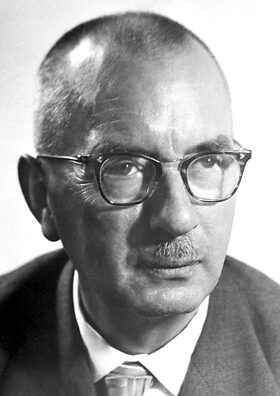
Karl Ziegler
Karl Ziegler was a German chemist. Born November 26, 1898, in Helsa. Died August 12, 1973, in Mülheim an der Ruhr. Educated at University of Marburg and RWTH Aachen University. Awards include Werner von Siemens Ring, Great Cross with Star and Sash of the Order of Merit of the Federal Republic of Germany and Pour le Mérite for Sciences and Arts order.
Facts
41 facts · 2 confirmed by two sources · 13 cited · 26 from one source
What’s different
- Died: we show August 12, 1973 (Confirmed). Wikidata also lists August 11, 1973
Where this comes from
Papalocal keeps its own record. It started from these sources; what each one said is kept here as it was copied, so a change on their side never changes this page by itself. Tap one to read its version.
What Wikidata says · copied November 16, 2026 · revision 2569007680
- Described as
- German chemist (1898–1973)
- Other names
- Karl Waldemar Ziegler
- Born
- November 26, 1898 · 7 references
- Died
- August 12, 1973 · 2 references; August 11, 1973 · 2 references
- Born in
- Helsa · 1 reference
- Died in
- Mülheim an der Ruhr · 1 reference
- Buried in
- Mülheim an der Ruhr Main Cemetery
- Citizen of
- Germany
- Occupation
- chemist · 1 reference; engineer; university teacher · 1 reference; art collector · 1 reference
- Worked for
- Goethe University Frankfurt; Heidelberg University; RWTH Aachen University; Martin Luther University Halle-Wittenberg; Max Planck Institute for Coal Research (1943–1969) · 1 reference; University of Marburg
- Education
- University of Marburg; RWTH Aachen University · 1 reference
- Member of
- Royal Society of London (1971–); German Academy of Sciences Leopoldina (1938–) · 1 reference; Bavarian Academy of Sciences and Humanities; North Rhine-Westphalia Academy for Sciences and Arts; Royal Society of Edinburgh; Göttingen Academy of Sciences and Humanities in Lower Saxony
- Awards
- Werner von Siemens Ring (1960); Great Cross with Star and Sash of the Order of Merit of the Federal Republic of Germany; Pour le Mérite for Sciences and Arts order (1969); Nobel Prize in Chemistry (1963) · 2 references; Wilhelm Exner Medal (1971) · 1 reference; Carl Engler Medal (1958) · 1 reference; Liebig Medal (1935) · 1 reference; Hall of Fame of German Research (2010); Carl Duisberg Plaque (1953) · 1 reference; Lavoisier Medal (1955); Foreign Member of the Royal Society (1971) · 1 reference; honorary doctor of the University of Giessen; honorary doctor of the Technische Universität Darmstadt; Honorary doctor of the Heidelberg University; War Merit Cross 2nd Class without Swords (1940)
- Field
- inorganic chemistry
- Children
- Marianne Witte · 1 reference
- Wikipedias with a page
- 63
Wikidata item Q76624 (wikidata.org/wiki/Q76624), public domain (CC0). Copied November 16, 2026.
What Wikipedia says · copied November 16, 2026 · revision 1378442865
Karl Waldemar Ziegler (German: [kaːʁl ˈvaldəˌmaʁ ˈt͡siːɡlɐ]; 26 November 1898 – 12 August 1973) was a German chemist who won the Nobel Prize in Chemistry in 1963, with Giulio Natta, for work on polymers. The Nobel Committee recognized his "excellent work on organometallic compounds [which]...led to new polymerization reactions and ... paved the way for new and highly useful industrial processes". He is also known for his work involving free-radicals, many-membered rings, and organometallic compounds, as well as the development of Ziegler–Natta catalyst. One of many awards Ziegler received was the Werner von Siemens Ring in 1960 jointly with Otto Bayer and Walter Reppe, for expanding the scientific knowledge of and the technical development of new synthetic materials.
- Born, in its opening lines
- November 26, 1898
- Died, in its opening lines
- August 12, 1973
From the Wikipedia article “Karl Ziegler” (en.wikipedia.org/wiki/Karl_Ziegler), by its contributors, under CC BY-SA 4.0 (creativecommons.org/licenses/by-sa/4.0/). Copied November 16, 2026; not changed.
Confirmed Two sources agree. Cited One source, and it names where it got it. One source One source, without a reference of its own. Sources disagree The sources disagree. We show the best-supported value and keep theirs below.
