
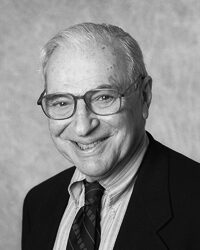
Kenneth Arrow
Kenneth Arrow was an American economist. Born August 23, 1921, in New York City. Died February 21, 2017, in Palo Alto. Educated at City College of New York and Townsend Harris High School. Awards include Guggenheim Fellowship, honorary doctor of the University of Vienna and Distinguished Fellow of the American Economic Association.
Facts
49 facts · 2 confirmed by two sources · 24 cited · 23 from one source
Where this comes from
Papalocal keeps its own record. It started from these sources; what each one said is kept here as it was copied, so a change on their side never changes this page by itself. Tap one to read its version.
What Wikidata says · copied November 13, 2026 · revision 2563199498
- Described as
- American economist (1921–2017)
- Other names
- Kenneth Joseph Arrow, Kenneth J. Arrow, Ken Arrow
- Born
- August 23, 1921 · 14 references
- Died
- February 21, 2017 · 9 references
- Born in
- New York City · 2 references
- Died in
- Palo Alto · 2 references
- Name at birth
- Kenneth Joseph Arrow
- Citizen of
- United States · 1 reference
- Occupation
- economist · 1 reference; statistician; teacher · 1 reference; political scientist · 1 reference; writer · 1 reference; university teacher · 1 reference
- Worked for
- University of Chicago; Santa Fe Institute; Harvard University · 1 reference
- Education
- City College of New York; Townsend Harris High School · 1 reference; Columbia University (2 times) (1941–1951); City University of New York · 1 reference
- Member of
- Royal Society of London (2006–); National Academy of Sciences (1968–); American Academy of Arts and Sciences; Pontifical Academy of Social Sciences · 1 reference; American Philosophical Society (1968–) · 1 reference; American Association for the Advancement of Science · 1 reference; Institute of Mathematical Statistics (1951–) · 1 reference; Econometric Society (1951–) · 1 reference
- Awards
- Guggenheim Fellowship · 1 reference; honorary doctor of the University of Vienna · 1 reference; Distinguished Fellow of the American Economic Association; Fellow of the American Academy of Arts and Sciences; Fellow of the Econometric Society (1951) · 1 reference; Fellow of the Institute of Mathematical Statistics (1951) · 1 reference; John Bates Clark Medal (1957); Fellow of the American Statistical Association (1959) · 1 reference; Prize in Economic Sciences in Memory of Alfred Nobel (1972) · 1 reference; honorary doctor of Paris Descartes University (1974) · 1 reference; John von Neumann Prize (1977); honorary doctor of the Paul Cézanne University (1984) · 1 reference; John von Neumann Theory Prize (1986); Kampé de Fériet Award (1998); National Medal of Science (2004)
- Field
- economics · 1 reference; economics and politics · 1 reference; literature · 1 reference
- Siblings
- Anita Summers
- Lived in
- California; New York City
- Website
- http://economics.stanford.edu/faculty/arrow
- Wikipedias with a page
- 72
Wikidata item Q192592 (wikidata.org/wiki/Q192592), public domain (CC0). Copied November 13, 2026.
What Wikipedia says · copied November 13, 2026 · revision 1384635927
Kenneth Joseph Arrow (August 23, 1921 – February 21, 2017) was an American economist, mathematician and political theorist. He received the John Bates Clark Medal in 1957, and the Nobel Memorial Prize in Economic Sciences in 1972, along with John Hicks.
In economics, Arrow was a major figure in postwar neoclassical economic theory. Four of his students (Roger Myerson, Eric Maskin, John Harsanyi, and Michael Spence) went on to become Nobel laureates themselves. His contributions to social choice theory, notably his "impossibility theorem", and his work on general equilibrium analysis are significant. His work in many other areas of economics, including endogenous growth theory and the economics of information, was also foundational.
- Born, in its opening lines
- August 23, 1921
- Died, in its opening lines
- February 21, 2017
From the Wikipedia article “Kenneth Arrow” (en.wikipedia.org/wiki/Kenneth_Arrow), by its contributors, under CC BY-SA 4.0 (creativecommons.org/licenses/by-sa/4.0/). Copied November 13, 2026; not changed.
Confirmed Two sources agree. Cited One source, and it names where it got it. One source One source, without a reference of its own. Sources disagree The sources disagree. We show the best-supported value and keep theirs below.
