
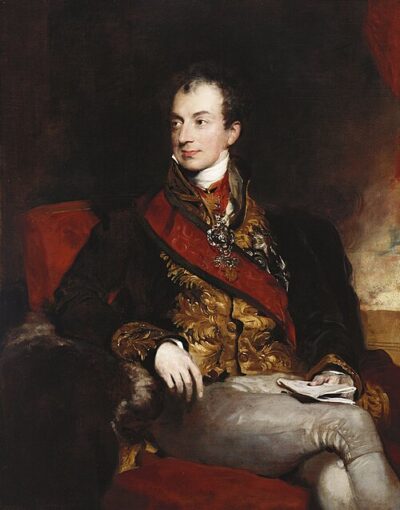
Klemens von Metternich
Klemens von Metternich was an Austrian diplomat, foreign minister and Chancellor. Born May 15, 1773, in Koblenz. Died June 11, 1859, in Vienna. Positions held include Minister-President of Austria (1821–1848), ambassador to Saxony (1801–1803) and ambassador of Austria to France (1806–1809). Educated at University of Strasbourg and Johannes Gutenberg University Mainz. Awards include Knight of the Order of the Holy Spirit, Knight of the Order of Saint Michael and Knight of the Order of the Golden Fleece.
Facts
57 facts · 2 confirmed by two sources · 19 cited · 36 from one source
Where this comes from
Papalocal keeps its own record. It started from these sources; what each one said is kept here as it was copied, so a change on their side never changes this page by itself. Tap one to read its version.
What Wikidata says · copied November 16, 2026 · revision 2567483069
- Described as
- Austrian diplomat, foreign minister and Chancellor (1773–1859)
- Other names
- Clemens von Metternich, Klemens Wenzel von Metternich, Clement, Prince von Metternich
- Born
- May 15, 1773 · 12 references
- Died
- June 11, 1859 · 11 references
- Born in
- Koblenz · 2 references
- Died in
- Vienna · 4 references
- Buried in
- Metternich tomb · 1 reference
- Citizen of
- Holy Roman Empire; Austrian Empire
- Occupation
- diplomat · 1 reference; politician · 1 reference; writer · 1 reference
- Positions held
- Minister-President of Austria (1821–1848); ambassador to Saxony (1801–1803); ambassador of Austria to France (1806–1809); ambassador of the Holy Roman Empire to Prussia (1803–1806); invited and represented member of the House of Magnates (1832–1836) · 1 reference
- Worked for
- Emperor of Austria
- Education
- University of Strasbourg; Johannes Gutenberg University Mainz (–1794) · 1 reference
- Member of
- German Archaeological Institute; Royal Swedish Academy of Letters, History and Antiquities; Towarzystwo Naukowe Krakowskie · 1 reference; Secret State Conference
- Awards
- Knight of the Order of the Holy Spirit; Knight of the Order of Saint Michael; Knight of the Order of the Golden Fleece; Order of the Black Eagle (1813); Pour le Mérite for Sciences and Arts order (1842); Order of Saint Anna, 1st class; Order of Saint Alexander Nevsky; Order of St. Andrew; Order of the Red Eagle 1st Class; Knight Grand Cross of the Order of Saint Stephen of Hungary; Knight of the Order of Saint Joseph; Knight Grand Cross of the Order of Saint Joseph; Grand Cross of the Order of Charles III · 1 reference; Order of the Redeemer · 1 reference; Military Order of Maria Theresa · 1 reference
- Spouse
- Maria Eleonore von Kaunitz (1795–) · 1 reference; Maria Antonia, Countess of Beilstein (1827–) · 1 reference; Gräfin Melanie Zichy-Ferraris de Zich et Vásonykeö (1831–) · 1 reference
- Children
- Richard von Metternich · 1 reference; Melanie Metternich-Zichy · 1 reference; Marie-Clementine Bagration; Maria Leopoldina Prinzessin von Metternich-Winneburg zu Beilstein · 1 reference; Franz Karl Johann Georg von Metternich-Winneburg zu Beilstein · 1 reference; Klemens Eduard von Metternich-Winneburg zu Beilstein · 1 reference; Prince Viktor of Metternich-Winneburg-Beilstein · 1 reference; Princess Clementine Metternich · 1 reference; Maria Antonia Prinzessin von Metternich-Winneburg zu Beilstein · 1 reference; Leontine von Metternich · 1 reference; Klemens Prinz von Metternich · 1 reference; Paul Fürst von Metternich · 1 reference
- Father
- Franz Georg Karl von Metternich · 1 reference
- Mother
- Maria Beatrix von Kageneck · 1 reference
- Siblings
- Pauline Prinzessin von Metternich-Winneburg; Joseph von Metternich
- Religion
- Catholicism
- Wikipedias with a page
- 96
Wikidata item Q45662 (wikidata.org/wiki/Q45662), public domain (CC0). Copied November 16, 2026.
What Wikipedia says · copied November 16, 2026 · revision 1377336316
Klemens Wenzel Nepomuk Lothar, Prince of Metternich-Winneburg zu Beilstein (15 May 1773 – 11 June 1859), known as Klemens von Metternich ( MET-ər-nikh, German: [ˈkleːmɛns fɔn ˈmɛtɐnɪç]) or Prince Metternich, was a German statesman and diplomat in the service of the Austrian Empire. Metternich was at the center of the European balance of power known as the Concert of Europe for three decades as Austrian foreign minister from 1809 and chancellor from 1821 until the Revolutions of 1848 forced his resignation.
Born into the House of Metternich in 1773 as the son of a diplomat, Metternich received a good education at the universities of Strasbourg and Mainz. Metternich rose through key diplomatic posts, including ambassadorial roles in the Kingdom of Saxony, the Kingdom of Prussia, and especially Napoleonic France. One of his first assignments as Foreign Minister was to engineer a détente with France that included the marriage of Napoleon to the Austrian archduchess Marie Louise. Soon after, he engineered Austria's entry into the War of the Sixth Coalition on the Allied side, signed the Treaty of Fontainebleau that sent Napoleon into exile and led the Austrian delegation at the Congress of Vienna that divided post-Napoleonic Europe amongst the major powers. For his service to the Austrian Empire, he was given the title of Prince in October 1813.
Under his guidance, the "Metternich system" of international congresses continued for another decade as Austria aligned itself with Russia and to a lesser extent Prussia. This marked the high point of Austria's diplomatic importance and thereafter Metternich slowly slipped into the periphery of international diplomacy. At home, Metternich held the post of Chancellor of State from 1821 until 1848 under both Francis I and his son Ferdinand I. After a brief exile in London, Brighton, and Brussels that lasted until 1851, he returned to the Viennese court, only this time to offer advice to Ferdinand's successor, Franz Josef. Having outlived his generation of politicians, Metternich died at the age of 86 in 1859.
A traditional conservative, Metternich was keen to maintain the balance of power, particularly by resisting Russian territorial ambitions in Central Europe and the Ottoman Empire. He disliked liberalism and strove to prevent the breakup of the Austrian Empire, for example, by crushing nationalist revolts in Austrian northern Italy. At home, he pursued a similar policy, using censorship and a wide-ranging spy network to suppress unrest.
Metternich has been both praised and heavily criticized for the policies he pursued. His supporters pointed out that he presided over the "Austrian system" when international diplomacy helped prevent major wars in Europe. His qualities as a diplomat were commended, some noting that his achievements were considerable in light of the weakness of his negotiating position. Meanwhile, his detractors argued that he could have done much to secure Austria's future, and he was deemed a stumbling block to reforms in Austria. Metternich was also a supporter of the arts, taking a particular interest in music; he knew some of the most eminent composers in Europe, including Haydn, Beethoven, Rossini, Paganini and Liszt.
- Born, in its opening lines
- May 15, 1773
- Died, in its opening lines
- June 11, 1859
From the Wikipedia article “Klemens von Metternich” (en.wikipedia.org/wiki/Klemens_von_Metternich), by its contributors, under CC BY-SA 4.0 (creativecommons.org/licenses/by-sa/4.0/). Copied November 16, 2026; not changed.
Confirmed Two sources agree. Cited One source, and it names where it got it. One source One source, without a reference of its own. Sources disagree The sources disagree. We show the best-supported value and keep theirs below.
