
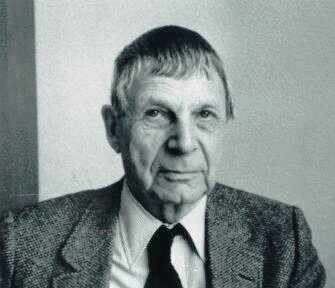
Lars Ahlfors
Lars Ahlfors was a Finnish mathematician. Born April 18, 1907, in Helsinki. Died October 11, 1996, in Pittsfield. Known for Schwarz–Ahlfors–Pick theorem, Denjoy–Carleman–Ahlfors theorem and Ahlfors finiteness theorem. Educated at University of Helsinki and Nya svenska samskolan. Awards include Wolf Prize in Mathematics, Fields medal and Leroy P. Steele Prize.
Facts
39 facts · 2 confirmed by two sources · 18 cited · 19 from one source
Where this comes from
Papalocal keeps its own record. It started from these sources; what each one said is kept here as it was copied, so a change on their side never changes this page by itself. Tap one to read its version.
What Wikidata says · copied November 13, 2026 · revision 2567780571
- Described as
- Finnish mathematician (1907-1996)
- Other names
- Lars Valerian Ahlfors, Lars V. Ahlfors, L. V. Ahlfors
- Born
- April 18, 1907 · 11 references
- Died
- October 11, 1996 · 7 references
- Born in
- Helsinki · 2 references
- Died in
- Pittsfield · 2 references
- Buried in
- Hietaniemi cemetery · 3 references
- Cause of death
- pneumonia
- Name at birth
- Lars Valerian Ahlfors
- Citizen of
- Russian Empire; Finland (1917–); United States; Grand Duchy of Finland (–1917)
- Occupation
- mathematician · 1 reference; university teacher
- Worked for
- Harvard University (2 times) (1935–1977) · 1 reference; University of Zurich (1944–1946) · 1 reference; University of Helsinki (2 times) (1933–1940) · 1 reference
- Education
- University of Helsinki (1924–1928) · 1 reference; Nya svenska samskolan (–1924) · 1 reference; University of Zurich (1928–1929) · 1 reference; University of Paris (1930–1932) · 1 reference
- Member of
- Royal Swedish Academy of Sciences; Academy of Sciences of the USSR; Russian Academy of Sciences; National Academy of Sciences (1953–)
- Known for
- Schwarz–Ahlfors–Pick theorem; Denjoy–Carleman–Ahlfors theorem; Ahlfors finiteness theorem; Ahlfors theory; Ahlfors measure conjecture; Ahlfors regular measure
- Awards
- Wolf Prize in Mathematics (1981) · 1 reference; Fields medal (1936) · 2 references; Leroy P. Steele Prize (1982) · 2 references; Guggenheim Fellowship (1971) · 1 reference
- Field
- mathematical analysis; mathematics · 1 reference; complex analysis · 1 reference; function theory · 1 reference
- Father
- Axel Ahlfors · 1 reference
- Wikipedias with a page
- 47
Wikidata item Q211642 (wikidata.org/wiki/Q211642), public domain (CC0). Copied November 13, 2026.
What Wikipedia says · copied November 13, 2026 · revision 1371961026
Lars Valerian Ahlfors (18 April 1907 – 11 October 1996) was a Finnish mathematician and the leading figure in complex analysis during the 20th century. He is remembered for his work on Riemann surfaces, quasiconformal mappings and Teichmüller spaces, and for his textbook on complex analysis. In 1936 Ahlfors was one of the first two recipients of the Fields Medal, along with American mathematician Jesse Douglas, and in 1981 he received the Wolf Prize in Mathematics.
- Born, in its opening lines
- April 18, 1907
- Died, in its opening lines
- October 11, 1996
From the Wikipedia article “Lars Ahlfors” (en.wikipedia.org/wiki/Lars_Ahlfors), by its contributors, under CC BY-SA 4.0 (creativecommons.org/licenses/by-sa/4.0/). Copied November 13, 2026; not changed.
Confirmed Two sources agree. Cited One source, and it names where it got it. One source One source, without a reference of its own. Sources disagree The sources disagree. We show the best-supported value and keep theirs below.
