
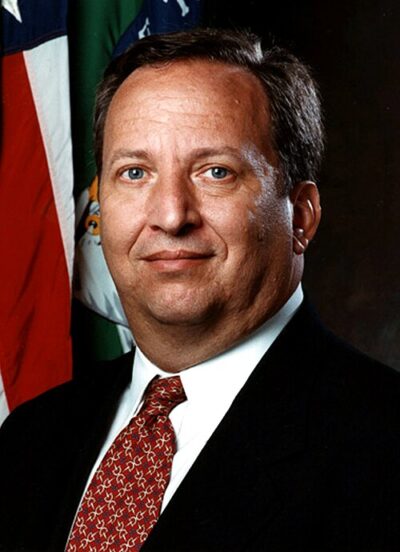
Lawrence Summers
Lawrence Summers is an American economist and government official. Born November 30, 1954, in New Haven. Positions held include United States Secretary of the Treasury (1999–2001), President of Harvard University (2001–2006) and United States Deputy Secretary of the Treasury (1995–1999). Educated at Massachusetts Institute of Technology and Harvard University. Awards include John Bates Clark Medal, Adam Smith Award and Alan T. Waterman Award.
Facts
38 facts · 1 confirmed by two sources · 17 cited · 20 from one source
Where this comes from
Papalocal keeps its own record. It started from these sources; what each one said is kept here as it was copied, so a change on their side never changes this page by itself. Tap one to read its version.
What Wikidata says · copied November 15, 2026 · revision 2565411644
- Described as
- American economist and government official (born 1954)
- Other names
- Lawrence H. Summers, Larry Summers, Lawrence Henry Summers
- Born
- November 30, 1954 · 5 references
- Born in
- New Haven · 3 references
- Citizen of
- United States · 2 references
- Occupation
- economist · 2 references; university teacher; professor · 3 references; scientist · 2 references; politician · 3 references; banker
- Positions held
- United States Secretary of the Treasury (1999–2001); President of Harvard University (2001–2006); United States Deputy Secretary of the Treasury (1995–1999); Chief Economist of the World Bank (1991–1993); Director of the National Economic Council (2009–2010)
- Political party
- Democratic Party
- Worked for
- Harvard University; United States Department of the Treasury
- Education
- Massachusetts Institute of Technology (–1975); Harvard University (–1982) · 1 reference; Harriton High School · 1 reference
- Member of
- National Academy of Sciences; American Academy of Arts and Sciences; Group of Thirty · 1 reference; Econometric Society (1985–) · 1 reference
- Awards
- John Bates Clark Medal (1993) · 1 reference; Adam Smith Award (2009); Alan T. Waterman Award (1987) · 1 reference; Golden Plate Award (2000) · 1 reference; Global Economy Prize (2011) · 2 references; Fellow of the Econometric Society (1985) · 2 references; Fellow of the American Academy of Arts and Sciences (1987) · 1 reference; honorary doctor of Harvard University (2007) · 2 references
- Field
- economics · 1 reference
- Spouse
- Elisa New (2005–) · 2 references; Victoria Perry · 1 reference
- Father
- Robert Summers
- Mother
- Anita Summers
- Religion
- Judaism
- Wikipedias with a page
- 36
Wikidata item Q317953 (wikidata.org/wiki/Q317953), public domain (CC0). Copied November 15, 2026.
What Wikipedia says · copied November 15, 2026 · revision 1385469089
Lawrence Henry Summers (born November 30, 1954) is an American economist. He served as the 71st United States Secretary of the Treasury from 1999 to 2001, the 27th president of Harvard University from 2001 to 2006, and the eighth director of the National Economic Council from 2009 to 2010. He was the Charles W. Eliot University Professor at Harvard Kennedy School until his resignation in February 2026.
Summers became a professor of economics at Harvard University in 1983. He left Harvard in 1991, working as the chief economist of the World Bank from 1991 to 1993. In 1993, Summers was appointed Under Secretary for International Affairs of the United States Department of the Treasury under President Bill Clinton's administration. In 1995, he was promoted to Deputy Secretary of the Treasury under his long-time political mentor Robert Rubin. In 1999, he succeeded Rubin as Secretary of the Treasury. While working for the Clinton administration, Summers played a leading role in the American response to the 1994 economic crisis in Mexico, the 1997 Asian financial crisis, and the 1998 Russian financial crisis. He was also influential in the Harvard Institute for International Development and American-advised privatization of the economies of the post-Soviet states, and in the deregulation of the U.S. financial system, including the repeal of the Glass–Steagall Act.
Following the end of Clinton's term, Summers served as the 27th president of Harvard University from 2001 to 2006. Summers resigned as Harvard's president in the wake of a no-confidence vote by Harvard faculty, which resulted in large part from Summers's conflict with Cornel West, financial conflict of interest questions regarding his relationship with Andrei Shleifer, and a 2005 speech in which he offered three reasons for the under-representation of women in science and engineering, including the possibility that there exists a "different availability of aptitude at the high end", in addition to patterns of discrimination and socialization.
After his first departure from Harvard, Summers worked as a managing director at the hedge fund D. E. Shaw & Co. Summers rejoined public service during the Obama administration, serving as the director of the White House United States National Economic Council for President Barack Obama from January 2009 until November 2010, where he was Director of the White House National Economic Council, part of the Obama administration's response to the Great Recession.
He went on leave from his teaching responsibilities at Harvard and his role as the director of the Mossavar-Rahmani Center for Business and Government in November 2025 due to an investigation into his ties to Jeffrey Epstein.
- Born, in its opening lines
- November 30, 1954
From the Wikipedia article “Larry Summers” (en.wikipedia.org/wiki/Larry_Summers), by its contributors, under CC BY-SA 4.0 (creativecommons.org/licenses/by-sa/4.0/). Copied November 15, 2026; not changed.
Confirmed Two sources agree. Cited One source, and it names where it got it. One source One source, without a reference of its own. Sources disagree The sources disagree. We show the best-supported value and keep theirs below.
