
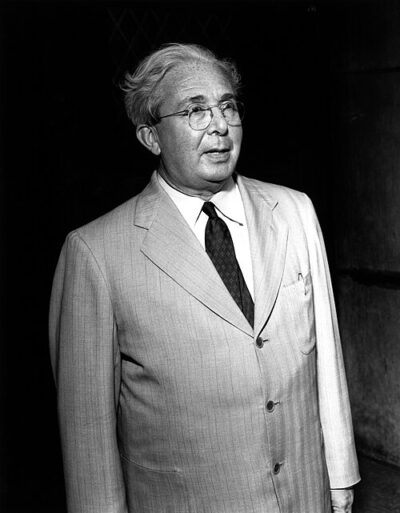
Leó Szilárd
Leó Szilárd was a Hungarian-American Jewish physicist and inventor. Born February 11, 1898, in Budapest. Died May 30, 1964, in La Jolla. Educated at Budapest University of Technology and Economics and Humboldt-Universität zu Berlin. Awards include Atoms for Peace Award, Humanist of the Year and Albert Einstein Award.
Facts
40 facts · 2 confirmed by two sources · 12 cited · 26 from one source
Where this comes from
Papalocal keeps its own record. It started from these sources; what each one said is kept here as it was copied, so a change on their side never changes this page by itself. Tap one to read its version.
What Wikidata says · copied November 13, 2026 · revision 2568344474
- Described as
- Hungarian-American Jewish physicist and inventor (1898–1964)
- Other names
- Leo Szilard
- Born
- February 11, 1898 · 10 references
- Died
- May 30, 1964 · 12 references
- Born in
- Budapest · 2 references
- Died in
- La Jolla
- Buried in
- Fiume Road Graveyard · 1 reference
- Cause of death
- myocardial infarction
- Citizen of
- Hungary; Germany (1930–); United States (1943–)
- Occupation
- nuclear physicist · 1 reference; inventor; physicist · 1 reference; university teacher; science fiction writer; scientist · 1 reference; molecular biologist · 1 reference
- Worked for
- Humboldt-Universität zu Berlin; Technische Universität Berlin; Columbia University; University of Chicago; Brandeis University
- Education
- Budapest University of Technology and Economics (1918); Humboldt-Universität zu Berlin (–1922); Technische Universität Berlin · 1 reference
- Member of
- American Academy of Arts and Sciences; American Physical Society · 1 reference; Emergency Committee of Atomic Scientists; National Academy of Sciences
- Awards
- Atoms for Peace Award (1959); Humanist of the Year (1960); Albert Einstein Award (1960); National Inventors Hall of Fame (1996) · 1 reference
- Field
- atomic physics; molecular biology · 1 reference; physics; chain reaction · 1 reference; nuclear bomb · 1 reference; nuclear reactor · 1 reference
- Spouse
- Gertrud Weiss Szilard
- Mother
- Tekla Szilárd · 1 reference
- Wikipedias with a page
- 67
Wikidata item Q153238 (wikidata.org/wiki/Q153238), public domain (CC0). Copied November 13, 2026.
What Wikipedia says · copied November 13, 2026 · revision 1379578742
Leo Szilard (; Hungarian: Leó Szilárd [ˈlɛoː ˈsilaːrd]; born Leó Spitz; February 11, 1898 – May 30, 1964) was a Hungarian-born American physicist, biologist, and inventor who made numerous important discoveries in nuclear physics and the biological sciences. He conceived the nuclear chain reaction in 1933, and patented the idea in 1936. In late 1939 he wrote the Einstein–Szilard letter for Albert Einstein's signature that resulted in the Manhattan Project that built the atomic bomb, and then in 1945 wrote the Szilard petition asking president Harry S. Truman to demonstrate the bomb without dropping it on civilians. According to György Marx, he was one of the Hungarian scientists known as The Martians.
Szilard initially attended Palatine Joseph Technical University in Budapest, but his engineering studies were interrupted by service in the Austro-Hungarian Army during World War I. He left Hungary for Germany in 1919, enrolling at Technische Hochschule (Institute of Technology) in Berlin-Charlottenburg (now Technische Universität Berlin), but became bored with engineering and transferred to Friedrich Wilhelm University, where he studied physics. He wrote his doctoral thesis on Maxwell's demon, a long-standing puzzle in the philosophy of thermal and statistical physics. Szilard was the first scientist of note to recognize the connection between thermodynamics and information theory.
Szilard coined and submitted the earliest known patent applications and the first publications for the concept of the electron microscope (1928), the cyclotron (1929), and also contributed to the development of the linear accelerator (1928) in Germany. Between 1926 and 1930, he worked with Einstein on the development of the Einstein refrigerator. After Adolf Hitler became chancellor of Germany in 1933, Szilard urged his family and friends to flee Europe while they still could. He moved to England, where he helped found the Academic Assistance Council, an organization dedicated to helping refugee scholars find new jobs. While in England, he discovered a means of isotope separation known as the Szilard–Chalmers effect, alongside Thomas A. Chalmers.
Foreseeing another war in Europe, Szilard moved to the United States in 1938, where he worked with Enrico Fermi and Walter Zinn on means of creating a nuclear chain reaction. He was present when this was achieved within the Chicago Pile-1 on December 2, 1942. He worked for the Manhattan Project's Metallurgical Laboratory at the University of Chicago on aspects of nuclear reactor design, where he was the chief physicist. He drafted the Szilard petition advocating a non-lethal demonstration of the atomic bomb, but the Interim Committee chose to use them in a military strike instead.
Together with Enrico Fermi, he applied for a nuclear reactor patent in 1944. He publicly sounded the alarm against the possible development of salted thermonuclear bombs, a new kind of nuclear weapon that might annihilate mankind. His inventions, discoveries, and contributions related to biological science are also equally important; they include the discovery of feedback inhibition and the invention of the chemostat. According to Theodore Puck and Philip I. Marcus, Szilard gave essential advice which made the earliest cloning of the human cell a reality.
Diagnosed with bladder cancer in 1960, he underwent a cobalt-60 treatment that he had designed. He helped found the Salk Institute for Biological Studies, where he became a resident fellow. Szilard founded Council for a Livable World in 1962 to deliver "the sweet voice of reason" about nuclear weapons to Congress, the White House, and the American public. He died in his sleep of a heart attack in 1964.
- Born, in its opening lines
- February 11, 1898
- Died, in its opening lines
- May 30, 1964
From the Wikipedia article “Leo Szilard” (en.wikipedia.org/wiki/Leo_Szilard), by its contributors, under CC BY-SA 4.0 (creativecommons.org/licenses/by-sa/4.0/). Copied November 13, 2026; not changed.
Confirmed Two sources agree. Cited One source, and it names where it got it. One source One source, without a reference of its own. Sources disagree The sources disagree. We show the best-supported value and keep theirs below.
