
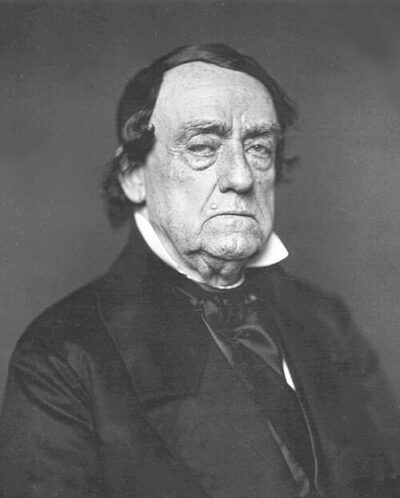
Lewis Cass
Lewis Cass was an American politician. Born October 9, 1782, in Exeter. Died June 17, 1866, in Detroit. Positions held include Ohio state representative (1806–1807), United States Secretary of State (1857–1860) and President pro tempore of the United States Senate (1854). Educated at Phillips Exeter Academy.
Facts
35 facts · 2 confirmed by two sources · 14 cited · 19 from one source
Where this comes from
Papalocal keeps its own record. It started from these sources; what each one said is kept here as it was copied, so a change on their side never changes this page by itself. Tap one to read its version.
What Wikidata says · copied November 15, 2026 · revision 2568747905
- Described as
- American politician (1782-1866)
- Born
- October 9, 1782 · 5 references
- Died
- June 17, 1866 · 5 references
- Born in
- Exeter · 1 reference
- Died in
- Detroit · 1 reference
- Buried in
- Elmwood Cemetery · 1 reference
- Citizen of
- United States
- Occupation
- politician · 1 reference; diplomat; lawyer · 1 reference; writer · 1 reference; ambassador · 1 reference; governor · 1 reference; foreign minister · 1 reference
- Positions held
- Ohio state representative (1806–1807); United States Secretary of State (1857–1860); President pro tempore of the United States Senate (1854); United States Secretary of War (1831–1836); Governor of Michigan (1813–1831); United States Ambassador to France (1836–1842); ambassador; United States senator (1845–1857) · 1 reference; board member (1847); senator · 1 reference; defence minister · 1 reference
- Political party
- Democratic Party
- Education
- Phillips Exeter Academy
- Member of
- American Antiquarian Society; Academy of Sciences of Turin (1849–) · 1 reference
- Children
- Lewis Cass, Jr.; Mary Sophia Cass; Matilda Frances Cass · 1 reference
- Father
- Jonathan Cass
- Mother
- Mary Cass · 1 reference
- Military branch
- United States Army
- Military rank
- brigadier general
- Wikipedias with a page
- 30
Wikidata item Q503119 (wikidata.org/wiki/Q503119), public domain (CC0). Copied November 15, 2026.
What Wikipedia says · copied November 15, 2026 · revision 1383274968
Lewis Cass (October 9, 1782 – June 17, 1866) was a United States Army officer and politician. He represented Michigan in the United States Senate and served in the Cabinets of two U.S. Presidents, Andrew Jackson and James Buchanan. He was also the 1848 Democratic presidential nominee. A slave owner himself, he was a leading spokesman for the doctrine of popular sovereignty, which at the time held the idea that people in each U.S state should have the right to decide whether to permit slavery as a matter of states' rights.
Born in Exeter, New Hampshire, he attended Phillips Exeter Academy before establishing a legal practice in Zanesville, Ohio. After serving in the Ohio House of Representatives, he was appointed as a U.S. Marshal. Cass also joined the Freemasons and eventually co-founded the Grand Lodge of Michigan. He fought at the Battle of the Thames in the War of 1812 and was appointed to govern Michigan Territory in 1813. He negotiated treaties with American tribes to open land for American settlement as part of a belief in "manifest destiny" and led a survey expedition into the northwest part of the territory.
Cass resigned as governor in 1831 to accept appointment as Secretary of War under Andrew Jackson. As Secretary, he helped implement Jackson's policy of Indian removal. After serving as ambassador to France from 1836 to 1842, he unsuccessfully sought the presidential nomination at the 1844 Democratic National Convention; a deadlock between supporters of Cass and former President Martin Van Buren ended with the nomination of James K. Polk. In 1845, the Michigan Legislature elected Cass to the Senate, where he served until 1848. Cass's nomination for president at the 1848 Democratic National Convention precipitated a split in the party, as Cass's advocacy for popular sovereignty alienated the anti-slavery wing of the party. Van Buren led the Free Soil Party's presidential ticket and appealed to many anti-slavery Democrats, contributing to the victory of Whig nominee Zachary Taylor.
Cass returned to the Senate in 1849 and continued to serve until 1857 when he accepted appointment as United States Secretary of State. He unsuccessfully sought to buy land from Mexico and sympathized with pro-slavery American filibusters in Latin America. Cass resigned in December 1860 to protest Buchanan's handling of the threatened secession of several Southern states. Since his death in 1866, he has been commemorated in various ways, including a statue in the National Statuary Hall.
- Born, in its opening lines
- October 9, 1782
- Died, in its opening lines
- June 17, 1866
From the Wikipedia article “Lewis Cass” (en.wikipedia.org/wiki/Lewis_Cass), by its contributors, under CC BY-SA 4.0 (creativecommons.org/licenses/by-sa/4.0/). Copied November 15, 2026; not changed.
Confirmed Two sources agree. Cited One source, and it names where it got it. One source One source, without a reference of its own. Sources disagree The sources disagree. We show the best-supported value and keep theirs below.
