
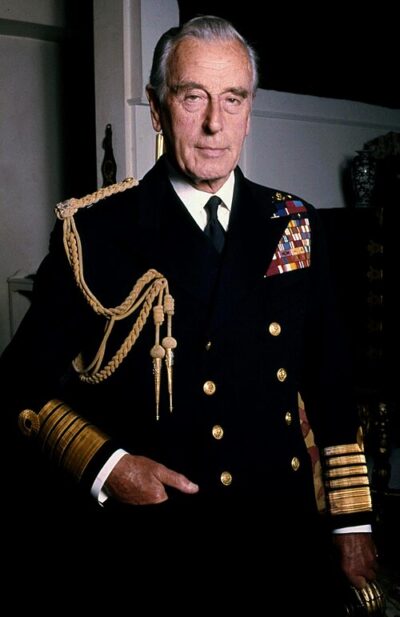
Louis Mountbatten, 1st Earl Mountbatten of Burma
Louis Mountbatten, 1st Earl Mountbatten of Burma was a British statesman and naval officer. Born June 25, 1900, in Windsor Castle. Died August 27, 1979, in Mullaghmore. Positions held include Governor-General of India (1947–1948), Member of the Privy Council of the United Kingdom (1947–) and member of the House of Lords. Educated at Christ's College and Lockers Park School. Awards include Distinguished Service Order, Knight Grand Cross of the Order of the Bath and Knight Grand Cross of the Royal Victorian Order.
Facts
50 facts · 2 confirmed by two sources · 25 cited · 23 from one source
Where this comes from
Papalocal keeps its own record. It started from these sources; what each one said is kept here as it was copied, so a change on their side never changes this page by itself. Tap one to read its version.
What Wikidata says · copied November 16, 2026 · revision 2568964567
- Described as
- British statesman and naval officer (1900-1979)
- Other names
- The Earl Mountbatten of Burma, Prince Louis of Battenberg, Louis Francis Albert Victor Nicholas Mountbatten, 1st Earl Mountbatten of Burma, Adm. Louis Francis Albert Victor Nicholas George Mountbatten, Lord Louis Mountbatten, Louis Mountbatten, Lord Mountbatten
- Born
- June 25, 1900 · 13 references
- Died
- August 27, 1979 · 12 references
- Born in
- Windsor Castle · 1 reference
- Died in
- Mullaghmore
- Buried in
- Romsey Abbey · 1 reference
- Cause of death
- explosion
- Citizen of
- United Kingdom
- Occupation
- politician; military personnel; diplomat; naval officer · 1 reference; admiral · 1 reference; governor-general · 1 reference
- Positions held
- Governor-General of India (1947–1948); Member of the Privy Council of the United Kingdom (1947–) · 1 reference; member of the House of Lords; Chief of the Defence Staff (1959–1965); First Sea Lord (1955–1959); Lord Lieutenant of the Isle of Wight (1974–1979) · 2 references; Governor of the Isle of Wight (1965–) · 1 reference
- Education
- Christ's College; Lockers Park School · 1 reference
- Member of
- Royal Society of London
- Awards
- Distinguished Service Order (1941) · 1 reference; Knight Grand Cross of the Order of the Bath (1955) · 1 reference; Knight Grand Cross of the Royal Victorian Order (1937) · 1 reference; Chief Commander of the Legion of Merit (1943); Grand Cross of the Order of Isabella the Catholic (1922); Order of the Star of Romania; Legionnaire of Legion of Merit; Grand Cross of the Legion of Honour; Order of the Nile; Order of the Star of Nepal; Knight of the Garter (1946) · 1 reference; Companion of the Order of the Bath (1943) · 1 reference; Knight Commander of the Order of the Bath (1945) · 1 reference; Order of Merit (1965) · 1 reference; Member of the Royal Victorian Order (1920) · 1 reference
- Spouse
- Edwina Mountbatten, Countess Mountbatten of Burma (1922–1960) · 2 references
- Children
- Lady Pamela Hicks · 1 reference; Patricia Knatchbull, 2nd Countess Mountbatten of Burma
- Father
- Prince Louis of Battenberg · 1 reference
- Mother
- Princess Victoria of Hesse and by Rhine · 1 reference
- Siblings
- George Mountbatten, 2nd Marquess of Milford Haven · 1 reference; Louise Mountbatten · 1 reference; Princess Alice of Battenberg · 1 reference
- Religion
- Church of England; Anglicanism · 1 reference
- Military branch
- Royal Navy · 1 reference
- Military rank
- Admiral of the Fleet
- Wikipedias with a page
- 66
Wikidata item Q157068 (wikidata.org/wiki/Q157068), public domain (CC0). Copied November 16, 2026.
What Wikipedia says · copied November 16, 2026 · revision 1385575501
Louis Francis Albert Victor Nicholas Mountbatten, 1st Earl Mountbatten of Burma (born Prince Louis of Battenberg; 25 June 1900 – 27 August 1979), commonly known as Lord Mountbatten, was a British statesman, naval officer, and member of the British royal family. A maternal uncle of Prince Philip and second cousin once removed of Queen Elizabeth II, he served in the Royal Navy during both world wars and rose to become Supreme Allied Commander, South East Asia Command, in the later stages of the Second World War. He subsequently oversaw the transition of India to independence as the last Viceroy of British India and the first governor-general of independent India. In these positions he oversaw British India's partition into the Dominions of India and Pakistan and the integration of the princely states into India.
Mountbatten later held senior posts in the post‑war armed forces, serving as First Sea Lord and then as Chief of the Defence Staff until 1965, making him the longest-serving professional head of the British Armed Forces to date. During this period Mountbatten also served as chairman of the NATO Military Committee for a year. He remained closely associated with the royal family throughout his life and acted as a mentor to his great‑nephew, the future King Charles III. Beyond his official duties, he was active in international education, naval and sporting organisations, and a range of charitable and cultural initiatives.
His career and reputation have been the subject of considerable debate. Admirers highlighted his energy, charm, and administrative ability, while critics accused him of vanity, self‑promotion, and flawed judgement, particularly in relation to the partition of India and his wartime assessments in South East Asia. His private life attracted scrutiny, and after his death allegations of child sexual abuse were made.
In August 1979, Mountbatten was assassinated by the Provisional Irish Republican Army when a bomb exploded aboard his fishing boat in Mullaghmore, County Sligo. His death prompted widespread condemnation and international mourning, and he received a ceremonial funeral at Westminster Abbey.
- Born, in its opening lines
- June 25, 1900
- Died, in its opening lines
- August 27, 1979
From the Wikipedia article “Lord Mountbatten” (en.wikipedia.org/wiki/Lord_Mountbatten), by its contributors, under CC BY-SA 4.0 (creativecommons.org/licenses/by-sa/4.0/). Copied November 16, 2026; not changed.
Confirmed Two sources agree. Cited One source, and it names where it got it. One source One source, without a reference of its own. Sources disagree The sources disagree. We show the best-supported value and keep theirs below.
