
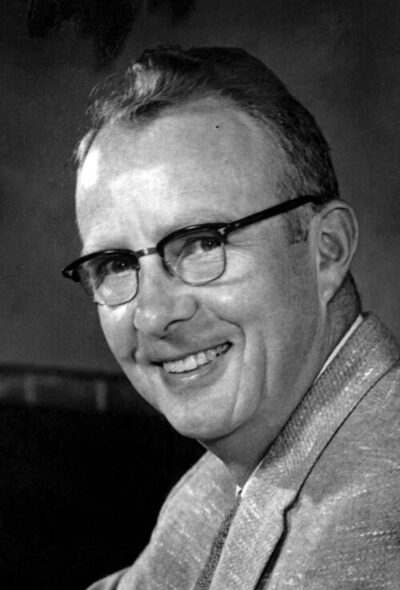
Luis Walter Alvarez
Luis Walter Alvarez was an American experimental physicist, inventor, and professor. Born June 13, 1911, in San Francisco. Died September 1, 1988, in Berkeley. Positions held include university teacher and president (1969). Educated at University of Chicago and San Francisco Polytechnic High School. Awards include Nobel Prize in Physics, National Medal of Science and Collier Trophy.
Facts
42 facts · 2 confirmed by two sources · 23 cited · 17 from one source
Where this comes from
Papalocal keeps its own record. It started from these sources; what each one said is kept here as it was copied, so a change on their side never changes this page by itself. Tap one to read its version.
What Wikidata says · copied November 13, 2026 · revision 2563199302
- Described as
- American experimental physicist, inventor, and professor (1911–1988)
- Other names
- Luis W. Alvarez, Luis Alvarez
- Born
- June 13, 1911 · 11 references
- Died
- September 1, 1988 · 3 references
- Born in
- San Francisco · 4 references
- Died in
- Berkeley · 3 references
- Cause of death
- lung cancer
- Citizen of
- United States
- Occupation
- physicist · 1 reference; nuclear physicist; university teacher; inventor · 1 reference; astronomer · 1 reference
- Positions held
- university teacher · 1 reference; president (1969) · 1 reference
- Worked for
- University of California, Berkeley
- Education
- University of Chicago · 1 reference; San Francisco Polytechnic High School · 1 reference
- Member of
- National Academy of Sciences · 1 reference; American Philosophical Society (1953–) · 1 reference; American Physical Society · 1 reference; American Academy of Arts and Sciences · 1 reference; National Academy of Engineering · 1 reference; JASON
- Awards
- Nobel Prize in Physics (1968) · 2 references; National Medal of Science (1963) · 1 reference; Collier Trophy (1945) · 1 reference; Medal for Merit (1947) · 1 reference; California Scientist of the Year (1960) · 2 references; Albert Einstein Award (1961) · 1 reference; Michelson–Morley Award (1965) · 1 reference; honorary doctor of the University of Chicago (1967) · 1 reference; honorary doctor of Carnegie-Mellon University (1968) · 1 reference; National Inventors Hall of Fame (1978) · 1 reference; Fellow of the American Physical Society; John Scott Award (1952) · 2 references; Enrico Fermi Award (1987) · 1 reference; Fellow of the American Academy of Arts and Sciences; honorary doctorate of the Autonomous University of Madrid
- Field
- physics
- Spouse
- Geraldine Smithwick; Janet L. Landis
- Children
- Walter Alvarez
- Father
- Walter C. Alvarez
- Wikipedias with a page
- 83
Wikidata item Q178344 (wikidata.org/wiki/Q178344), public domain (CC0). Copied November 13, 2026.
What Wikipedia says · copied November 13, 2026 · revision 1379166099
Luis Walter Alvarez (June 13, 1911 – September 1, 1988) was an American experimental physicist, inventor, and professor who was awarded the Nobel Prize in Physics in 1968 for his discovery of resonance states in particle physics using the hydrogen bubble chamber. In 2007 the American Journal of Physics commented, "Luis Alvarez was one of the most brilliant and productive experimental physicists of the twentieth century."
After receiving his PhD from the University of Chicago in 1936, Alvarez went to work for Ernest Lawrence at the Radiation Laboratory at the University of California, Berkeley. Alvarez devised a set of experiments to observe K-electron capture in radioactive nuclei, predicted by the beta decay theory but never before observed. He produced tritium using the cyclotron and measured its lifetime. In collaboration with Felix Bloch, he measured the magnetic moment of the neutron.
In 1940, Alvarez joined the MIT Radiation Laboratory, where he contributed to a number of World War II radar projects, from early improvements to Identification friend or foe (IFF) radar beacons, now called transponders, to a system known as VIXEN for preventing enemy submarines from realizing that they had been found by the new airborne microwave radars. The radar system for which Alvarez is best known and which has played a major role in aviation, most particularly in the post war Berlin airlift, was Ground Controlled Approach (GCA). Alvarez spent a few months at the University of Chicago working on nuclear reactors for Enrico Fermi before coming to Los Alamos to work for Robert Oppenheimer on the Manhattan Project. Alvarez worked on the design of explosive lenses, and the development of exploding-bridgewire detonators. As a member of Project Alberta, he observed the Trinity nuclear test from a B-29 Superfortress, and later the bombing of Hiroshima from the B-29 The Great Artiste.
After the war Alvarez was involved in the design of a liquid hydrogen bubble chamber that allowed his team to take millions of photographs of particle interactions, develop complex computer systems to measure and analyze these interactions, and discover entire families of new particles and resonance states. This work resulted in his being awarded the Nobel Prize in 1968. He was involved in a project to x-ray the Egyptian pyramids to search for unknown chambers. With his son, geologist Walter Alvarez, he developed the Alvarez hypothesis which proposes that the extinction event that wiped out the non-avian dinosaurs was the result of an asteroid impact.
- Born, in its opening lines
- June 13, 1911
- Died, in its opening lines
- September 1, 1988
From the Wikipedia article “Luis Walter Alvarez” (en.wikipedia.org/wiki/Luis_Walter_Alvarez), by its contributors, under CC BY-SA 4.0 (creativecommons.org/licenses/by-sa/4.0/). Copied November 13, 2026; not changed.
Confirmed Two sources agree. Cited One source, and it names where it got it. One source One source, without a reference of its own. Sources disagree The sources disagree. We show the best-supported value and keep theirs below.
