
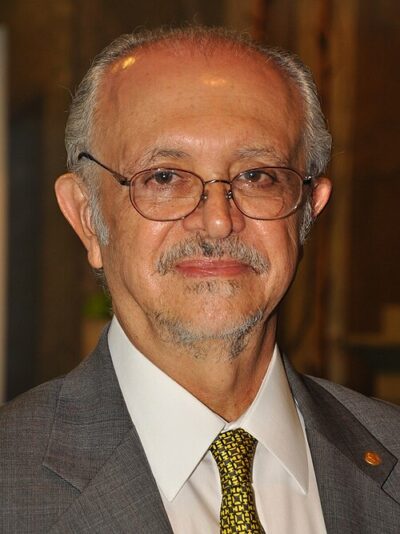
Mario Molina
Mario Molina was a Mexican chemical engineer. Born March 19, 1943, in Mexico City. Died October 7, 2020, in Mexico City. Educated at National Autonomous University of Mexico and University of California, Berkeley. Awards include Grand Cross of the Order of Isabella the Catholic, Presidential Medal of Freedom and Nobel Prize in Chemistry.
Facts
44 facts · 2 confirmed by two sources · 19 cited · 23 from one source
Where this comes from
Papalocal keeps its own record. It started from these sources; what each one said is kept here as it was copied, so a change on their side never changes this page by itself. Tap one to read its version.
What Wikidata says · copied November 13, 2026 · revision 2565432065
- Described as
- Mexican chemical engineer (1943–2020)
- Other names
- Mario J Molina, Mario José Molina, Mario J. Molina
- Born
- March 19, 1943 · 5 references
- Died
- October 7, 2020 · 2 references
- Born in
- Mexico City · 2 references
- Died in
- Mexico City · 1 reference
- Cause of death
- myocardial infarction · 1 reference
- Name at birth
- Mario José Molina Henríquez
- Citizen of
- Mexico; United States (1989–)
- Occupation
- chemist · 3 references; engineer; university teacher
- Worked for
- University of California, San Diego (2005–) · 1 reference; University of California, Irvine (1973–1980); Jet Propulsion Laboratory (1980–1989); Massachusetts Institute of Technology (1989–2005) · 1 reference
- Education
- National Autonomous University of Mexico (1960–) · 1 reference; University of California, Berkeley (1968–1972); University of Freiburg (1965–)
- Member of
- Pontifical Academy of Sciences; National Academy of Sciences; Mexican Academy of Sciences; Colegio Nacional; National Academy of Medicine; American Association for the Advancement of Science · 1 reference; American Philosophical Society (2007–)
- Awards
- Grand Cross of the Order of Isabella the Catholic (2008) · 1 reference; Presidential Medal of Freedom (2013) · 1 reference; Nobel Prize in Chemistry (1995) · 2 references; NASA Exceptional Scientific Achievement Medal (1989); Willard Gibbs Award (1998) · 1 reference; Tyler Prize for Environmental Achievement (1983) · 1 reference; Volvo Environment Prize (2004) · 1 reference; Max Planck Research Award (1994); Fellow of the American Physical Society; Knight of the Legion of Honour (2012); Heinz Award (2003) · 1 reference; honorary doctorate from the Pontifical Catholic University of Peru; honorary doctor of the University of Madrid Complutense (2012); Newcomb Cleveland Prize; honorary doctor of the University of Miami (2001) · 1 reference
- Field
- physical chemistry · 1 reference; chemical engineering · 1 reference; chemistry · 1 reference
- Spouse
- Luisa T Molina (1973–2005) · 2 references
- Wikipedias with a page
- 71
Wikidata item Q19045 (wikidata.org/wiki/Q19045), public domain (CC0). Copied November 13, 2026.
What Wikipedia says · copied November 13, 2026 · revision 1384045311
Mario José Molina-Pasquel Henríquez (19 March 1943 – 7 October 2020) was a Mexican physical chemist. He played a pivotal role in the discovery of the Antarctic ozone hole, and was a co-recipient of the 1995 Nobel Prize in Chemistry for his role in discovering the threat to the Earth's ozone layer from chlorofluorocarbon (CFC) gases. He was the first Mexican-born scientist to receive a Nobel Prize in Chemistry and the third Mexican-born person to receive a Nobel prize.
In his career, Molina held research and teaching positions at University of California, Irvine, California Institute of Technology, Massachusetts Institute of Technology, University of California, San Diego, and the Center for Atmospheric Sciences at the Scripps Institution of Oceanography. Molina was also Director of the Mario Molina Center for Energy and Environment in Mexico City. Molina was a climate policy advisor to the President of Mexico, Enrique Peña Nieto.
- Born, in its opening lines
- March 19, 1943
- Died, in its opening lines
- October 7, 2020
From the Wikipedia article “Mario Molina” (en.wikipedia.org/wiki/Mario_Molina), by its contributors, under CC BY-SA 4.0 (creativecommons.org/licenses/by-sa/4.0/). Copied November 13, 2026; not changed.
Confirmed Two sources agree. Cited One source, and it names where it got it. One source One source, without a reference of its own. Sources disagree The sources disagree. We show the best-supported value and keep theirs below.
