
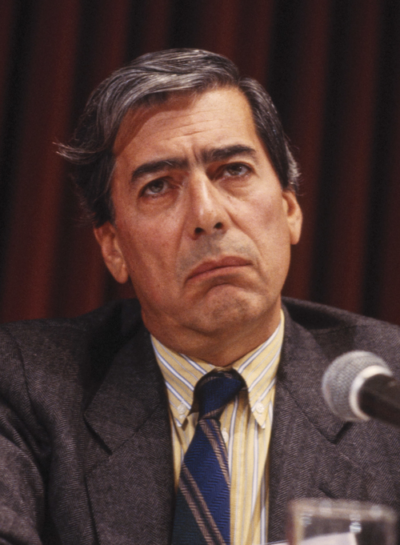
Mario Vargas Llosa
Mario Vargas Llosa was a Peruvian, Spanish and Dominican novelist and writer. Born March 28, 1936, in Arequipa. Died April 13, 2025, in Lima. Positions held include chairman of PEN International (1977–1979), Member of the Académie française (2021–2025) and Member of the Royal Spanish Academy (1996–2025). Known for The Time of the Hero, The Green House and Conversation in The Cathedral. Educated at National University of San Marcos and Complutense University of Madrid. Awards include Nobel Prize in Literature, Rómulo Gallegos Prize and Princess of Asturias Literary Prize.
Facts
73 facts · 2 confirmed by two sources · 30 cited · 41 from one source
Where this comes from
Papalocal keeps its own record. It started from these sources; what each one said is kept here as it was copied, so a change on their side never changes this page by itself. Tap one to read its version.
What Wikidata says · copied November 16, 2026 · revision 2569548808
- Described as
- Peruvian, Spanish and Dominican novelist and writer (1936–2025)
- Other names
- 1st Marquess of Vargas Llosa, Jorge Mario Pedro Vargas Llosa, Vargas Llosa
- Born
- March 28, 1936 · 10 references
- Died
- April 13, 2025 · 4 references
- Born in
- Arequipa · 3 references
- Died in
- Lima · 2 references
- Name at birth
- Jorge Mario Pedro Vargas Llosa
- Citizen of
- Peru; Spain (1993–) · 1 reference; Dominican Republic (2023–) · 1 reference
- Occupation
- novelist · 1 reference; dramaturge; politician · 1 reference; journalist · 2 references; essayist · 1 reference; literary critic · 1 reference; university teacher · 1 reference; prose writer · 1 reference
- Positions held
- chairman of PEN International (1977–1979) · 1 reference; Member of the Académie française (2021–2025) · 1 reference; Member of the Royal Spanish Academy (1996–2025) · 1 reference
- Political party
- Liberty Movement (1987–1993) · 1 reference; People's Liberty (2023–2025) · 1 reference
- Worked for
- Princeton University; King's College London (1969–1970); La Crónica (1952) · 1 reference; La Industria (1952) · 1 reference; Autonomous University of Barcelona; Harvard University (1992)
- Education
- National University of San Marcos (1953–1958); Complutense University of Madrid (1958–1971); Leoncio Prado Military Academy (1950–1951); Colegio La Salle (1947–1949); Colegio San Miguel de Piura (1952)
- Member of
- Royal Spanish Academy · 1 reference; American Academy of Arts and Sciences; Brazilian Academy of Letters; Mont Pelerin Society; Peruvian Academy of Language (1977–2025); Inter-American Dialogue; Académie Française (2021–) · 2 references
- Known for
- The Time of the Hero; The Green House; Conversation in The Cathedral
- Awards
- Nobel Prize in Literature (2010) · 1 reference; Rómulo Gallegos Prize (1967); Princess of Asturias Literary Prize (1986); Grinzane Cavour Prize (1986); Premio Planeta de Novela (1993) · 1 reference; honorary doctor of the University of Rennes 2 (1994) · 1 reference; Miguel de Cervantes Prize (1994); Jerusalem Prize (1995); Peace Prize of the German Publishers' and Booksellers' Association (1996) · 1 reference; Mariano de Cavia' Price (1997); Menéndez Pelayo International Prize (1999); Ortega y Gasset Awards (1999) · 1 reference; Grand Cross, Special Class of the Order of the Sun of Peru (2001); Irving Kristol Award (2005) · 1 reference; Honorary doctor of the Humboldt University of Berlin (2005) · 1 reference
- Field
- literature · 1 reference; creative and professional writing · 1 reference
- Spouse
- Julia Urquidi Illanes (1955–1964) · 2 references; Patricia Llosa Urquidi (1965–2015) · 1 reference
- Children
- Álvaro Vargas Llosa · 1 reference; Morgana Vargas Llosa · 1 reference; Gonzalo Vargas Llosa
- Father
- Ernesto Vargas Maldonado · 1 reference
- Mother
- Dora Llosa Ureta · 1 reference
- Religion
- agnosticism · 1 reference
- Lived in
- Arequipa; Cochabamba (1937–1945); Piura (1945–1947); Lima; Paris
- Website
- https://www.catedravargasllosa.org/
- Wikipedias with a page
- 131
Wikidata item Q39803 (wikidata.org/wiki/Q39803), public domain (CC0). Copied November 16, 2026.
What Wikipedia says · copied November 16, 2026 · revision 1384235645
Jorge Mario Pedro Vargas Llosa, 1st Marquess of Vargas Llosa (28 March 1936 – 13 April 2025) was a Peruvian novelist, journalist, essayist, and politician. Vargas Llosa was one of the most significant Latin American novelists and essayists and one of the leading writers of his generation. Some critics consider him to have had a more substantial international impact and worldwide audience than any other writer of the Latin American Boom. In 2010, he won the Nobel Prize in Literature for "his cartography of structures of power and his trenchant images of the individual's resistance, revolt, and defeat".
Vargas Llosa rose to international fame in the 1960s with novels such as The Time of the Hero (La ciudad y los perros, 1963/1966), The Green House (La casa verde, 1965/1968), and the monumental Conversation in The Cathedral (Conversación en La Catedral, 1969/1975). He wrote prolifically across various literary genres, including literary criticism and journalism. His novels include comedies, murder mysteries, historical novels, and political thrillers. He won the 1967 Rómulo Gallegos Prize and the 1986 Prince of Asturias Award. Several of his works have been adopted as feature films, such as Captain Pantoja and the Special Service (1973/1978) and Aunt Julia and the Scriptwriter (1977/1982). Vargas Llosa's perception of Peruvian society and his experiences as a native Peruvian influenced many of his works. Increasingly, he expanded his range and tackled themes from other parts of the world. In his essays, Vargas Llosa criticized nationalism in different parts of the world.
Like many Latin American writers, Vargas Llosa was politically active. While he initially supported the Cuban revolutionary government of Fidel Castro, Vargas Llosa later became disenchanted with its policies, particularly after the imprisonment of Cuban poet Heberto Padilla in 1971, and later identified as a classical liberal and held anti–left-wing views. He ran for the presidency of Peru with the centre-right Democratic Front coalition in the 1990 election, advocating for liberal reforms, but lost the election to Alberto Fujimori in a landslide.
Vargas Llosa continued his literary career while advocating for right-wing activists and candidates internationally following his exit from direct participation in Peruvian politics. He was awarded the 1994 Miguel de Cervantes Prize, the 1995 Jerusalem Prize, the 2010 Nobel Prize in Literature, the 2012 Carlos Fuentes Prize, and the 2018 Pablo Neruda Order of Artistic and Cultural Merit. In 2011, Vargas Llosa was made Marquess of Vargas Llosa by the Spanish king Juan Carlos I. In 2021, he was elected to the Académie Française.
- Born, in its opening lines
- March 28, 1936
- Died, in its opening lines
- April 13, 2025
From the Wikipedia article “Mario Vargas Llosa” (en.wikipedia.org/wiki/Mario_Vargas_Llosa), by its contributors, under CC BY-SA 4.0 (creativecommons.org/licenses/by-sa/4.0/). Copied November 16, 2026; not changed.
Confirmed Two sources agree. Cited One source, and it names where it got it. One source One source, without a reference of its own. Sources disagree The sources disagree. We show the best-supported value and keep theirs below.
