
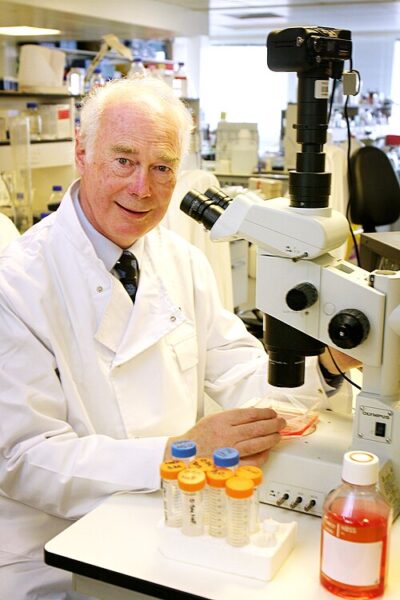
Martin Evans
Martin Evans is an English developmental biologist. Born January 1, 1941, in Stroud. Educated at Christ's College and University College London. Awards include Albert Lasker Award for Basic Medical Research, Nobel Prize in Physiology or Medicine and Copley Medal.
Facts
34 facts · 1 confirmed by two sources · 12 cited · 21 from one source
Where this comes from
Papalocal keeps its own record. It started from these sources; what each one said is kept here as it was copied, so a change on their side never changes this page by itself. Tap one to read its version.
What Wikidata says · copied November 16, 2026 · revision 2563064010
- Described as
- English developmental biologist
- Other names
- Martin John Evans, Martin J. Evans, Sir Martin Evans, Sir Martin John Evans
- Born
- January 1, 1941 · 5 references
- Born in
- Stroud
- Name at birth
- Martin John Evans
- Citizen of
- United Kingdom
- Occupation
- geneticist; university teacher; biologist · 1 reference
- Worked for
- University College London; Cardiff University
- Education
- Christ's College; University College London; St Dunstan's College · 1 reference
- Member of
- European Molecular Biology Organization; Academia Europaea (2009–) · 1 reference; Royal Society of London (1993) · 1 reference; Learned Society of Wales (2013–) · 1 reference
- Awards
- Albert Lasker Award for Basic Medical Research (2001) · 1 reference; Nobel Prize in Physiology or Medicine (2007) · 2 references; Copley Medal (2009) · 1 reference; EMBO Membership; March of Dimes Prize in Developmental Biology (1999); William Bate Hardy Prize (1993); honorary doctor of University College London; honorary doctor of the Aristotle University of Thessaloniki; honorary doctorate from the University of Cambridge; Fellow of the Academy of Medical Sciences (2008) · 1 reference; Baly Medal (2009); honorary doctor of the University of Bath; Fellow of the Royal Society (1993) · 1 reference; Knight Bachelor; Fellow of the Learned Society of Wales (2013) · 1 reference
- Field
- developmental biology; biology · 1 reference; embryology · 1 reference
- Wikipedias with a page
- 56
Wikidata item Q207719 (wikidata.org/wiki/Q207719), public domain (CC0). Copied November 16, 2026.
What Wikipedia says · copied November 16, 2026 · revision 1385717726
Sir Martin John Evans FLSW (born 1 January 1941) is an English biologist who, with Matthew Kaufman, was the first to culture mice embryonic stem cells and cultivate them in a laboratory in 1981. He is also known, along with Mario Capecchi and Oliver Smithies, for his work in the development of the knockout mouse and the related technology of gene targeting, a method of using embryonic stem cells to create specific gene modifications in mice. In 2007, the three shared the Nobel Prize in Physiology or Medicine in recognition of their discovery and contribution to the efforts to develop new treatments for illnesses in humans.
He won a major scholarship to Christ's College, Cambridge at a time when advances in genetics were occurring there and became interested in biology and biochemistry. He then went to University College London where he learned laboratory skills supervised by Elizabeth Deuchar. In 1978, he moved to the Department of Genetics, at the University of Cambridge, and in 1980 began his collaboration with Matthew Kaufman. They explored the method of using blastocysts for the isolation of embryonic stem cells. After Kaufman left, Evans continued his work, upgrading his laboratory skills to the newest technologies, isolated the embryonic stem cell of the early mouse embryo and established it in a cell culture. He genetically modified and implanted it into adult female mice with the intent of creating genetically modified offspring, work for which he was awarded the Nobel Prize in 2007. In 2015, he was elected a Fellow of the Learned Society of Wales. Today, genetically modified mice are considered vital for medical research.
- Born, in its opening lines
- January 1, 1941
From the Wikipedia article “Martin Evans” (en.wikipedia.org/wiki/Martin_Evans), by its contributors, under CC BY-SA 4.0 (creativecommons.org/licenses/by-sa/4.0/). Copied November 16, 2026; not changed.
Confirmed Two sources agree. Cited One source, and it names where it got it. One source One source, without a reference of its own. Sources disagree The sources disagree. We show the best-supported value and keep theirs below.
