
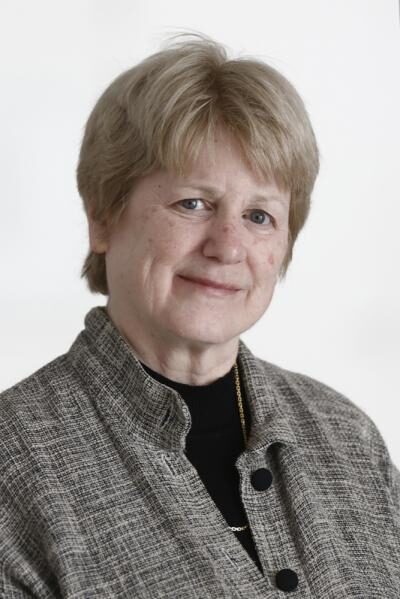
Mary-Claire King
Mary-Claire King is an American geneticist. Born February 27, 1946, in Wilmette. Educated at University of California, San Francisco and University of California, Berkeley. Awards include Paul Ehrlich and Ludwig Darmstaedter Prize, National Medal of Science and Dr A.H. Heineken Prize for Medicine.
Facts
35 facts · 1 confirmed by two sources · 22 cited · 12 from one source
Where this comes from
Papalocal keeps its own record. It started from these sources; what each one said is kept here as it was copied, so a change on their side never changes this page by itself. Tap one to read its version.
What Wikidata says · copied November 15, 2026 · revision 2566330294
- Described as
- American geneticist
- Other names
- King MC
- Born
- February 27, 1946 · 1 reference
- Born in
- Wilmette
- Citizen of
- United States
- Occupation
- biologist; geneticist; human rights defender; university teacher
- Worked for
- University of California, Berkeley; University of Washington (1995–) · 1 reference
- Education
- University of California, San Francisco (1974–1976) · 1 reference; University of California, Berkeley (1967–1972) · 1 reference; Carleton College (1963–1966) · 1 reference
- Member of
- National Academy of Sciences (2005–) · 1 reference; American Academy of Arts and Sciences (1999–) · 1 reference; American Association for the Advancement of Science (1993–) · 1 reference; French Academy of Sciences (2009–) · 2 references; American Philosophical Society; National Academy of Medicine · 1 reference
- Awards
- Paul Ehrlich and Ludwig Darmstaedter Prize (2013) · 1 reference; National Medal of Science (2014) · 1 reference; Dr A.H. Heineken Prize for Medicine (2006) · 1 reference; Gruber Prize in Genetics (2004) · 1 reference; Pearl Meister Greengard Prize (2010) · 1 reference; Komen Brinker Award for Scientific Distinction (1999) · 1 reference; Weizmann Women & Science Award (2006) · 1 reference; Lasker-Koshland Special Achievement Award in Medical Science (2014) · 1 reference; Shaw Prize in Life Science and Medicine (2018) · 1 reference; Mendel Medal (2018) · 1 reference; Dan David Prize (2018) · 1 reference; Benjamin Franklin Medal (2018) · 1 reference; Prince Mahidol Award (2018) · 1 reference; Marion Spencer Fay Award (2004) · 1 reference; ASHG Lifetime Achievement Award (2020) · 1 reference
- Field
- genetics · 1 reference
- Website
- http://depts.washington.edu/kingweb/ · 1 reference
- Wikipedias with a page
- 29
Wikidata item Q437741 (wikidata.org/wiki/Q437741), public domain (CC0). Copied November 15, 2026.
What Wikipedia says · copied November 15, 2026 · revision 1378627361
Mary-Claire King (born February 27, 1946) is an American geneticist. She was the first to show that breast cancer can be inherited due to mutations in the gene she called BRCA1. She studies human genetics and is particularly interested in genetic heterogeneity and complex traits. She studies the interaction of genetics and environmental influences and their effects on human conditions such as breast and ovarian cancer, inherited deafness, schizophrenia, HIV, systemic lupus erythematosus and rheumatoid arthritis. She has been the American Cancer Society Professor of the Department of Genome Sciences and of Medical Genetics at the University of Washington School of Medicine since 1995.
Besides known for her accomplishment in identifying breast cancer genes, King is also known for demonstrating that humans and chimpanzees are 99% genetically identical and for applying genomic sequencing to identify victims of human rights abuses. In 1984, in Argentina, she began working in identifying children who had been stolen from their families and adopted illegally under the military dictatorship during the Dirty War (1976–1983). She has received many awards, including the Lasker Award and the National Medal of Science. In 2002, Discover magazine recognized King as one of the 50 most important women in science.
- Born, in its opening lines
- February 27, 1946
From the Wikipedia article “Mary-Claire King” (en.wikipedia.org/wiki/Mary-Claire_King), by its contributors, under CC BY-SA 4.0 (creativecommons.org/licenses/by-sa/4.0/). Copied November 15, 2026; not changed.
Confirmed Two sources agree. Cited One source, and it names where it got it. One source One source, without a reference of its own. Sources disagree The sources disagree. We show the best-supported value and keep theirs below.
