
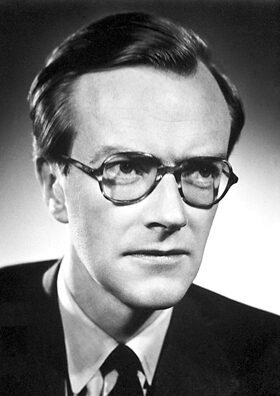
Maurice Wilkins
Maurice Wilkins was a New Zealand-born English physicist and biologist. Born December 15, 1916, in Pongaroa. Died October 5, 2004, in Blackheath. Educated at University of Cambridge and University of Birmingham. Awards include Nobel Prize in Physiology or Medicine, Commander of the Order of the British Empire and Fellow of the Royal Society.
Facts
35 facts · 2 confirmed by two sources · 5 cited · 28 from one source
Where this comes from
Papalocal keeps its own record. It started from these sources; what each one said is kept here as it was copied, so a change on their side never changes this page by itself. Tap one to read its version.
What Wikidata says · copied November 16, 2026 · revision 2567246572
- Described as
- New Zealand-born English physicist and biologist
- Other names
- Maurice Hugh Frederick Wilkins, Maurice H. F. Wilkins, Maurice H F Wilkins, Maurice Hugh Frederic Wilkins
- Born
- December 15, 1916 · 7 references
- Died
- October 5, 2004 · 7 references
- Born in
- Pongaroa · 1 reference
- Died in
- Blackheath · 1 reference
- Name at birth
- Maurice Hugh Frederick Wilkins · 1 reference
- Citizen of
- New Zealand; United Kingdom · 1 reference
- Occupation
- biophysicist · 1 reference; physician; physicist; crystallographer; researcher; author
- Worked for
- University of California, Berkeley; King's College London
- Education
- University of Cambridge; University of Birmingham; King Edward's School; St John's College
- Member of
- Royal Society of London; American Academy of Arts and Sciences; European Molecular Biology Organization
- Awards
- Nobel Prize in Physiology or Medicine (1962) · 2 references; Commander of the Order of the British Empire; Fellow of the Royal Society; Albert Lasker Award for Basic Medical Research (1960) · 1 reference; EMBO Membership; Honorary member of the British Biophysical Society
- Field
- molecular biology; phosphorescence; isotope separation; microscopy; X-ray crystallography
- Spouse
- Patricia Ann Chidgey; Ruth Wilkins
- Wikipedias with a page
- 71
Wikidata item Q184659 (wikidata.org/wiki/Q184659), public domain (CC0). Copied November 16, 2026.
What Wikipedia says · copied November 16, 2026 · revision 1383916178
Maurice Hugh Frederick Wilkins (15 December 1916 – 5 October 2004) was a New Zealand-born British biophysicist and Nobel laureate whose research spanned multiple areas of physics and biophysics, contributing to the scientific understanding of phosphorescence, isotope separation, optical microscopy, and X-ray diffraction. He is most noted for initiating and leading early X-ray diffraction studies on DNA at King's College London, and for his pivotal role in enabling the discovery of the double helix structure of DNA.
Wilkins began investigating nucleic acids in 1948. By 1950, he and his team had produced some of the first high-quality X-ray diffraction images of DNA fibers. He presented this work in 1951 at a conference in Naples, where it significantly influenced James Watson, prompting Watson to pursue DNA structure research with Francis Crick.
In 1951, Rosalind Franklin joined King’s College and was assigned to the same DNA project, though without a clear delineation of leadership. Tensions developed due to overlapping roles and lack of administrative clarity. During this period, Franklin and graduate student Raymond Gosling captured the high-resolution Photo 51, a diffraction image of B-form DNA. In early 1953, John Randall instructed Gosling to hand it over to Wilkins. Wilkins, in turn, showed it to Watson—without Franklin's consent. This action has been the subject of significant ethical and historiographical debate.
Using insights from Photo 51 and prior data—including Wilkins' own diffraction studies—Watson and Crick constructed their double helix model in March 1953. Wilkins simultaneously continued experimental validation, producing confirmatory diffraction images published in the same issue of Nature.
Wilkins' contributions were not limited to verification. He had led the DNA diffraction research at King’s before Franklin’s arrival, initiated the methods that led to Photo 51, and played a central role in sharing data and coordinating the laboratory’s DNA efforts—roles often underrepresented in historical summaries.
In later years, Wilkins extended his studies to RNA structure and worked on the biological effects of radiation.
He shared the 1962 Nobel Prize for Physiology or Medicine with Watson and Crick, awarded "for their discoveries concerning the molecular structure of nucleic acids and its significance for information transfer in living material". Although Franklin had died in 1958 and was therefore ineligible, Wilkins acknowledged her work in his writings and interviews.
In 2000, King's College London named one of its science buildings the Franklin-Wilkins Building to honor their contributions; of note, Wilkins had insisted that Franklin's name be put first. Scholarly reassessments in recent decades have increasingly recognized Wilkins’ role as foundational to the DNA discovery effort.
- Born, in its opening lines
- December 15, 1916
- Died, in its opening lines
- October 5, 2004
From the Wikipedia article “Maurice Wilkins” (en.wikipedia.org/wiki/Maurice_Wilkins), by its contributors, under CC BY-SA 4.0 (creativecommons.org/licenses/by-sa/4.0/). Copied November 16, 2026; not changed.
Confirmed Two sources agree. Cited One source, and it names where it got it. One source One source, without a reference of its own. Sources disagree The sources disagree. We show the best-supported value and keep theirs below.
