
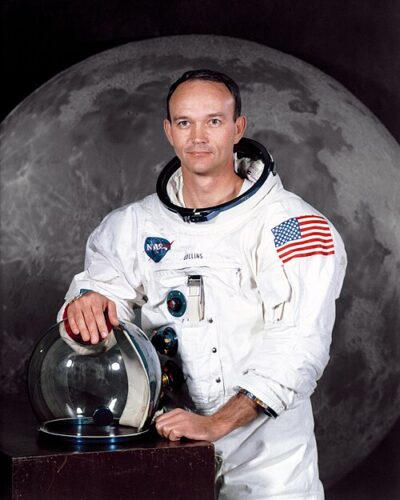
Michael Collins
Michael Collins was an American astronaut. Born October 31, 1930, in Rome. Died April 28, 2021, in Naples. Positions held include Assistant Secretary of State for Public Affairs (1970–1971). Educated at U.S. Air Force Test Pilot School and United States Military Academy. Awards include Distinguished Flying Cross, Order of Culture and Presidential Medal of Freedom.
Facts
50 facts · 2 confirmed by two sources · 17 cited · 31 from one source
Where this comes from
Papalocal keeps its own record. It started from these sources; what each one said is kept here as it was copied, so a change on their side never changes this page by itself. Tap one to read its version.
What Wikidata says · copied November 13, 2026 · revision 2565946580
- Described as
- American astronaut (1930–2021)
- Born
- October 31, 1930 · 2 references
- Died
- April 28, 2021 · 2 references
- Born in
- Rome · 2 references
- Died in
- Naples · 2 references
- Buried in
- Arlington National Cemetery (2023–) · 1 reference
- Cause of death
- cancer · 2 references
- Name at birth
- Michael Collins · 1 reference
- Citizen of
- United States
- Occupation
- military officer; astronaut · 1 reference; test pilot · 2 references; autobiographer; actor; air force pilot · 1 reference; entrepreneur · 1 reference
- Positions held
- Assistant Secretary of State for Public Affairs (1970–1971)
- Worked for
- National Aeronautics and Space Administration; Smithsonian Institution
- Education
- U.S. Air Force Test Pilot School; United States Military Academy; Harvard Business School; St. Albans School; Academia del Perpetuo Socorro
- Member of
- NASA Astronaut Group 3
- Awards
- Distinguished Flying Cross; Order of Culture (1969); Presidential Medal of Freedom (1969) · 1 reference; NASA Exceptional Service Medal (1966); Washington State Book Award (2002); Congressional Gold Medal; National Aviation Hall of Fame (1985) · 1 reference; Grande Médaille d'Or des Explorations (1970); Langley Gold Medal (1999); Cullum Geographical Medal (1969); United States Astronaut Hall of Fame; Hubbard Medal (1970); NASA Distinguished Service Medal (2008) · 1 reference; star on Hollywood Walk of Fame · 1 reference; International Space Hall of Fame (1977) · 2 references
- Field
- astronautics · 1 reference; space project · 1 reference; entrepreneurship · 1 reference; space program · 1 reference; aviation museum · 1 reference; space exploration
- Spouse
- Patricia Finnegan (1957–2014)
- Children
- Kate Collins
- Father
- James Lawton Collins
- Military branch
- United States Air Force
- Military rank
- brigadier general
- Wikipedias with a page
- 87
Wikidata item Q104859 (wikidata.org/wiki/Q104859), public domain (CC0). Copied November 13, 2026.
What Wikipedia says · copied November 14, 2026 · revision 1385624820
Michael Collins (October 31, 1930 – April 28, 2021) was an American astronaut who flew the Apollo 11 command module Columbia around the Moon in 1969 while his crewmates, Neil Armstrong and Buzz Aldrin, made the first crewed landing on the surface. He was also a test pilot and major general in the U.S. Air Force Reserve.
Born in Rome, Kingdom of Italy, where his father was serving as the U.S. military attaché, Collins graduated in the Class of 1952 from the United States Military Academy. He followed his father, brother, uncle, and cousin into the military. He joined the United States Air Force, and flew F-86 Sabre fighters at Chambley-Bussières Air Base, France. He was accepted into the U.S. Air Force Experimental Flight Test Pilot School at Edwards Air Force Base in 1960, also graduating from the Aerospace Research Pilot School (Class III).
Selected as part of NASA's third group of 14 astronauts in 1963, Collins flew in space twice. His first spaceflight was on Gemini 10 in 1966, in which he and Command Pilot John Young performed orbital rendezvous with two spacecraft and undertook two extravehicular activities (EVAs, also known as spacewalks). On the 1969 Apollo 11 mission, he became one of 24 Apollo astronauts to reach the Moon, which he orbited thirty times. He was the fourth person (and third American) to perform a spacewalk, the first person to achieve more than one spacewalk, and, after Young, who flew the command module on Apollo 10, the second person to orbit the Moon alone.
After retiring from NASA in 1970, Collins took a job in the Department of State as Assistant Secretary of State for Public Affairs. A year later, he became the director of the National Air and Space Museum, and held this position until 1978, when he stepped down to become undersecretary of the Smithsonian Institution. In 1980, he took a job as vice president of LTV Aerospace. He resigned in 1985 to start his own consulting firm. Along with his Apollo 11 crewmates, Collins was awarded the Presidential Medal of Freedom in 1969 and the Congressional Gold Medal in 2011.
- Born, in its opening lines
- October 31, 1930
- Died, in its opening lines
- April 28, 2021
From the Wikipedia article “Michael Collins (astronaut)” (en.wikipedia.org/wiki/Michael_Collins_(astronaut)), by its contributors, under CC BY-SA 4.0 (creativecommons.org/licenses/by-sa/4.0/). Copied November 14, 2026; not changed.
Confirmed Two sources agree. Cited One source, and it names where it got it. One source One source, without a reference of its own. Sources disagree The sources disagree. We show the best-supported value and keep theirs below.
